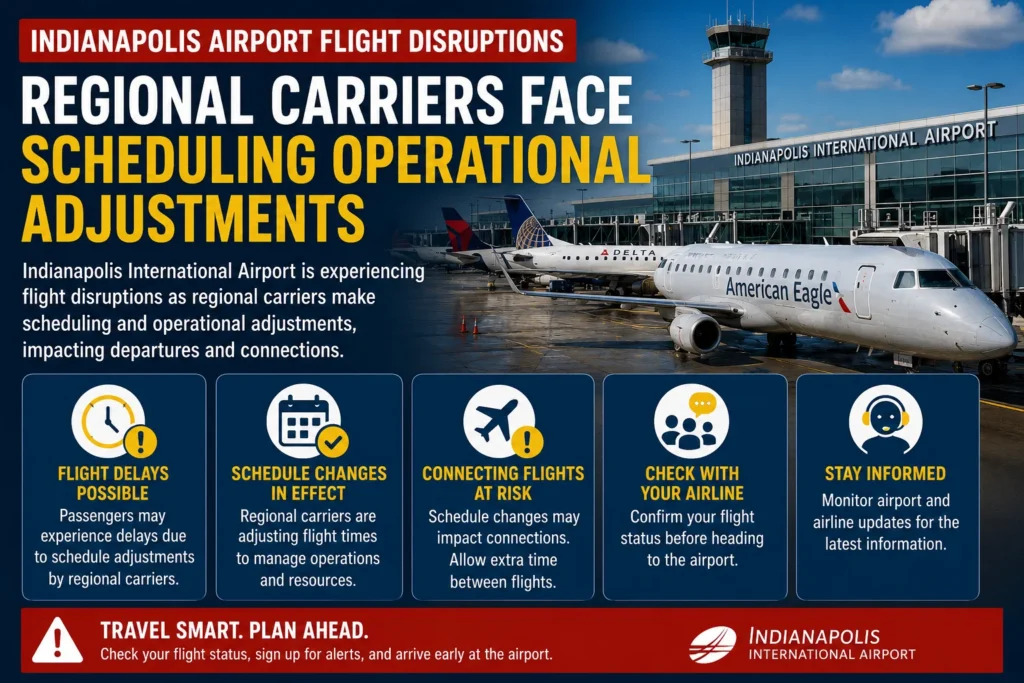
Indianapolis International Airport is navigating a phase of unexpected scheduling instability, with 17 scheduled flights suspended and dozens more experiencing timing alterations. The operational adjustments primarily affect regional operators, including Republic Airways, Endeavor Air, PSA Airlines, and Southwest Airlines, creating minor ripple effects across key domestic and global transit corridors.
According to data compiled from seasonal flight tracking logs and standard airline station reports, travelers heading to major North American commercial and leisure destinations—including New York City, Toronto, Orlando, Minneapolis, and Austin—are experiencing significant timetable variations. These schedule re-alignments have impacted both corporate commuters and vacationers, resulting in temporary terminal traffic increases and altered connection windows.
The current adjustments emphasize the interconnected nature of regional aviation networks. When a key Midwestern gateway experiences a clustered window of scheduling alterations, the subsequent aircraft rotation updates and crew duty-time requirements can occasionally extend into neighboring route systems.
Comprehensive Network Impact and Affected Transit Hubs
While the immediate operational updates remain focused around Indianapolis, the secondary effects of these scheduling shifts have subtly touched a network of major cities. The impact is most noticeable within busy eastern corridors, with minor operational timing extensions recorded at LaGuardia Airport and John F. Kennedy International Airport in New York, alongside fields in Philadelphia, Boston, and Baltimore.
Federal transportation documentation and airport operational outlines show that the scheduling adjustments have mirrored patterns found across multiple geographical sectors:
Southern and Southwestern Hubs: Atlanta, Charlotte, Dallas-Fort Worth, Houston, Austin, and Orlando.
Midwest and Northern Sectors: Chicago O’Hare, Detroit Metro, and Minneapolis-St Paul.
Western Gateways: Denver, Phoenix Sky Harbor, Las Vegas, and Los Angeles International.
International Crossings: Toronto Pearson International and Luxembourg City.
Statistical Overview of Flight Cancellations and Schedule Delays
Among the regional operators managing service challenges, Republic Airways experienced the largest volume of timetable adjustments for the service day. Conversely, Southwest Airlines succeeded in maintaining the vast majority of its scheduled route infrastructure intact, despite managing an elevated volume of minor departure adjustments.
The following official performance metrics outline the precise operational distribution recorded per carrier during this scheduling window:
| Operating Air Carrier | Confirmed Flight Cancellations | Recorded Flight Delays |
| Republic Airways | 9 | 22 |
| Endeavor Air (Delta Connection) | 5 | 4 |
| PSA Airlines (American Eagle) | 2 | 5 |
| Southwest Airlines | 1 | 18 |
| Combined Operational Impact | 17 | 49 |
Republic Airways’ nine service cancellations represented the largest modification to the airport’s standard daily timetable. Endeavor Air followed with five service cancellations, affecting a selection of its regional commuter runs. PSA Airlines, while logging only two complete cancellations, saw a noticeable proportional shift in its morning operation, with approximately 28% of its regional departures experiencing timing changes. Southwest Airlines displayed significant structural reliability with a cancellation rate of just 1%, though its 18 delayed departures added minor holding volume to terminal gate areas.
Passenger Management and Alternative Routing Strategies
For travelers navigating these regional airline scheduling re-alignments, transport authorities recommend utilizing proactive management strategies to ensure smooth alternative travel planning.
The Federal Aviation Administration (FAA) and Department of Transportation (DOT) encourage passengers to lean heavily on mobile application software. Prioritizing direct airline apps and automated email notifications remains more efficient than relying solely on physical terminal displays, as automated rebooking confirmations are systematically distributed electronically before being broadcast at departure gates.
If physical customer service counters experience temporary customer queues, travelers are advised to utilize omnichannel digital resources. Contacting carrier support via verified online chat platforms or international telephone support lines frequently yields faster resolution windows during peak operational adjustments.
Passengers are also encouraged to review their carrier’s official contract of carriage documents. Depending on the underlying factors behind a service suspension and the specific regulatory jurisdiction involved—such as specialized passenger protections for cross-border flights routing to European points like Luxembourg—travelers may qualify for direct accommodation options, meal vouchers, or alternative carrier re-routing. When primary commercial rebooking paths are full, exploring regional surface transport alternatives, including passenger rail networks or regional bus connections, can serve as an effective solution for shorter geographic distances.
For more travel news like this, keep reading Global Travel Wire