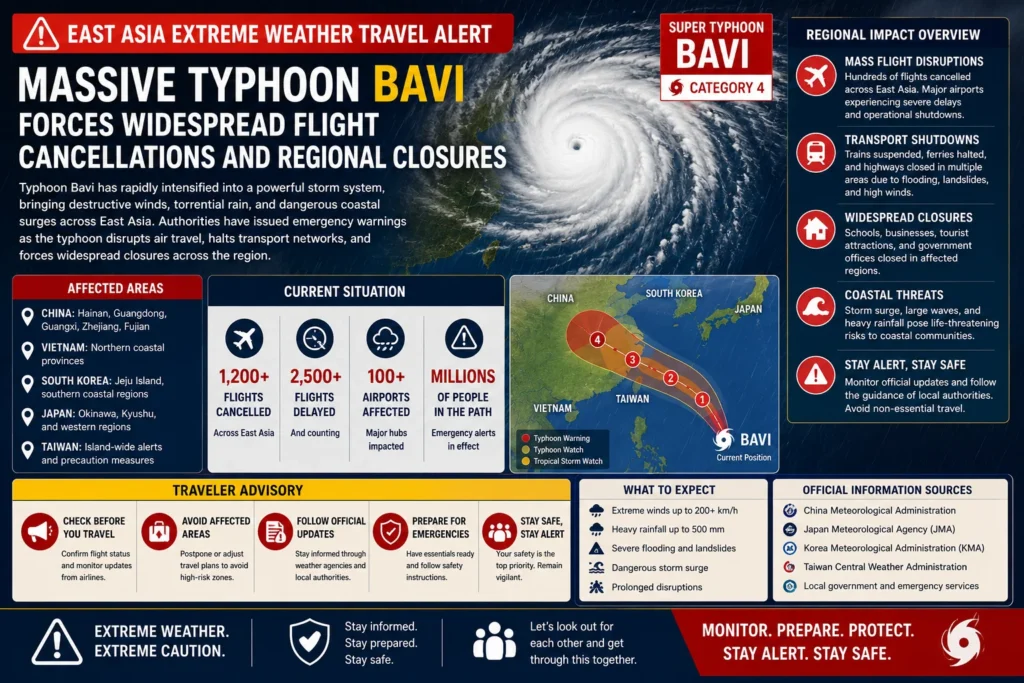
A massive meteorological system is actively disrupting the East Asia travel corridor, forcing aviation authorities, maritime transportation networks, and emergency services into high-readiness mode. The Western North Pacific has generated one of its largest tropical cyclones in decades, prompting multi-country emergency declarations. Officially designated as Typhoon Bavi, the colossal storm system spans roughly 1,000 kilometers at its widest point, projecting a massive wind field that links the safety protocols of the Philippines, Taiwan, Japan, and mainland China into a shared high-risk zone.
The rapid movement of this severe weather pattern has already triggered extensive regional safety measures. International logistics, infrastructure networks, and seasonal vacation itineraries have been heavily altered as central ministries and local meteorological centers issue urgent safety warnings. Travelers navigating the Western Pacific are experiencing severe logistical disruptions, with regional flight schedules completely grounded and primary maritime channels closed to public transit.
Severe Monsoon Rains Trigger Destructive Landslides in the Southern Philippines
Before moving into the northern corridors of the Pacific, the sprawling outer bands of the weather system interacted heavily with local southwest monsoon patterns, causing severe environmental emergencies in the Philippines. Official disaster management statements from the National Disaster Risk Reduction and Management Council confirm that torrential rainfall triggered devastating landslides on the southern island of Mindanao.
According to verified reports from regional emergency response coordinators, the localized landslides resulted in at least 15 confirmed fatalities, with search and rescue teams actively clearing debris to locate six missing residents. The structural volume of rainfall overwhelmed local soil capacities overnight, burying multiple residential structures in mountainous zones. National disaster agencies continue to warn that moderate to heavy precipitation will persist throughout the weekend, complicating recovery efforts and elevating the risk of secondary flash floods across central and southern provinces.
Extensive Aviation Grounds and Emergency Preparations Disrupt Regional Travel Matrix
As the core of Typhoon Bavi advances northwest toward the Luzon Strait and the waters adjacent to Taiwan, commercial aviation networks are implementing large-scale preventative groundings. The sheer size of the storm circle has created hazardous flying conditions, prompting carriers to prioritize safety over operational schedules.
Official airline operations updates reveal extensive cancellations impacting tens of thousands of passengers across the region:
All Nippon Airways: Canceled more than 160 commercial flights through the weekend, disrupting travel plans for approximately 20,000 international and domestic travelers.
Japan Airlines: Grounded over 100 scheduled routes, directly impacting nearly 20,000 passengers navigating the southern islands archipelago.
Regional Flag Carriers: Major operators including Cathay Pacific, Thai Airways, and Malaysia Airlines officially suspended all weekend flights connecting to Taipei and select coastal destinations in eastern China.
In addition to flight suspensions, local maritime authorities have completely halted ferry operations serving outlying island networks, effectively trapping transit capabilities until the severe marine conditions subside.
Taiwan and Japan Posture Communities for Massive Rainfall Accumulations
The Central Weather Administration of Taiwan has issued official land and sea warnings for a broad swath of the island, spanning from northern Changhua to the eastern counties of Yilan and Hualien. While the meteorological tracking models indicate the center of Typhoon Bavi will pass just north of the coastline rather than making a direct physical landfall, the storm’s exceptional 380-kilometer strong-wind radius makes it the largest system by size to threaten the territory in more than 30 years.
Official municipal declarations confirm that financial markets, schools, and public administrative offices in Taipei, New Taipei, and Keelung have been temporarily closed to safeguard the public. The Ministry of National Defense has placed approximately 29,000 military personnel on high alert, pre-positioning emergency machinery and rescue vehicles near landslide-prone mountain routes like the Suhua Highway. Local weather services warn that the storm bands could dump close to 1 meter of total rainfall in mountainous corridors, prompting the proactive evacuation of more than 2,000 residents from high-risk sectors. Across the coast, maritime bureaus have closed public beaches and ordered all commercial fishing vessels to remain tightly secured in local harbors to withstand forecast waves reaching up to 9 meters.
Concurrently, the Japan Meteorological Agency has placed the remote Sakishima Islands within the Okinawa Prefecture on maximum alert. Local municipal offices in Ishigaki have suspended public operations as residents prepare for extreme wind gusts topping 162 kilometers per hour. Local retail monitors report that standard grocery supplies have been completely exhausted as families prepare for potential long-term grid failures.
Mainland China Readies Northern and Eastern Provinces for Landfall Impacts
Across the Taiwan Strait, China’s National Meteorological Center has issued high-level emergency notices as Typhoon Bavi prepares to make landfall along the eastern coast over the weekend. The central forecast indicates that the core of the storm will strike near the coastal manufacturing and transit hubs of Zhejiang and Fujian provinces.
Due to the immense thermal energy absorbed by the storm over the open Pacific, environmental experts warn that Bavi’s remnants and outer rainbands are projected to push deep inland, bringing prolonged, heavy rainfall to northern provinces that traditionally have less experience managing severe tropical systems. Local governments across Jiangsu, Anhui, and the Bohai Sea region have been officially directed to strengthen reservoir monitoring, reinforce urban drainage systems, and evacuate all offshore personnel from wind farms and maritime drilling platforms immediately.
For more travel news like this, keep reading Global Travel Wire