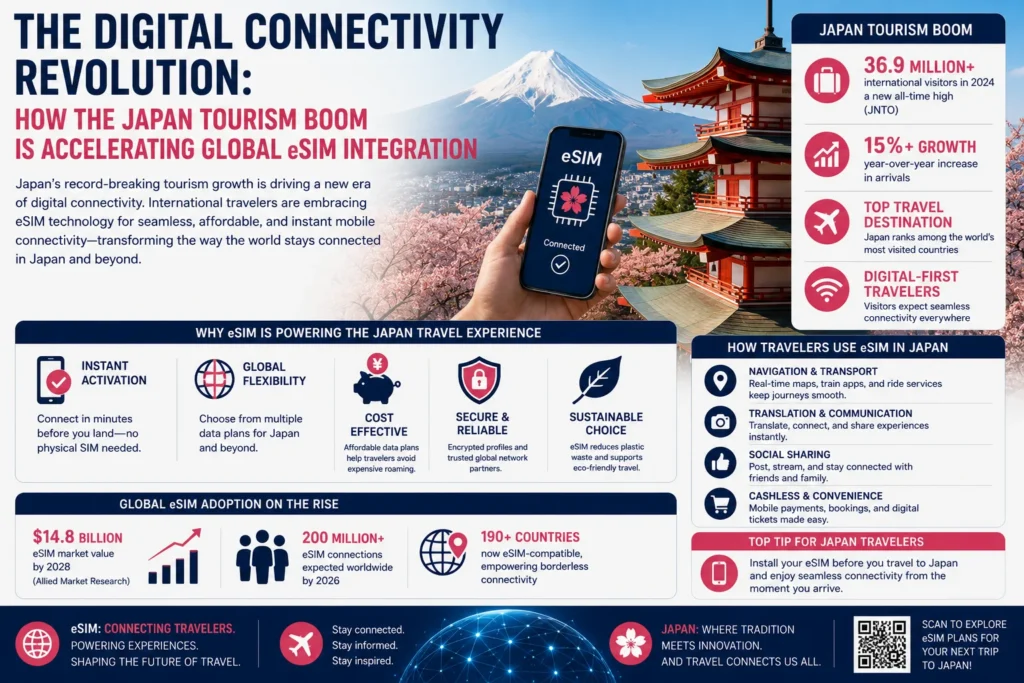
International leisure travel has returned with unprecedented momentum, testing the structural limits of global transit hubs, hospitality networks, and communication infrastructures. According to official public arrival data compiled by the Japan Tourism Agency, the nation welcomed an astonishing 42.7 million international visitors in 2025, solidifying a historic milestone as inbound arrivals crossed the 40 million threshold for the first time in the country’s history. As global travelers fill traditional ryokans in Kyoto and navigate the iconic crossings of Tokyo, a profound technological shift is quietly modernizing the traveler experience.
The traditional post-flight ritual of standing in long airport queues to purchase physical SIM cards, exchange currency, and fill out paper identification forms is rapidly disappearing. In its place, international voyagers are utilizing digital mobile profiles activated well before departure. Driven by the extraordinary scale of the ongoing Japan tourism boom, the global travel industry is experiencing an accelerated transition toward embedded subscriber identity module technology, fundamentally changing how destinations manage visitor connectivity.
Unprecedented Growth and the Realities of Modern Tourism Infrastructure
The scale of inbound tourism growth across the Japanese archipelago represents one of the most resilient economic recoveries in modern maritime and aviation history. Statistical releases from the Ministry of Land, Infrastructure, Transport and Tourism indicate that foreign visitor spending reached a historic 9.5 trillion yen (approximately 60 billion dollars) in consecutive fiscal periods, elevating tourism to the nation’s second-largest source of foreign income, trailing only the automobile export sector.
While regional East Asian markets like South Korea, Taiwan, and China continue to supply robust passenger volumes, official immigration ledgers reveal an unprecedented 22 percent surge in combined arrivals from the United States, Europe, and Australia. This extensive diversification introduces millions of travelers with varied communication habits, distinct technology preferences, and heightened expectations for seamless mobile access.
To sustain this momentum, the government has established a target of 60 million annual visitors by 2030. However, scaling up to meet this ambitious benchmark exerts tremendous pressure on localized infrastructure:
Major international airports, including Narita and Haneda, are managing heavily congested flight schedules.
The domestic hospitality and service sectors face persistent structural labor shortages.
Public transit networks, digital payment gateways, and cellular networks are being required to serve a visitor base far larger than their original design parameters.
Because digital mapping applications, real-time translation tools, and automated rail scheduling platforms are completely indispensable to the modern independent traveler, instantaneous network access has evolved from a simple luxury into a critical piece of national tourism infrastructure.
Universal Convenience Drives the Shift Toward Digital Mobile Profiles
The rapid adoption of this advanced mobile technology extends far beyond any single geographic market, reflecting a universal shift toward digital-first utility. Major smartphone manufacturers have spent several years phasing out traditional hardware dependencies, with recent premium mobile models arriving in global markets completely devoid of physical SIM trays.
From a practical planning perspective, digital cellular profiles remove significant friction from international arrivals. Travelers no longer need to handle fragile plastic chips, risk losing their primary domestic card, or expose sensitive personal data to unsecured public airport wireless networks. Instead, a travel data package can be securely purchased via an application, scanned via a quick-response code, and stored dynamically on a device prior to boarding.
Upon touchdown, the device automatically interfaces with local cellular towers, establishing instantaneous high-speed data access. This capability addresses a classic travel anxiety, ensuring that arriving passengers can coordinate airport transfers, access digital accommodation vouchers, and contact emergency services without relying on local physical vendor counters.
How Mobile Operators and Travel Platforms are Engineering Solutions
Japanese telecommunications providers and international travel booking platforms have adapted swiftly to this behavioral evolution. Recognizing that connectivity directly influences overall visitor satisfaction, major network operators have deployed short-term, data-only digital profiles explicitly structured around standard tourist visa durations.
Rather than leaving data access as an afterthought to be resolved upon arrival, global airlines and digital travel agencies now integrate data plan options directly into the primary ticket purchasing flow. Furthermore, regional convenience store chains and transport hubs have transitioned their inventory away from physical tourist cards, dedicating retail space to instantly downloadable cellular profiles. This unified industrial alignment ensures that international tourists can bypass congested immigration lines and terminal crowds with their primary navigation tools already fully functional.
The Long-Term Horizon of Global Travel Connectivity
As the global travel market looks toward 2027, the standard operating procedures of international tourism are positioned for further digital integration. Tourism boards in high-volume destinations like Thailand, South Korea, and the United Arab Emirates are closely mirroring these digital frameworks, treating mobile data accessibility as a core metric of national competitiveness.
Future developments are projected to bring tighter structural links between electronic visa systems, airline check-in confirmations, and automated data profile provisioning. Additionally, as multi-country regional itineraries continue to rise across Asia and Europe, cross-border data plans that cover entire continents under a single profile will become the baseline standard. By removing traditional communication barriers, the global tourism sector ensures that exploring unfamiliar frontiers remains safer, more efficient, and entirely connected.
For more travel news like this, keep reading Global Travel Wire