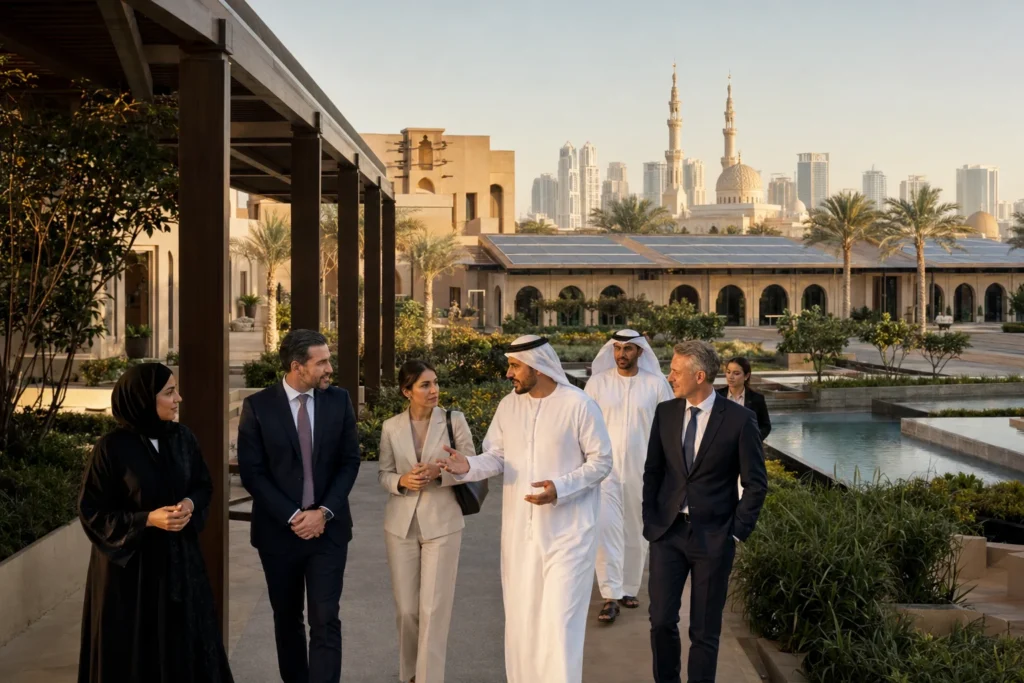
The emirate of Sharjah is establishing progressive benchmarks for sustainable economic management through targeted operational reforms within its hospitality ecosystem. In an expansive meeting coordinated at the headquarters of the Sharjah Chamber of Commerce and Industry, public infrastructure planners and hospitality executives formalized a major support framework intended to secure long-term sector resilience. Under the institutional direction of the Representative Committee of the Hotel Sector Business Group, the meeting outlined an aggressive package of utility facilitates, direct administrative relief measures, and fiscal exemptions engineered to fortify the local business environment. By establishing this public-private operational alliance, the emirate is building structural safeguards to expand hotel capacities, improve energy resource management, and secure competitive placement within the regional leisure market.
Central to this strategic update is a newly deployed incentive program managed natively by the Sharjah Electricity, Water, and Gas Authority. The comprehensive program operates under explicit executive parameters designed to reduce utility overheads, elevate corporate compliance with environmental goals, and insulate tourism businesses against seasonal demand shifts. Rather than relying on temporary promotional concepts, the joint strategy leverages long-term structural relief to foster an optimal ecosystem for entrepreneurs, global investors, and luxury hotel brands.
Concrete Utility Facilitations and Fiscal Incentives Detailed
The operational measures introduced by the utility authority constitute an advanced model of public-private integration, translating macroeconomic sustainability visions into actionable corporate relief. According to official project frameworks presented by customer service departments, the dedicated facility program spans a multi-month period, providing immediate operating cost optimization during high-intensity summer trading months. The core fiscal and operational measures deployed under the new framework include:
Extended Bill Settlement Cycles: Tourism establishments receive an additional month’s grace period for standard utility bill settlements, providing immediate cash flow relief.
Structured Instalment Matrices: Hospitality operators can transition standard consumption bills into predictable monthly instalments to avoid capital allocation constraints.
Administrative Penalty Waivers: The authority has instituted a complete three-month exemption from utility cut-off fines to ensure continuous operation across all registered venues.
New Account Capital Relief: Newly established hospitality businesses can distribute initial account insurance costs across four distinct quarterly installments, lowering structural entry barriers for incoming investors.
Infrastructure Plan Approval Exemptions: Engineering and architectural plan review fees are waived entirely for three months for all upcoming tourist facilities.
Project Service Timeline Extensions: The delivery window for infrastructure services will be extended automatically for active developments without triggering supplementary penalty fees.
Meter Service Fee Freezes: Utility service fees for non-operating or seasonal meters within certified hotels and tourist complexes are frozen to eliminate empty maintenance costs.
Systemic Unit Separation: Active hotel properties will be legally and physically separated from unused adjacent structures to eliminate inaccurate baseline utility pricing.
Electrical Maintenance Micro-Incentives: Regulatory permits for critical electrical upkeep and grid integration works can be settled through deferred installment schedules.
Transaction Cost Absorption: The government authority will absorb all bank transaction fees resulting from consumption payments managed via digital bank transfers for a three-month period.
Strategic Vetting and Collaborative Policy Directives
The high-level chamber meeting brought together prominent public sector architects, regulatory administrators, and elite hospitality operators. Vetted by senior diplomatic and international relations directors from the Sharjah Chamber, the talks focused on transforming top-tier state directives into direct, measurable outcomes for front-line operators. The representative body noted that maintaining active communication loops between policy creators and real estate executives is critical to avoiding structural waste.
To guarantee that these utility reliefs translate cleanly into enhanced service execution, the committee established an absolute priority on active on-site monitoring. Under this system, specialized field teams will conduct systematic review visits across hotels, eco-resorts, and tourist properties. These field audits are designed to ensure that individual operators maximize the specific financial advantages made available by the state, while simultaneously gathering raw feedback to guide future policy iterations. The collected operational data will feed directly into periodic compliance reports presented to senior executive councils, allowing for agile updates to the emirate’s broader investment frameworks.
Linking Sustainability to Peak Tourism Campaigns
A major focus of the current regulatory push is leveraging these reduced overhead costs to aggressively capture expanding summer traveler flows. The utility relief framework integrates directly with the emirate’s flagship marketing push, the Sharjah Summer Promotions, which runs through mid-September. By reducing immediate utility pressures, the government enables hotel operators to allocate capital toward competitive pricing models, enhanced guest experiences, and advanced internal training programs for hospitality personnel.
These synchronized steps ensure that the local workforce continues to achieve international standards of excellence while adapting to modern eco-tourism demands. The implementation of specialized training guarantees that as the emirate scales its destination footprint, its human capital remains fully capable of delivering high-tier luxury service balanced with responsible consumption habits.
Long-Term Trajectory of Sharjah Tourism Sustainability
The coordinated deployment of these public assets indicates a clear commitment to safeguarding the economic stability of the hospitality industry. By mitigating the operational frictions caused by variable energy costs and seasonal variations, Sharjah is building a highly resilient, predictable destination market. The initiative provides a clear template for how resource managers can proactively partner with commercial entities to maintain sustainable growth.
As global capital flows increasingly prioritize destinations that feature clear environmental policies alongside low regulatory risks, Sharjah’s integrated public-private framework positions it as an exceptionally secure hub for foreign direct investment. Through continuous collaboration, systematic utility management, and absolute structural transparency, the emirate continues to solidify its status as a premium economic, tourism, and investment model on both regional and international levels.
For more travel news like this, keep reading Global Travel Wire