Global air transit networks, international tour operators, and corporate travel managers are recalibrating logistics following official travel safety updates issued by the United States Department of State. Under updated government security evaluations, multiple nations and specific high-risk territories remain classified under Level 4 “Do Not Travel” advisories. These comprehensive safety notices warn against all travel to designated areas due to extreme threats including armed conflict, ongoing civil instability, widespread criminal activity, arbitrary detention risks, and severe limitations on official consular assistance.
The government advisories serve as official directives for citizens, international organizations, and travel service providers evaluating risk exposure across volatile international corridors across the Middle East, Eastern Europe, Africa, and parts of the Caribbean.
Evaluating Risk Indicators and Government Advisory Classifications
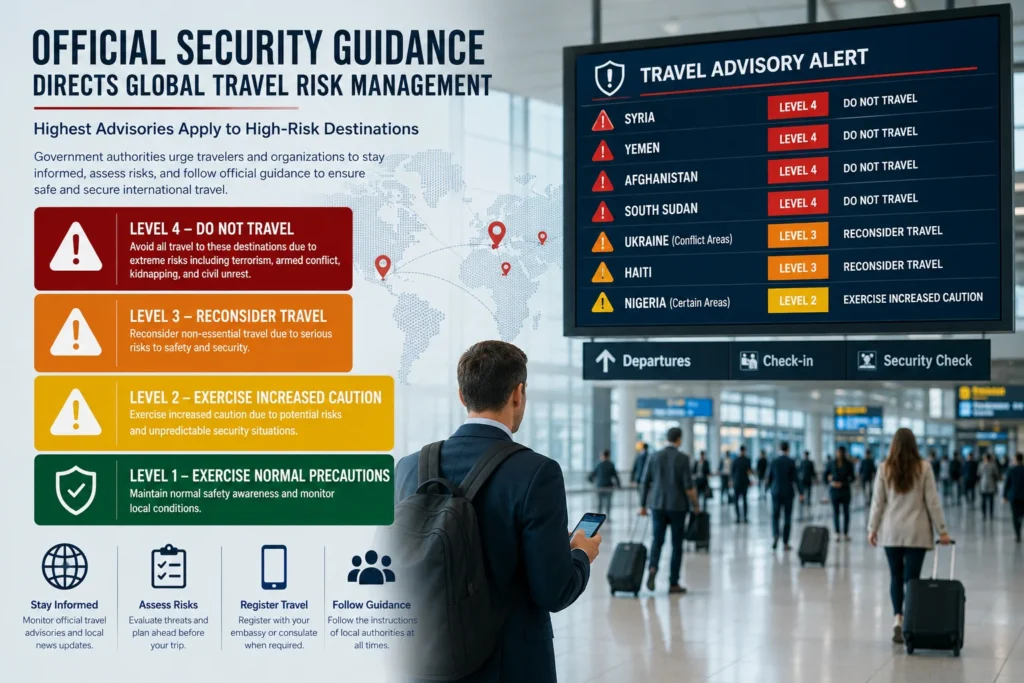
The official four-tier advisory framework operated by consular authorities establishes standardized risk levels based on objective, continuous security assessments. Level 4 represents the highest threat category, assigned exclusively to destinations where life-threatening dangers exist and where foreign government diplomatic posts have diminished capacity or zero operational ability to render emergency assistance.
Official security criteria utilized to determine Level 4 designations encompass several distinct risk indicators:
Violent Crime and Gang Activity: Regions where organized crime networks or civil gang operations exceed local law enforcement capabilities, creating severe public safety hazards.
Terrorism and Insurgency Threats: Territories facing active militant operations, targeted attacks on public infrastructure, or elevated risks of hostage-taking.
Armed Conflict and Military Hostilities: Countries involved in active international or internal military clashes, missile strikes, or active artillery combat zones.
Wrongful or Arbitrary Detention: Destinations where foreign nationals face increased risk of arbitrary arrest, prolonged detention without formal charges, or restricted legal access.
Health Crises and Natural Disasters: Extreme environmental or public health emergencies where local medical systems are overloaded or completely non-functional.
When a country is placed under a Level 4 advisory, standard travel insurance coverage policies are frequently invalidated, requiring specialized international risk underwriting for essential personnel operating in affected zones.
Overview of High-Risk Destinations Under Highest Travel Warnings
Official travel advisories outline specific regional hazards across primary Level 4 designated destinations:
Afghanistan: Designated Level 4 due to active terrorism threats, high kidnapping risks, arbitrary detention hazards, and civil instability. The local embassy has suspended in-person operations, leaving zero direct consular support.
Syria: Subject to Level 4 warnings reflecting ongoing armed conflict, civil unrest, terrorism, and widespread kidnapping threats, with all official consular services suspended.
Yemen: Marked by active military hostilities, missile strikes, civil war, and high terrorism risks. Emergency medical evacuations or consular extractions remain unavailable through standard diplomatic channels.
Iran: Placed under Level 4 due to severe risks of wrongful detention and regional conflict. The absence of direct diplomatic relations requires reliance on protecting power arrangements for emergency inquiries.
Iraq: Subject to Level 4 advisories due to terrorism, militia activity, and localized armed conflicts, with diplomatic operations strictly confined to protected zones.
Russia: Designated Level 4 due to conflict-related security impacts, unpredictable law enforcement actions, terrorism, and the potential for arbitrary detention of foreign nationals.
Haiti: Categorized under Level 4 as a result of armed gang violence, severe civil unrest, kidnapping, and regular interruptions to commercial aviation services.
Sudan and South Sudan: Placed under Level 4 due to active civil conflict, widespread violence, and severe humanitarian disruptions, with official embassy operations suspended or heavily restricted.
Operational Impact on Global Aviation, Maritime Routes, and Tour Operations
The enforcement of Level 4 safety advisories extends far beyond personal itinerary decisions, directly reshaping the wider international transport and hospitality economy. Commercial flight dispatchers regularly alter flight paths to bypass restricted airspace above active conflict areas. These reroutings increase flight durations, fuel consumption, and operational complexity for long-haul international flights.
Cruising schedules and maritime itineraries are similarly affected. Port authorities and commercial cruise lines continuously monitor diplomatic advisories, suspending shore excursions and port calls in destinations experiencing rapid security declines.
Furthermore, international hospitality operators and event organizers defer investments in regions subject to prolonged high-tier advisories, redirecting tourism capital toward stable regional markets that offer certified visitor safety protocols.
Official Pre-Travel Safety Protocols and Consular Guidelines
For essential workers, humanitarian personnel, or individuals navigating transit corridors adjacent to high-risk territories, official government agencies mandate adherence to strict safety preparation standards:
Enroll in Official Traveler Registration Programs: Citizens traveling overseas are urged to submit trip itineraries, hotel locations, and contact details to official government portals, such as the Smart Traveler Enrollment Program, enabling consular officers to dispatch automated security alerts and establish contact during emergencies.
Verify Emergency Consular Contact Channels: Identify the nearest active embassy or consulate in advance. In nations lacking direct diplomatic presence, confirm which third-country protecting power manages emergency consular inquiries.
Procure Specialized High-Risk Insurance: Standard commercial travel policies typically exclude coverage for Level 4 zones. Travelers entering high-risk environments must secure specialized policies offering emergency medical evacuation, political extraction, and security risk coverage.
Maintain Secure Communication Systems: Keep physical printouts of critical travel documents, emergency contact lists, and offline mapping tools to guard against digital communication blackouts.
Long-Term Outlook for Regional Destination Recovery
Restoring a destination’s tourism status following a Level 4 advisory requires sustained peace, restored public infrastructure, and verified security improvements. Government agencies review advisory levels at least every six months—or immediately when local conditions change—ensuring that travel advisories accurately reflect real-time ground realities.
Through rigorous risk evaluation, international safety monitoring, and coordinated public guidance, government travel advisories continue to safeguard international travelers while providing a clear benchmark for global destination readiness.
For more travel news like this, keep reading Global Travel Wire