Emirates Engineering has launched a new student innovation programme that challenges young people to transform retired aircraft materials into practical and sustainable products.
The Material Futures Studio is a six-week initiative led by the Upcycling department at Emirates Engineering in Dubai. It brings university students together with aviation specialists to address real material-management challenges within the airline industry.
The first edition includes 23 students from Khalifa University, Emirates Aviation University and the University of Sharjah.
Participants will study materials removed during aircraft maintenance and cabin refurbishment. They will then develop concepts and prototypes that give those materials a useful second life.
The programme reflects the growing importance of circular economy practices within aviation. It also demonstrates how airline sustainability can extend beyond fuel efficiency, aircraft emissions and operational performance.
Students enter the aircraft engineering environment
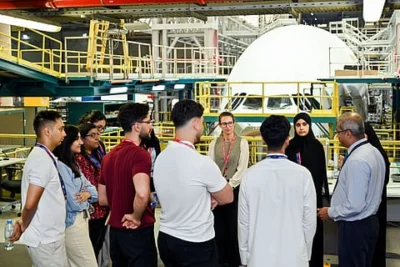
The Material Futures Studio began with an orientation programme and a detailed tour of Emirates Engineering facilities.
Students met senior aviation leaders and observed maintenance operations carried out across the Emirates fleet. These activities included both A-checks and more extensive C-checks.
The participants also visited the airline’s dedicated upcycling workshop. There, Emirates Engineering specialists currently convert retired aircraft materials into handcrafted products.
This direct exposure gives students a clearer understanding of how aircraft maintenance works and why components must sometimes be removed.
Aviation regulations require airlines to maintain strict safety and reliability standards. Therefore, materials may be withdrawn from aircraft even when they still have potential value outside active flight operations.
The programme encourages students to see these materials as resources rather than waste.
Six-week challenge turns ideas into prototypes
Over six weeks, students will explore new ways to reuse materials recovered from Emirates aircraft.
Emirates Engineering team members will guide participants through idea generation, design development and prototype creation.
The programme will conclude with a final showcase. Students will present their concepts and physical prototypes created from repurposed aviation materials.
This approach connects academic knowledge with real industrial challenges. It also allows participants to develop practical skills in engineering, design, sustainability and product development.
At the same time, Emirates can engage directly with emerging talent and identify ideas that may support future innovation.
The initiative could encourage more young people to consider careers in aircraft engineering, maintenance, industrial design and sustainable aviation.
Fleet retrofit programme creates new materials
The Material Futures Studio builds on Emirates’ wider aircraft upcycling strategy.
The airline is carrying out a major fleet retrofit programme involving 219 wide-body aircraft. The programme includes 110 Airbus A380s and 109 Boeing 777s.
Emirates is investing approximately US$5 billion to refurbish these aircraft with redesigned interiors, updated seating and new passenger products.
The extensive programme generates large volumes of materials as older cabin components are removed. Emirates Engineering manages part of this material entirely through its in-house upcycling operation in Dubai.
Rather than sending suitable materials directly for disposal, the engineering team converts selected items into useful products.
These materials may include seat fabrics, leather, aluminium and other cabin components that can no longer perform their original aviation function.
Repurposing them helps extend their usable life and may reduce waste generated during the refurbishment process.
Aircrafted products demonstrate circular design
Emirates has already developed several upcycling projects using retired aircraft interiors.
Its Aircrafted by Emirates collection includes limited-edition luggage, bags and accessories made from reclaimed materials taken from Airbus A380 and Boeing 777 cabins.
Emirates Engineering employees produce the items by hand in Dubai. The project combines aviation heritage with practical design while demonstrating how cabin materials can gain a new purpose.
The airline has also expanded its upcycling work through the Aircrafted KIDS initiative.
This programme transforms recovered fabrics and other materials into durable backpacks for children. Emirates has donated more than 4,000 handmade backpacks to young people across 11 countries.
These initiatives show how aircraft refurbishment materials can support both environmental and community-focused projects.
The Material Futures Studio now gives students an opportunity to develop further possibilities.
Sustainability expands across aircraft lifecycles
Aviation sustainability is often associated with sustainable aviation fuel, modern aircraft and more efficient flight operations.
However, the environmental impact of aviation also includes aircraft production, maintenance, cabin refurbishment and end-of-life material management.
Airlines operate complex fleets containing thousands of components and many different materials. Responsible reuse can reduce waste while supporting more efficient resource management.
Circular economy principles aim to keep products and materials in use for longer. They also encourage organisations to design new applications for items that have completed their original purpose.
For travellers, aircraft upcycling may not create an immediate change during a flight. Nevertheless, it can strengthen the wider sustainability practices behind the passenger journey.
As travellers become more interested in environmental responsibility, airlines are under increasing pressure to explain how they manage impacts across their entire operation.
Education supports aviation’s future workforce
The Material Futures Studio places students at the centre of sustainable aviation development.
By working with real aircraft materials and industry specialists, participants can understand both the technical restrictions and creative opportunities involved in aviation upcycling.
The programme also supports Dubai’s position as a major centre for aircraft engineering, maintenance and aviation innovation.
Emirates is developing a US$5.1 billion engineering complex at Dubai South, which is expected to become one of the world’s most advanced maintenance, repair and overhaul facilities.
Against this expanding engineering landscape, developing skilled young professionals will remain essential.
The Material Futures Studio shows that future aviation progress will depend not only on new aircraft and digital technology. It will also require creative thinking about materials, waste and responsible resource use.
For more travel news like this, keep reading Global Travel Wire