Official Industry Data Highlights Shift in Worldwide Flight Movement
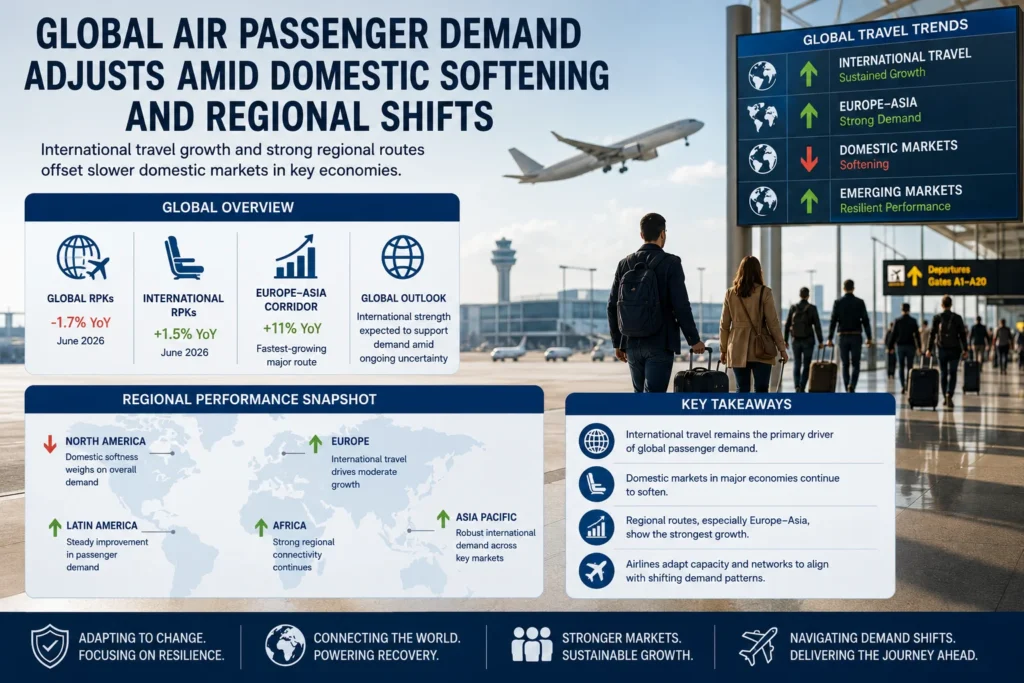
Global tourism and air transport sectors experienced an operational adjustment during mid-2026 as total passenger volume contracted slightly following months of sustained post-pandemic growth. According to official performance metrics released by the International Air Transport Association, overall global air passenger demand, measured in revenue passenger kilometers, declined by 1.7% year-on-year in June 2026. Global airline capacity, measured in available seat kilometers, dropped by 1.3% compared to the same period in the previous year, while the global passenger load factor settled at 84.2%, representing a slight 0.4 percentage point dip.
The latest official dataset demonstrates that while passenger movement remains robust along several major intercontinental flight paths, domestic softening across key global economies and ongoing geopolitical realignments in the Middle East created downward pressure on overall totals. Despite these headwinds, international traveler mobility continues to support broader economic activity, highlighting the enduring desire for cross-border vacationing and business engagement worldwide.
Domestic Market Contraction Weighs Heavily on Industry Totals
The primary factor driving the mid-year contraction in worldwide passenger traffic was a notable drop across large domestic aviation markets. Total domestic air travel demand decreased by 3.0% year-on-year in June 2026, accompanied by a 2.4% reduction in domestic flight seat capacity. Because internal flights within major geographic boundaries account for a substantial share of total worldwide departures, contractions in key domestic markets disproportionately influence global averages.
In Asia, domestic passenger demand in China experienced a 5.2% decline year-on-year, marking one of the steepest domestic drops among major aviation nations. Domestic passenger traffic in Japan also contracted by 3.8% compared to June 2025, largely driven by elevated jet fuel costs that led airlines to consolidate schedules. Similarly, the domestic aviation sector in the United States recorded softer demand, slowing overall North American domestic growth.
Among major domestic travel markets globally, Brazil stood out as a positive exception, recording a 0.9% year-on-year increase in domestic passenger traffic, although its domestic load factor eased by 2.5 percentage points. Overall, consumer sensitivity to rising living costs, local economic restructuring, and shifting internal holiday preferences prompted travelers in several large countries to reduce short-distance domestic flights or opt for ground transport alternatives.
Resilience Across Selected International Flight Routes and Corridors
While domestic flight traffic experienced contraction, international air travel demonstrated notable resilience across multiple regions. Total international passenger demand decreased by a modest 0.9% year-on-year in June 2026, with capacity contracting by 0.6%. However, when excluding Middle Eastern flight sectors—which continued to face comparison challenges stemming from prior geopolitical disruptions—global international passenger traffic expanded by 1.1% year-on-year.
European carriers delivered one of the strongest regional performances globally, generating a 1.5% year-on-year increase in international passenger demand alongside a 2.0% expansion in available seat capacity. European airlines achieved an industry-leading average load factor of 87.1%. Long-haul international connectivity between Europe and Asia experienced particularly vibrant activity, with traffic along the Europe-Asia flight corridor surging by 11.0% year-on-year, underscoring strong international demand for long-distance leisure travel.
In the Asia-Pacific region, international passenger demand rose by 0.4% year-on-year despite a 1.1% reduction in available capacity, allowing the regional load factor to improve to 84.0%. To manage rising fuel expenditures, regional carriers trimmed short-haul international capacity within Asia by 4.8%, prioritizing high-yield long-haul international routes.
African airlines achieved the highest regional growth rate worldwide, recording a 6.7% year-on-year increase in passenger demand supported by a 7.0% increase in capacity. Latin American airlines also maintained positive momentum, logging a 3.5% demand increase and a 6.3% capacity expansion. Conversely, North American carriers recorded a 1.0% decline in international passenger demand, while Middle Eastern airlines experienced a 14.0% demand reduction and an 11.0% capacity contraction as flight networks continued their gradual operational normalization.
Strategic Impact on Global Tourism and Inbound Visitor Volume
The latest official aviation statistics provide valuable intelligence for national tourism boards, hotel operators, and destination management organizations as they refine their strategy for the remainder of 2026.
First, sustained growth across key long-haul corridors indicates that international long-distance vacationers remain willing to invest in premium overseas travel experiences despite broader economic uncertainty. Destinations catering to long-haul long-stay travelers stand to maintain steady tourism receipts, particularly those connected via direct European and Asian air bridges.
Second, capacity discipline practiced by commercial airlines means that flight seat availability may remain tight on select regional corridors. As airlines adjust flight schedules to absorb elevated jet fuel expenses and operational overheads, destination authorities must collaborate closely with airline partners to safeguard essential air connectivity and maintain stable flight frequencies.
Finally, official industry statements reinforce that air connectivity remains an essential driver of international trade, cultural exchange, and economic resilience. As geopolitical conditions stabilize and global fuel markets normalize, international passenger traffic is projected to resume its steady upward trajectory, reinforcing the vital role of commercial aviation in supporting the global tourism ecosystem.
For more travel news like this, keep reading Global Travel Wire