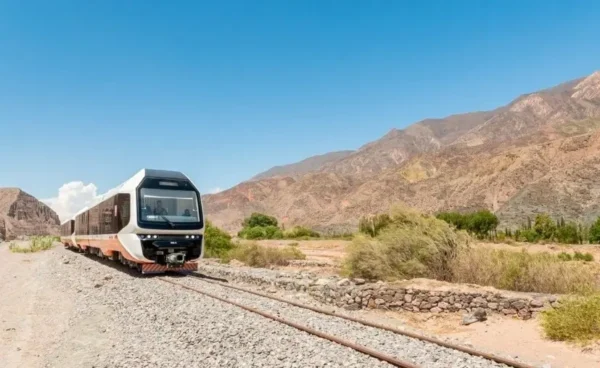
Argentina’s Tren Solar de la Quebrada is transforming tourism across Jujuy Province by combining renewable energy, advanced rail technology and easier access to the UNESCO-listed Quebrada de Humahuaca.
Recognised as Latin America’s first solar-electric passenger train, the service offers travellers a cleaner and quieter way to explore one of South America’s most culturally significant landscapes. It also improves connections between remote Andean communities, historic settlements and major visitor attractions.
The train travels through a valley shaped by more than 10,000 years of human movement, indigenous culture and commercial exchange. Its introduction places northern Argentina at the centre of the global shift towards low-emission transport and environmentally responsible tourism.
Solar technology powers a cleaner journey
The Tren Solar de la Quebrada uses modern battery technology supported by renewable energy infrastructure. The system reduces dependence on conventional fossil fuels while providing a smooth and immersive sightseeing experience.
The articulated two-car trains were manufactured by CRRC Tangshan and designed specifically for tourism journeys. Large panoramic windows offer extensive views of Jujuy’s colourful mountains, high-altitude valleys, traditional communities and historic railway landscapes.
Each train uses 352 kWh lithium iron phosphate battery packs. Dedicated solar photovoltaic plants with a combined capacity of 6 MW support the charging system alongside stationary battery storage facilities.
Ultra-fast charging technology allows the train to receive additional energy during station stops. Charging can take approximately 25 minutes, supporting efficient operations without causing major disruption to passengers.
Regenerative braking further improves performance. The system recovers energy when the train travels down steep sections of the Andean route, helping extend battery capacity and reduce overall power consumption.
UNESCO heritage destinations become more accessible
The railway follows the historic Ramal C section of the General Belgrano Railway. Its first operational phase covers approximately 42 kilometres between Volcán and Tilcara.
Stops include Volcán, Tumbaya, Purmamarca, Maimará, La Posta de Hornillos and Tilcara. Together, these destinations create a connected tourism route featuring archaeological sites, geological formations, traditional markets and indigenous heritage.
Volcán serves as the southern gateway to the journey. Visitors can explore regional craft traditions and discover products created by local artisans.
Tumbaya and La Posta de Hornillos add historical depth through sites connected to the valley’s colonial and commercial past.
Purmamarca is among the route’s strongest international attractions. The town sits near the Cerro de los Siete Colores, or Hill of Seven Colors, one of Argentina’s most recognisable natural landmarks.
Maimará offers views of the Paleta del Pintor, a striking mountain formation known for its layered colours. The surrounding area also supports high-altitude vineyards and emerging rural tourism experiences.
Tilcara, the current northern endpoint, provides access to archaeological attractions, traditional markets and cultural experiences reflecting the identity of the Andes.
Local communities benefit from tourism growth
The solar train functions as both a visitor attraction and a regional development project. By improving mobility between smaller destinations, it creates opportunities for hotels, restaurants, guides, artisans and other tourism businesses.
The service has carried more than 90,000 passengers, demonstrating strong interest in renewable-energy rail journeys and cultural tourism.
Social inclusion also forms an important part of the project. Around one-third of passengers have accessed the service through programmes offering free or subsidised journeys to indigenous populations and rural communities.
This approach allows local residents to benefit directly from the railway. It also encourages stronger interaction between visitors and communities preserving Jujuy’s crafts, cuisine, music and traditions.
Improved transport could encourage travellers to spend more time in the region rather than making short visits to individual attractions. Longer stays may support hotel demand, employment and visitor spending throughout the valley.
Expansion could create a wider Andean corridor
Future development plans aim to extend the railway north towards Humahuaca and eventually La Quiaca near Argentina’s border with Bolivia.
The broader ambition involves restoring around 300 kilometres of the historic international railway corridor. Such an expansion could reconnect additional communities while creating a stronger cross-border tourism route through the Andes.
A connection to Humahuaca would provide easier access to more cultural landmarks, heritage sites and mountain landscapes. Reaching La Quiaca could eventually support combined Argentina and Bolivia travel itineraries.
The expansion may also strengthen tourism cooperation between destinations across northern Argentina. Improved rail connectivity could support tour operators, accommodation providers and local businesses seeking to serve longer multi-destination journeys.
A new symbol of sustainable travel
The Tren Solar de la Quebrada demonstrates how clean transport can support heritage protection, visitor access and regional development.
For travellers, the service offers more than transportation between towns. It creates a panoramic journey through ancient landscapes, colourful mountains and living indigenous culture.
As demand grows for environmentally responsible holidays, Argentina’s solar train gives Jujuy a distinctive position in the international tourism market. The project is turning a historic Andean railway into a modern symbol of sustainable travel, cultural discovery and community-focused tourism.
For more travel news like this, keep reading Global Travel Wire