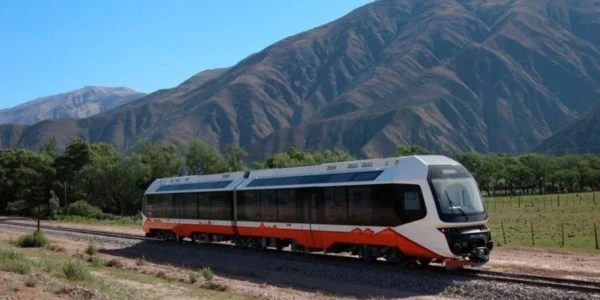
Argentina’s Tren Solar de la Quebrada is strengthening Jujuy’s position as a global sustainable tourism destination by combining battery-powered rail technology with one of South America’s most significant cultural landscapes.
The pioneering passenger service operates through the UNESCO-listed Quebrada de Humahuaca in northern Argentina. It connects colourful mountain scenery, historic settlements and communities that preserve centuries of Andean culture.
The train completed two years of operation in June 2026 after making its first official journey on June 18, 2024. During that period, it carried more than 90,000 passengers and developed into one of Jujuy’s flagship tourism attractions.
Its success demonstrates how clean transport can become part of the visitor experience rather than simply providing movement between destinations.
Solar-powered mobility enters Latin American tourism
The Tren Solar de la Quebrada is promoted by Jujuy as Latin America’s first tourism train powered by solar energy.
Its two-car light rail units were manufactured by CRRC Tangshan and designed specifically for the mountainous landscape. Each unit can accommodate approximately 70 passengers and operate at speeds of up to 60 kilometres per hour.
Lithium iron phosphate batteries power the trains, while wide panoramic windows and additional upper windows give passengers expansive views of the surrounding valley.
The design allows visitors to observe mountains, villages and high-altitude scenery without the noise and direct emissions associated with conventional diesel-powered railway services.
Jujuy’s renewable-energy resources support the railway’s low-carbon identity. The project also reflects the province’s wider ambition to connect tourism development with clean energy, local employment and environmental responsibility.
UNESCO valley creates a remarkable railway setting
The service travels through the Quebrada de Humahuaca, which UNESCO added to the World Heritage List in 2003.
The valley follows an important cultural route along the Río Grande and contains evidence of continuous use as a trade and transport corridor for around 10,000 years.
Pre-Hispanic settlements, agricultural landscapes, historic villages and living cultural traditions demonstrate the interaction between successive communities and the dramatic Andean environment.
This heritage gives the solar train a tourism value extending beyond its technology. Passengers are not simply taking a scenic rail journey. They are travelling through a cultural landscape shaped by Indigenous communities, ancient commerce and regional migration.
The railway connects Volcán, Tumbaya, Purmamarca, Posta de Hornillos, Maimará and Tilcara. Each stop provides access to different landscapes, traditions and tourism businesses.
Purmamarca and Tilcara anchor the experience
Purmamarca is among the best-known destinations along the route. The town provides access to Cerro de los Siete Colores, whose layered mineral formations create one of Argentina’s most recognisable mountain landscapes.
Maimará offers views of the Paleta del Pintor, another multicoloured geological formation that rises above the valley. High-altitude vineyards, agricultural traditions and local food products add further depth to the visitor experience.
Tilcara provides access to archaeological heritage, artisan markets and cultural attractions. Its position within the valley makes it an important base for travellers exploring northern Jujuy.
Volcán acts as a southern gateway, while Tumbaya and Posta de Hornillos connect passengers with religious, historical and rural traditions.
By linking these communities, the train encourages visitors to explore several destinations rather than concentrating their spending in a single tourism centre.
Record demand strengthens Jujuy tourism
Demand continued growing during Argentina’s 2026 winter season.
The solar train carried 7,340 passengers during July, representing an increase of 17.4% compared with the same month in 2025. Its regular experiences achieved average occupancy of 97%.
Special tourism products have expanded the railway’s appeal.
The Cielo en Movimiento experience combines a nighttime train journey with astronomy, Andean cosmology and regional gastronomy. Its July departures achieved 99% occupancy.
A new Tren del Vino experience also launched with a sold-out inaugural journey. The product connects railway travel with vineyards and the wider Jujuy wine route, creating additional opportunities for local producers and hospitality businesses.
These themed journeys show how railway infrastructure can support astrotourism, culinary tourism and cultural storytelling.
Local communities share the tourism benefits
Social inclusion forms an important part of the project.
Around one-third of the train’s first 90,000 passengers travelled through its social responsibility programme. The initiative gives local residents, institutions and community groups opportunities to experience the railway and reconnect with Jujuy’s cultural landscape.
More than 6,000 Jujuy residents participated through the programme during the first half of 2026 alone.
Stations have also hosted music, dance, sport and cultural presentations, allowing residents to share local talent with domestic and international visitors.
The service can generate wider economic activity for guides, artisans, accommodation providers, restaurants and transport operators serving communities along the route.
Jujuy emerges as a green travel icon
The Tren Solar de la Quebrada demonstrates how renewable-energy transport can support heritage preservation and regional tourism simultaneously.
Its combination of clean mobility, panoramic design and cultural access gives Argentina a distinctive attraction within the growing sustainable travel market.
As visitor demand rises, careful management will remain essential. Protecting the Quebrada’s landscapes and living traditions must remain central to future tourism development.
For Jujuy, the railway has already achieved more than restoring trains to a historic corridor. It has created a modern gateway into an ancient Andean landscape while giving communities new opportunities to participate in tourism growth.
For more travel news like this, keep reading Global Travel Wire