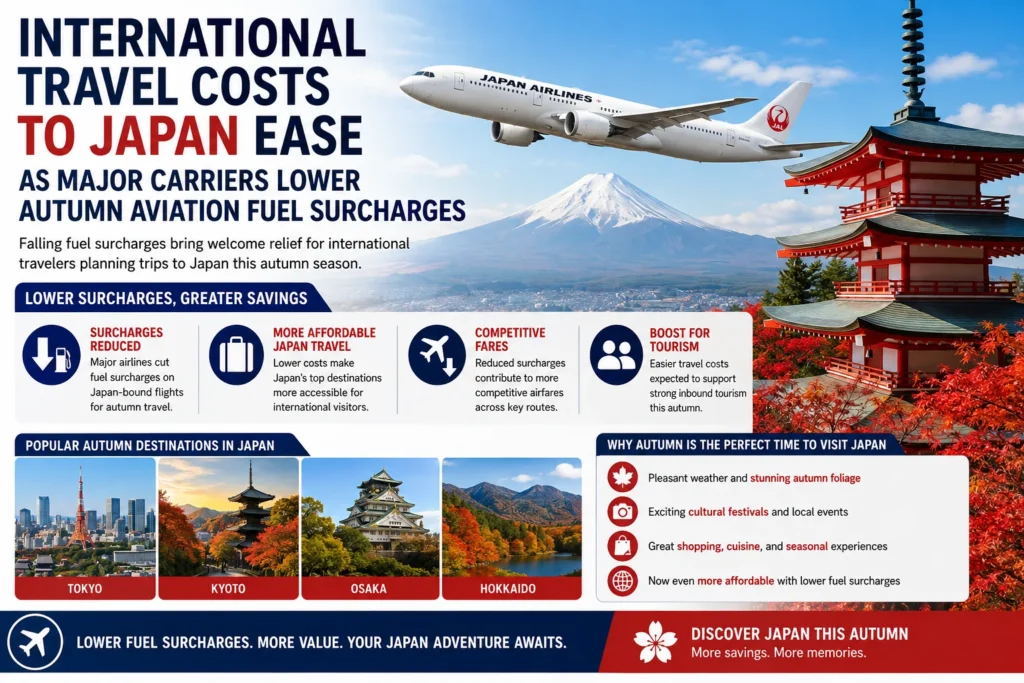
Travelers planning journeys to Japan can anticipate lower overall airfares this autumn as the nation’s premier flag carriers, All Nippon Airways (ANA) and Japan Airlines (JAL), adjust their fuel surcharges downward for international flight tickets issued throughout September and October. The reduction in surcharges follows several months of elevated transport fees, offering welcome relief for international visitors looking to explore Japanese destinations during the upcoming peak autumn travel season.
Fuel surcharges are standard variable fees integrated into international airfare calculations to help commercial carriers offset global fuel price volatility. ANA and JAL re-evaluate these pricing tiers every two months based on benchmark aviation fuel costs calculated during the preceding two-month period. Following recent policy adjustments and stabilizing fuel benchmark averages, the updated rates represent the most affordable international surcharge levels offered by major Japanese carriers since early May.
Breakdown of Passenger Savings Across Global Flight Routes
The upcoming fee reductions deliver tangible savings for travelers across major international long-haul and regional flight routes:
Europe, North America, Middle East, and Oceania: Surcharges on one-way flights operated by ANA will drop from 65,000 yen down to 55,000 yen per passenger. This change yields a direct savings of 10,000 yen per segment, translating to a total reduction of 20,000 yen for round-trip travelers.
Hawaii, India, and Indonesia: One-way fuel surcharges decrease from 40,400 yen to 35,800 yen per seat.
Thailand, Singapore, Malaysia, Myanmar, and Cambodia: Rates fall from 33,500 yen to 27,300 yen per segment.
China and Regional Destinations: One-way fees drop from 15,400 yen to 14,300 yen.
South Korea: Surcharges decrease from 7,400 yen down to 6,500 yen per leg.
Japan Airlines is expected to align its scheduled September and October surcharge revisions with these revised tiers, maintaining competitive parity across shared international corridors.
Market Conditions and Public Policy Stabilization
The surge in international flight surcharges earlier in the summer—when fees between Japan and long-haul markets reached historic peaks of 65,000 yen—was primarily driven by sharp spikes in global jet fuel prices following Middle Eastern supply chain disruptions. Because fuel remains one of the largest operational expenditures for commercial airlines, the rapid rise in crude indices impacted international passenger pricing.
The recent stabilization in ticket surcharges has been aided by targeted public policy measures, including government aviation fuel subsidies designed to absorb energy price volatility and protect regional connectivity. By mitigating extreme fuel price surges at domestic airports, public support mechanisms have allowed Japanese carriers to lower baseline ticket surcharges for incoming international visitors.
The timing of the fee reduction coincides with favorable exchange rate conditions. A competitive Japanese yen has enhanced the purchasing power of international travelers, making accommodation, local transit, dining, and cultural attractions within Japan highly accessible. The combined effect of reduced airfare surcharges and favorable currency conditions is expected to drive strong inbound travel interest across key source markets.
Regional Destination Marketing and Autumn Inbound Tourism Growth
Tourism promotional bodies, including the Japan National Tourism Organization (JNTO) and regional prefectural authorities, are preparing for a strong influx of international visitors as autumn foliage season approaches. The lower transport overhead helps support national strategies aimed at dispersing international visitors into regional destinations beyond the traditional Tokyo-Kyoto-Osaka travel corridor.
Regions such as Hokkaido, Tohoku, and the Japanese Alps rely heavily on international autumn arrivals to support local hospitality sectors, artisanal crafts, and rural eco-tourism initiatives. By lowering overall flight expenditures, tourism officials anticipate higher visitor spend within local communities, encouraging longer itineraries and deeper exploration of cultural heritage sites.
International travelers planning trips to Japan are advised to review ticket issuance timelines carefully. Because fuel surcharges are determined by the exact date an air ticket is purchased rather than the date of travel, passengers finalizing bookings between September 1 and October 31 will automatically benefit from the lower surcharge structure, regardless of whether their actual flight takes place later in the year.
As international air carriers continue to optimize route capacities and expand flight frequencies into major international gateways such as Tokyo Haneda, Tokyo Narita, and Kansai International Airport, the easing of fuel surcharges reinforces Japan’s position as a premier, accessible global travel destination.
For more travel news like this, keep reading Global Travel Wire