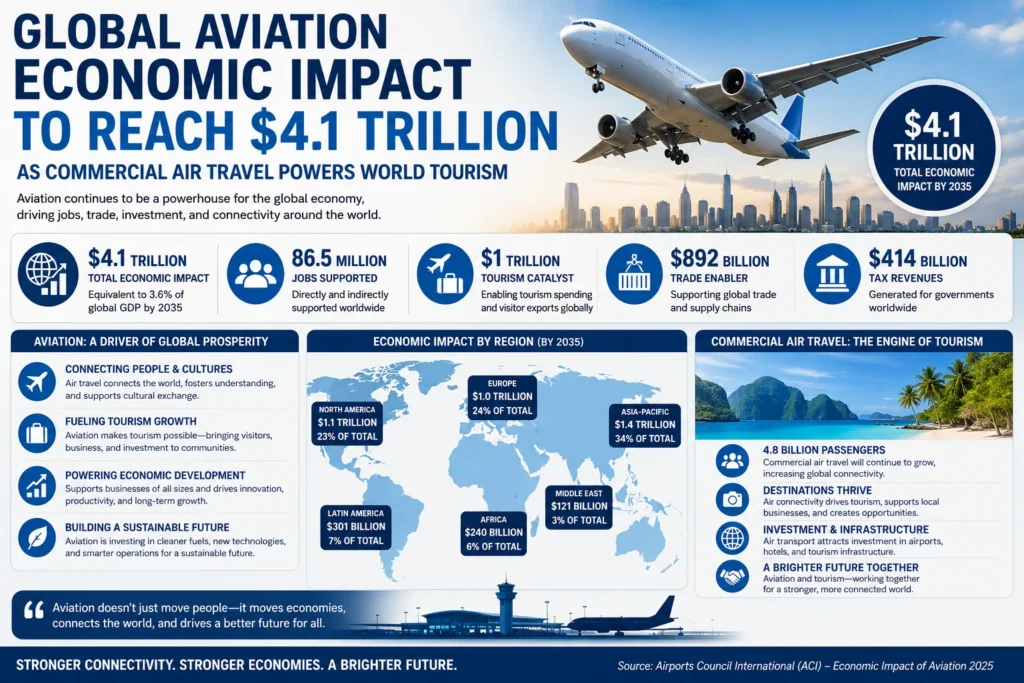
Commercial air transport is setting new benchmarks as the global aviation ecosystem prepares to contribute an estimated $4.1 trillion to the worldwide economy. Official statistical updates from the International Air Transport Association highlight an unprecedented acceleration in global air travel, with airlines projected to carry approximately 5.2 billion passengers across international and domestic networks.
The soaring demand for air connectivity underscores the foundational role of civil aviation in driving global tourism development, supporting international commerce, and fostering cross-border cultural exchange. Accounting for approximately 3.9 percent of global gross domestic product (GDP), the aviation sector continues to serve as an indispensable pillar of international economic stability, supporting an estimated 86.5 million direct and indirect jobs across hospitality, airport operations, travel services, and supply chain logistics.
The steady expansion builds upon a strong performance in passenger traffic, which recorded a 5.7 percent year-on-year increase. As global travelers demonstrate sustained enthusiasm for international journeys, air transport infrastructure remains central to destination competitiveness and regional economic vitality.
Key Destination Markets Lead Aviation Income and Tourism Growth
The economic value generated by commercial aviation is distributed across both established tourism hubs and rapidly developing regional destinations. Official economic evaluations ranking national aviation contributions highlight major geographic markets where air transport serves as a primary engine for GDP growth and international visitor receipts.
The United States maintains the world’s largest civil aviation market, with commercial air transport contributing approximately $1.3 trillion to national economic output. China ranks second globally, generating $253.6 billion in aviation-related economic activity as domestic travel and outbound international tourism continue to expand.
In Europe, Spain stands out as a leading destination where civil aviation generates $172.9 billion for the national economy. Spain’s high ranking reflects the critical importance of air connectivity in sustaining its world-class tourism industry, where air travel links European urban centers with popular coastal resorts and island destinations.
The top ten global aviation markets based on economic contribution include:
United States: $1.3 trillion GDP contribution
China: $253.6 billion GDP contribution
Spain: $172.9 billion GDP contribution
United Kingdom: $160.7 billion GDP contribution
France: $144.7 billion GDP contribution
Germany: $142.7 billion GDP contribution
Japan: $116.4 billion GDP contribution
Italy: $103.6 billion GDP contribution
United Arab Emirates: $92.0 billion GDP contribution
Saudi Arabia: $90.6 billion GDP contribution
The strong performance of destination markets such as France, Italy, the United Arab Emirates, and Saudi Arabia emphasizes how targeted investments in airport infrastructure, airline fleet expansion, and streamlined visitor facilitation directly translate into increased national economic prosperity.
Passenger Safety and Fleet Operations Maintain Global Traveler Trust
A cornerstone of the ongoing surge in international air travel is the commercial aviation sector’s rigorous commitment to operational safety. With airlines operating approximately 40 million flights worldwide each year, aviation maintains its position as one of the safest modes of transportation available to global travelers.
Industry safety statistics underscore that continuous technological enhancements, stringent oversight by national civil aviation authorities, and standardized international flight protocols have built exceptional resilience into global air transport. This high standard of operational reliability plays a vital role in maintaining consumer confidence, encouraging long-haul leisure travel, and supporting time-sensitive business travel networks across continents.
Beyond passenger transport, air cargo operations remain essential to global trade and tourism supply chains, carrying roughly 71.6 million metric tons of high-value freight annually valued at over $8 trillion. Air freight networks ensure the swift movement of perishables, luxury goods, and essential equipment that support international hotel operations, resort supply chains, and local tourism services worldwide.
Addressing Supply Chain Challenges and Accelerating Green Energy Transition
Despite positive growth trajectories, the commercial aviation ecosystem is navigating operational headwinds that impact airline capacity and route development. Global supply chain bottlenecks, delays in new aircraft deliveries from primary manufacturers, and geopolitical uncertainties continue to constrain fleet availability and influence international flight scheduling.
Concurrently, the aviation sector is prioritizing environmental sustainability as part of its long-term growth strategy. Achieving the global civil aviation goal of net-zero carbon emissions requires a rapid scale-up in Sustainable Aviation Fuel (SAF) production and distribution.
Official industry projections indicate that the global aviation sector will require approximately 500 million metric tons of Sustainable Aviation Fuel annually by 2050 to meet decarbonization targets. Transitioning to renewable fuels made from waste oils, agricultural residues, and synthetic carbon captures remains crucial to ensuring that future tourism growth aligns with global environmental preservation goals.
Strategic Infrastructure Investments Key to Sustaining Air Travel Momentum
As passenger volume approaches record heights, national tourism boards and transport ministries are prioritizing airport modernizations, digital passenger processing systems, and expanded runway capacity. Enhancing gateway efficiency allows destinations to manage higher visitor volumes while offering smooth travel experiences from arrival to departure.
By aligning air transport policies with regional tourism development programs, governments and aviation authorities are ensuring that commercial flight networks continue to unlock economic opportunities, connect diverse cultures, and drive global economic prosperity.
For more travel news like this, keep reading Global Travel Wire