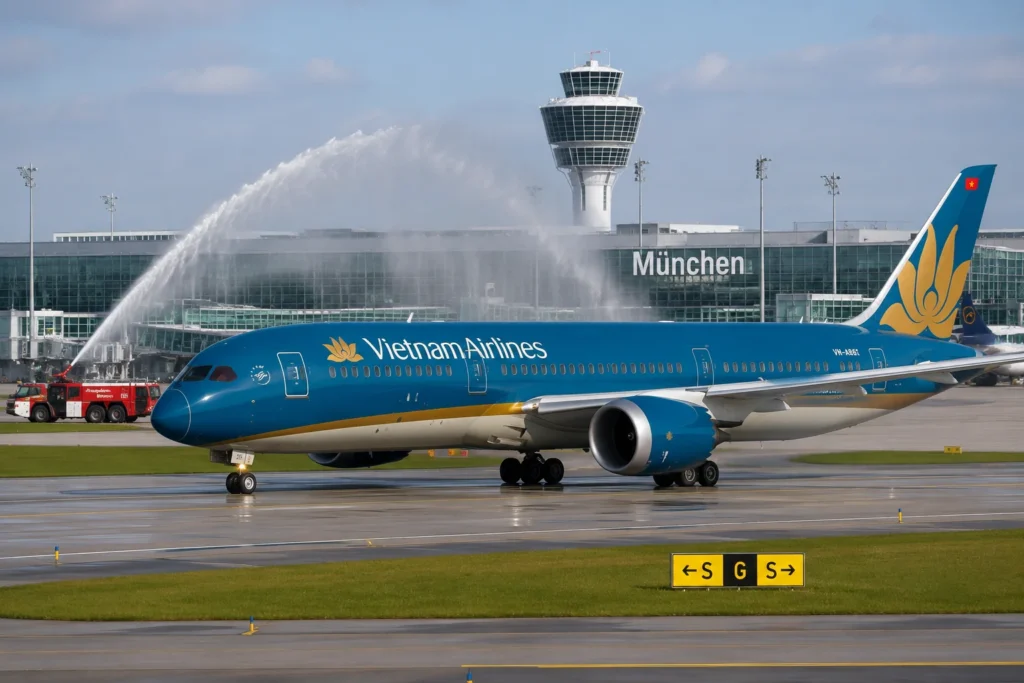
Civil aviation authorities and airport operational teams managed a swift technical response at Munich Airport following a flight disruption involving a Vietnam Airlines Boeing 787-9 Dreamliner. The long-haul international flight, bound for Hanoi, executed a safe return and landing shortly after departure due to a recorded technical issue during takeoff operations.
Following strict international aviation safety standards, the flight crew initiated standard return protocols immediately after encountering operational anomalies during departure. Ground services and air traffic management at Munich Airport coordinated closely with the airline crew to secure a safe landing environment, ensuring all passengers and cabin crew members remained completely unharmed throughout the incident.
Tactical Fuel Jettison and Runway Safety Procedures
Flight management protocols for long-haul commercial aircraft require specific gross weight adjustments prior to performing a safe precautionary landing. To reach optimal landing weight and reduce stress on landing gear systems, the Boeing 787 crew executed designated holding patterns in proximity to the airport to burn off excess fuel reserves safely.
Official operational reports confirm the sequence of events following takeoff:
Flight Identification: Vietnam Airlines long-haul service originating from Munich Airport destined for Hanoi, Vietnam.
Precautionary Decision: Immediate flight crew activation of return protocols following a post-takeoff technical advisory.
Airspace Holding: Execution of monitored holding patterns over designated flight corridors to achieve mandatory landing weight compliance.
Controlled Landing: Safe touchdown at Munich Airport under the supervision of local emergency response services and air traffic control.
Upon completing the controlled landing, the aircraft came to a halt on the north runway. As a precautionary measure, ground crews inspected the airframe before towing the jet to the parking apron, ensuring adherence to rigorous civil aviation safety standards.
Temporary Airfield Adjustments and Airport Traffic Management
To maintain continuous operational capacity while the aircraft remained on the active runway, Munich Airport authorities executed established contingency management procedures. Operations on the north runway were temporarily suspended to permit ground crews, engineering teams, and safety inspectors to assess the aircraft and clear the surface.
Air traffic controllers seamlessly redirected inbound and outbound commercial flights to the airport’s parallel south runway. These tactical adjustments allowed Munich Airport to maintain steady traffic flow, preventing widespread flight cancellations or extended regional airspace delays during the operational window.
| Operational Phase | Official Action Taken | Safety & Logistics Result |
| Post-Takeoff Alert | Flight crew initiates precautionary return protocol | Air traffic control clears holding airspace |
| Weight Reduction | Aircraft performs monitored holding maneuvers | Jet achieves target landing weight safely |
| Touchdown & Rollout | Aircraft lands safely on designated north runway | No injuries reported among passengers or crew |
| Airfield Management | Traffic rerouted temporarily to south runway | Airport operations maintain steady flow |
| Aircraft Inspection | Towing to engineering hangar for technical review | Formal investigation protocols activated |
Official Statements and Technical Investigation Protocols
Vietnam Airlines issued an official operational update confirming that the flight crew followed all required emergency procedures and safety guidelines established by international aviation regulators. The carrier emphasized that passenger safety and crew welfare remained the absolute priority during the event, confirming that all individuals aboard disembarked without incident and received standard ground assistance.
Engineering specialists, civil aviation authorities, and technical inspection teams have initiated formal technical reviews of the aircraft to evaluate flight control data, engine metrics, and landing gear systems. The aircraft will remain grounded under technical supervision until complete clearance is granted by civil aviation inspectors.
Vietnam Airlines confirmed ongoing coordination with airport management, maintenance providers, and aviation regulatory bodies to determine the exact root cause of the operational anomaly. The airline committed to arranging alternative transport itineraries for affected travelers, highlighting the importance of robust safety protocols, risk management, and regulatory compliance in modern international aviation.
For more travel news like this, keep reading Global Travel Wire