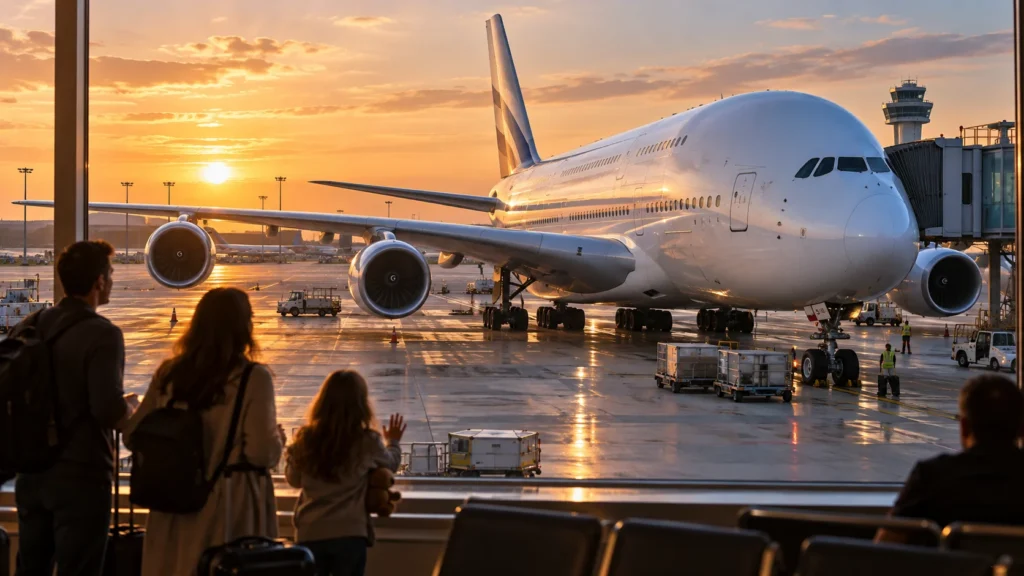
When the Airbus A380 took off from Toulouse, France, for its maiden voyage in April 2005, it signaled a major leap forward for global commercial aviation. Over two decades later, despite the official conclusion of its production line in December 2021, the double-decker superjumbo continues to maintain an unmatched reputation among long-haul travelers.
Aviation industry operational data and air travel passenger satisfaction metrics consistently indicate that the aircraft holds a unique competitive advantage in passenger comfort. From its spacious cabin layouts to its remarkably quiet flight performance, the world’s largest commercial airliner remains an enduring icon of modern air travel.
Unmatched Engineering and Cabin Comfort
The structural design of the double-decker superjumbo sets it apart from conventional twin-engine widebody aircraft. Measuring 73 meters in length with a wingspan stretching nearly 80 meters, the sheer physical mass and advanced aerodynamic engineering of the A380 provide exceptional flight stability. High-altitude turbulence is absorbed more smoothly across its frame, offering a noticeably steadier ride for passengers.
The physical dimensions of the aircraft also allow airlines to configure main cabin seating with enhanced personal space. Featuring a full-length upper deck, the main cabin offers generous headroom, wider seats, larger window apertures, and advanced LED mood lighting. Advanced environmental control systems refresh the cabin air every two to three minutes, maintaining optimal humidity and pressure levels to significantly reduce flight fatigue.
Sound reduction technology represents another major milestone of the aircraft’s design architecture. Advanced engine casing designs and composite hull materials damp engine noise within the cabin, creating one of the quietest long-haul flight environments in commercial aviation.
Environmental and Technological Capabilities
Developed to meet rapid growth in global air traffic, the aircraft introduced significant technological innovations to the aviation manufacturing sector. The design integrated lightweight carbon-composite materials, advanced fly-by-wire flight control interfaces, and high-efficiency engine systems.
Official environmental performance benchmarks recorded during its production cycle highlighted a baseline consumption rate of approximately 3.1 liters of fuel per 100 passenger-kilometers when operated at high capacity. The aircraft’s noise reduction footprint also met stringent international airport noise certification standards, enabling operations at noise-restricted hubs worldwide.
Fleet Dynamics and Global Airport Infrastructure
The commercial journey of the A380 reflects changing operational strategies within global air transport. Singapore Airlines inaugurated the first scheduled passenger service of the aircraft in October 2007 on its flagship route between Singapore and Sydney. Over its full production lifespan, a total of 251 aircraft were manufactured at the final assembly facility in France.
While passenger preference for the double-decker giant remained high, broader market dynamics gradually shifted international airline operations toward point-to-point routes utilizing highly efficient twin-engine widebodies. Operating a four-engine superjumbo required substantial airport infrastructure modifications, including reinforced taxiways, wider runways, and specialized dual-level boarding gates. These requirements concentrated operations primarily across major international hub airports.
High operational hourly expenses—averaging between US$26,000 and US$29,000 per flight hour—meant that airlines needed consistently high passenger load factors to maximize route profitability. The economic disruptions of the global pandemic further accelerated early fleet retirements for several international carriers.
Active Operations Across Global Hubs
Despite line closure, the superjumbo is experiencing a strong operational second act. Global air travel demand has led primary international carriers to maintain active A380 flight schedules across high-density long-haul corridors.
Emirates stands as the largest operator of the aircraft, having integrated 123 superjumbos into its global fleet. The Dubai-based flag carrier continues to utilize the aircraft as the backbone of its long-haul international network, operating high-frequency routes connecting major global destinations like London Heathrow.
Multiple flag carriers continue to operate active A380 fleets, including Singapore Airlines, British Airways, Qatar Airways, Qantas, All Nippon Airways, Korean Air, Etihad Airways, and Malaysia Airlines. Furthermore, dedicated charter operations, such as Malta-based Hi Fly operating a former China Southern airframe under the Global Airlines charter brand, highlight ongoing commercial interest in utilizing the double-decker platform for specialized route demands.
The Long-Term Legacy in Modern Aviation
As airlines gradually map out long-term fleet modernization strategies, next-generation twin-engine widebody aircraft—including the Airbus A350-1000 and the Boeing 777X—are stepping in to serve long-haul capacity requirements. These modern aircraft deliver extended range and lower fuel burn per seat without requiring four-engine maintenance requirements.
Nevertheless, the A380 retains a distinct status in modern travel culture. By establishing new standards for quietness, interior cabin space, and passenger comfort, the superjumbo transformed expectations for international long-haul flying. Its continued presence in the skies ensures that travelers around the globe can still experience one of the most remarkable achievements in commercial aviation history.
For more travel news like this, keep reading Global Travel Wire