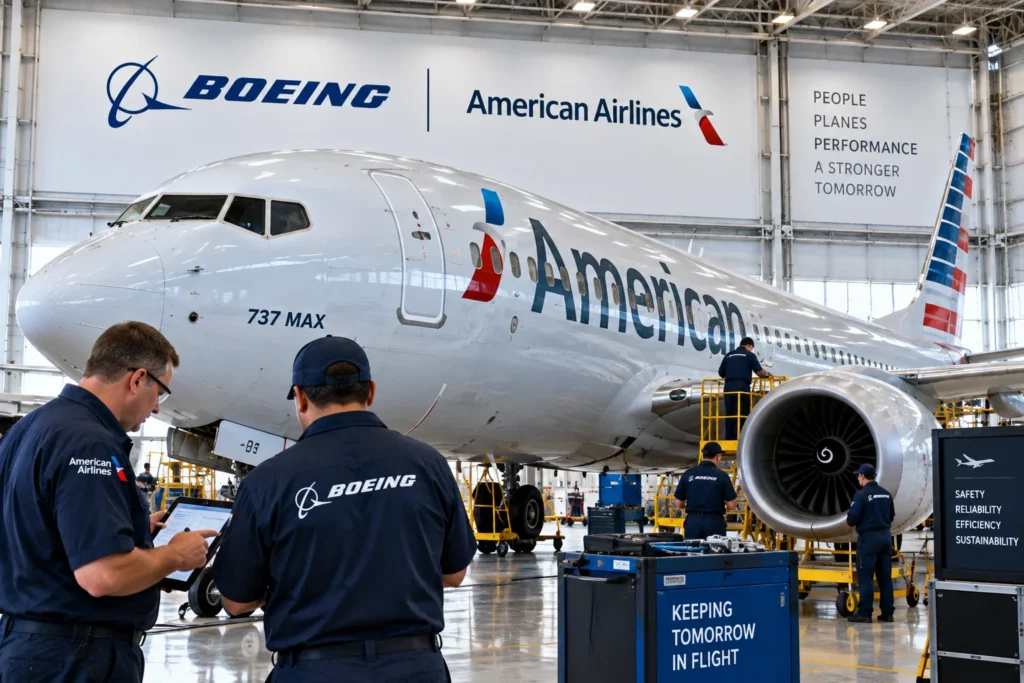
In a significant advance for global commercial fleet sustainability and maintenance efficiency, aerospace manufacturer Boeing and legacy carrier American Airlines announced the successful completion of the first landing gear exchange for a 737 MAX aircraft. The achievement marks the official expansion of the manufacturer’s long-standing Landing Gear Exchange Program to its modern single-aisle platform.
As commercial airlines worldwide expand flight schedules to meet robust international travel demand, optimizing heavy maintenance turnarounds remains vital to operational reliability. The successful swap demonstrates how standardized component exchanges reduce ground time, lower capital costs for commercial carriers, and strengthen resilience across global commercial aircraft maintenance protocols.
Streamlining Fleet Support Through Modular Component Exchange
The landing gear exchange model provides commercial carriers with an efficient alternative to traditional, time-consuming component overhauls. Under conventional heavy maintenance procedures, an aircraft must remain grounded for extended periods while its main and nose landing gear assemblies are removed, disassembled, inspected, repaired, and reinstalled.
Through the exchange program, fully overhauled and certified landing gear assemblies arrive at the operator’s maintenance base ready for immediate installation. For the inaugural 737 MAX procedure with American Airlines, the manufacturer delivered complete main and nose landing gear units alongside comprehensive installation kits.
This turnkey approach allowed maintenance technicians to execute a direct swap, replacing aging assemblies with certified units in a fraction of the time required for in-place refurbishment. By avoiding prolonged aircraft-on-ground status, carriers maintain schedule integrity, keep aircraft in revenue-generating service, and minimize flight disruptions across domestic and international route networks.
Operational Advantages for Airlines and Commercial Fleets
Managing specialized spare parts inventories presents a continuous logistical challenge for major airlines operating diverse global fleets. Purchasing, storing, and maintaining high-value structural components like landing gear requires significant capital allocation and dedicated warehouse capacity.
The expansion of the Landing Gear Exchange Program to next-generation single-aisle aircraft offers substantial operational and financial benefits for commercial operators:
Significant reduction in aircraft-on-ground turnaround times during scheduled heavy maintenance cycles.
Elimination of the need for individual carriers to purchase, store, and manage expensive spare landing gear inventory.
Transfer of technical overhaul, regulatory paperwork, and component obsolescence management directly to the original equipment manufacturer.
Enhanced predictability in maintenance budgeting and scheduling, aligning component replacements seamlessly with planned operational downtime.
Improved fleet utilization rates, enabling carriers to maintain high aircraft availability during peak seasonal travel periods.
By shifting from an ownership model to a forward-exchange framework, airlines can free up working capital while ensuring their operating fleets adhere strictly to certified airworthiness standards.
Global Infrastructure and Supply Chain Scaling
To support the roll-out of the exchange program across the growing global 737 MAX fleet, manufacturing and supply chain management divisions are actively expanding global overhaul capacity. The initiative relies on coordinated networks involving certified maintenance, repair, and overhaul facilities positioned strategically near major international aviation hubs.
Strategic priorities for scaling the program include expanding the physical inventory of MAX-capable landing gear units, establishing localized forward-exchange stock locations near primary airline bases, and tracking key operational metrics to measure turnaround speed and cost savings. This infrastructure ensures that operators across North America, Europe, Asia-Pacific, and Latin America can access replacement components without incurring lengthy shipping delays.
Furthermore, integrating advanced predictive maintenance data allows technical teams to schedule component exchanges well in advance of mandatory service thresholds. By coordinating heavy maintenance events alongside routine fleet servicing, airlines optimize hangar utilization and staff deployment.
Elevating Standards Across Global Aviation Networks
The successful validation of the end-to-end exchange process—from technical overhaul and regulatory certification to final delivery and installation—establishes a repeatable framework for operators of modern single-aisle aircraft. As airlines continue to modernize their fleets with fuel-efficient, next-generation platforms, maintaining high dispatch reliability remains essential to meeting global passenger demand.
By combining original equipment manufacturer expertise with carrier-level maintenance execution, collaborative initiatives strengthen the broader civil aviation ecosystem. As the exchange program scales globally, commercial airlines benefit from increased operational predictability, reduced maintenance overhead, and a highly resilient supply chain designed to keep global air travel moving safely and efficiently.
For more travel news like this, keep reading Global Travel Wire