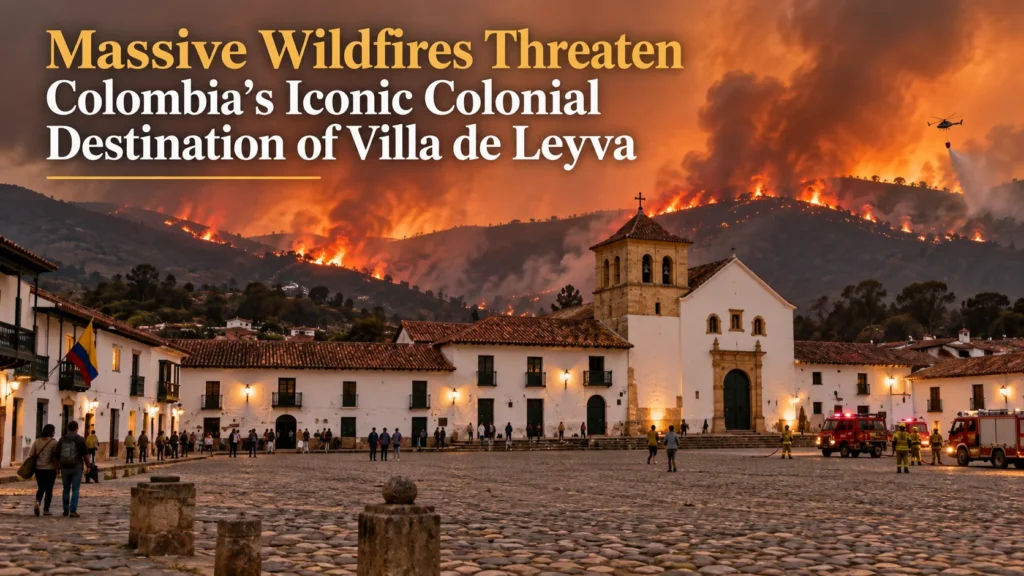
A devastating forest fire in central Colombia is advancing rapidly toward the historic town of Villa de Leyva, prompting emergency response efforts from national disaster response agencies and local municipal authorities. Ground crews and emergency personnel are battling intense blazes along the San Marcos hillside directly overlooking the municipal urban center in the department of Boyacá. The surrounding slopes, covered in dense Andean vegetation, are engulfed in flames that threaten the area’s rich biodiversity and centuries-old cultural infrastructure.
Villa de Leyva, celebrated for its preserved Spanish colonial architecture, cobblestone avenues, and expansive central plaza, welcomes over one million domestic and international travelers each year. Plumes of dense smoke rising from the San Marcos mountain range are visible across the historic district, raising serious concerns for public safety, local air quality, and the preservation of national heritage assets.
Official State Deployment and Emergency Action Plan
Public declarations from official authorities emphasize that full administrative, military, and emergency management infrastructure has been mobilized to contain the crisis. The national administration pledged comprehensive support to protect the urban perimeter, local residents, and visiting tourists, reaffirming state commitment to safeguarding one of Colombia’s primary cultural treasures.
To support ground forces operating in difficult terrain, the Departmental Government of Boyacá coordinated the deployment of specialized firefighting aircraft. The Ministry of the Interior confirmed that aerial operations include military helicopters configured for water drops over active fire lines, alongside emergency firefighting detachments mobilized directly from the capital district of Bogotá.
The Mayoralty of Bogotá deployed tactical response teams to reinforce local firefighting units operating out of Tunja and neighboring Boyacá municipalities. These joint emergency forces are executing containment lines designed to halt the fire’s advance and insulate the architectural core of Villa de Leyva from structural damage.
Climate Drivers and Extreme Drought Dynamics
Data released by the National Unit for Disaster Risk Management (UNGRD) indicates that this incident is part of a broader, severe wildfire emergency affecting multiple regions across Colombia. Official tracking identifies at least 18 active forest fires statewide, driven by extreme weather conditions that have severely strained regional disaster response capacity.
While forest fires routinely occur during the annual dry season across the high-altitude equatorial Andes, atmospheric conditions are exceptionally severe this year. An intense El Niño weather pattern has significantly suppressed seasonal precipitation across northern South America, resulting in prolonged drought and record-breaking surface temperatures. The intense heat and lack of ground moisture have reduced native Andean scrublands and forests into highly flammable fuel beds.
Unlike southern regions of the South American continent that often experience heavy, unseasonal rainfall during El Niño cycles, northern South American territories face severe rainfall deficits. The displacement of standard precipitation patterns accelerates soil evaporation, lowers water basin levels, and creates dry surface conditions that allow localized brush fires to rapidly spread into uncontrolled wildfires.
Scientific Assessment of Ecosystem Vulnerability
Environmental monitoring reports highlight how regional climate anomalies intersect with global warming trends to create unprecedented challenges for vulnerable mountain ecosystems. Official ecological evaluations note that compound climate impacts—combining elevated baseline temperatures with severe rainfall deficits—push native flora and fauna beyond historical adaptation thresholds.
The severe dry conditions rapidly deplete surface water reserves, making fire containment exponentially more difficult for emergency personnel operating in remote or topographically complex terrain. Beyond immediate structural threats to populated towns, these high-intensity fires cause severe ecological degradation, destroying fragile high-altitude habitats and causing long-term soil erosion across mountain slopes.
Operational Measures and Heritage Protection Priority
Regional authorities continue to monitor air quality, road accessibility, and safety parameters around Villa de Leyva. Emergency management officials are prioritizing the preservation of human life, structural integrity within the urban historic perimeter, and the protection of ecological reserves surrounding the municipality.
The multi-agency task force remains deployed on-site, utilizing real-time satellite imagery, localized weather monitoring, and coordinated aerial-ground interventions to suppress remaining active fire fronts and safeguard this critical cultural hub.
For more travel news like this, keep reading Global Travel Wire