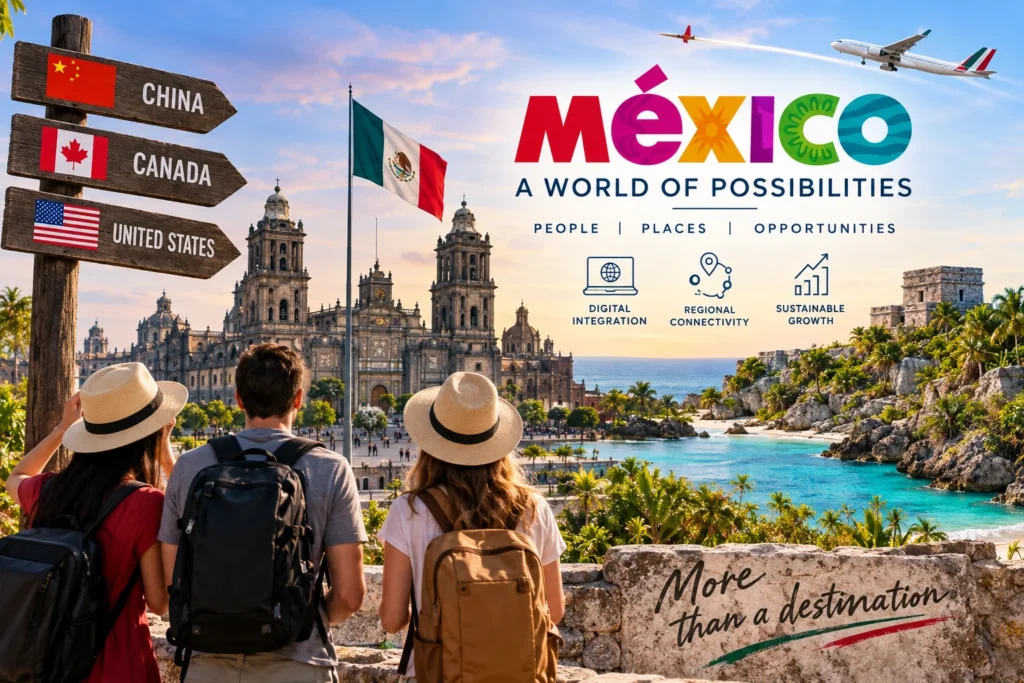
The Secretariat of Tourism of Mexico (SECTUR) has officially introduced its comprehensive 2026 global tourism roadmap. Designed to diversify international visitor inflows, the nationwide initiative combines targeted digital marketing with state-of-the-art air and rail infrastructure. By launching Mandarin-language digital portals to capture growing Asian outbound travel while reinforcing long-standing promotional campaigns across North America and Europe, official planners are directing visitor distribution far beyond traditional coastal resorts into cultural, heritage, and eco-tourism corridors.
Strategic Digital Integration and Market Diversification
Mexico’s 2026 tourism roadmap marks a significant strategic pivot toward digital innovation and source-market diversification. Coordinated through SECTUR and national promotional bodies, the multi-faceted campaign leverages localized digital platforms, contactless arrival systems, and multi-lingual concierge services to welcome high-value, long-haul travelers.
While North American markets continue to provide the baseline volume of cross-border and winter seasonal traffic, outbound travel from China, East Asia, and Europe represents a rapidly accelerating segment for cultural, culinary, and luxury itineraries across central and southern regions.
Target Source Markets and Specialized Destination Corridors
The official strategy aligns specific global source markets with targeted geographical corridors to showcase the country’s diverse landscapes and heritage.
China and East Asia
Promotional drives deploy direct Mandarin-language content across key Asian platforms, including WeChat, Xiaohongshu, and Douyin. Marketing efforts highlight UNESCO World Heritage sites in Mexico City, Guanajuato, Michoacán, and Chiapas to engage heritage and luxury travelers.
Canada
Promotional initiatives focus on extended-stay wellness, coastal relaxation, and cultural exploration packages. These offerings cater to Canadian long-stay travelers heading to popular regions such as Cancún, Riviera Maya, Puerto Vallarta, and Los Cabos.
United States
Efforts center on expanding multi-destination road routes, business travel, and short-break urban getaways. The strategy connects major U.S. aviation hubs directly with historic colonial centers as well as Pacific and Caribbean coastal destinations.
United Kingdom and Europe
Targeted campaigns across the UK, Germany, Spain, and France emphasize eco-tourism, regional gastronomy, and archaeological expeditions through Oaxaca, the Yucatan Peninsula, and the Riviera Maya.
Global Source Market and Regional Destination Matrix
The operational framework governing Mexico’s 2026 international expansion pairs global origin markets with key destination corridors and infrastructure assets:
China
Strategic Focus: Cultural heritage, UNESCO sites, luxury, and gastronomy
Primary Destinations: Mexico City, Guanajuato, Michoacán, Chiapas, and Quintana Roo
Transport & Infrastructure: Direct trans-Pacific flight routes connecting Shenzhen and Beijing to Mexico City via Tijuana; dedicated Mandarin digital web portals
Canada
Strategic Focus: Winter long-stay travel, resort relaxation, and wellness programs
Primary Destinations: Cancún, Riviera Maya, Los Cabos, Puerto Vallarta, and Mexico City
Transport & Infrastructure: High-frequency seasonal direct flights connecting Canadian metropolitan areas to Caribbean and Pacific coastal hubs
United States
Strategic Focus: Short breaks, beach resorts, cultural tours, and MICE (Meetings, Incentives, Conferences, and Exhibitions) events
Primary Destinations: Mexico City, Guadalajara, Cancún, Los Cabos, and Monterrey
Transport & Infrastructure: Dense cross-border air networks linking major airlines with Mexican gateways; streamlined digital migration cards
United Kingdom & Europe
Strategic Focus: Eco-tourism, ancient archaeological history, gastronomy, and luxury expeditions
Primary Destinations: Oaxaca, Yucatan Peninsula, Mexico City, and Riviera Maya
Transport & Infrastructure: Direct long-haul flights from London, Frankfurt, Madrid, and Paris into Mexico City and Cancún international airports
Latin America (Colombia & Brazil)
Strategic Focus: Regional leisure, luxury beach resorts, and family travel
Primary Destinations: Cancún, Mexico City, Los Cabos, and Riviera Nayarit
Transport & Infrastructure: Direct regional air corridors connecting Bogotá and São Paulo to major Mexican arrival hubs
Japan & South Korea
Strategic Focus: Ancient archaeological routes, cultural itineraries, and culinary tourism
Primary Destinations: Mexico City, Guanajuato, San Miguel de Allende, and the Yucatan region
Transport & Infrastructure: Trans-Pacific direct flights linking Tokyo Narita to Mexico City; multi-lingual airport assistance systems
Traveler Logistics: Transit Routes and Entry Regulations
Navigating Mexico’s expanding transport network requires awareness of digitized entry procedures and modernized transit connections.
Air Connectivity and Entry Rules
Travelers flying from East Asia can utilize direct trans-Pacific services connecting Shenzhen, Beijing, or Tokyo Narita to Mexico City Benito Juárez International Airport. Under official entry rules, foreign nationals holding valid multi-entry visas or permanent residency permits for the United States, Canada, Japan, the United Kingdom, or Schengen Area nations can enter Mexico for tourism up to 180 days without requiring a separate Mexican visa. All incoming international passengers must present the digital Multiple Migratory Form (FMM) upon arrival.
Tren Maya and Intercity Connectivity
Travelers exploring the Yucatan Peninsula and southern state regions can access the Tren Maya regional rail system. The rail line connects Cancún International Airport directly to prominent archaeological sites, Tulum, Bacalar, and Palenque in Chiapas. For intercity transit, domestic carriers operate frequent flights connecting Mexico City’s airport hubs to historic regional capitals like Oaxaca, Guanajuato, and Morelia.
Regional Economic Impact and Future Readiness
Mexico’s 2026 global tourism strategy demonstrates how digital platforms and modern transportation infrastructure can distribute visitor spending into secondary regional economies. By promoting inland heritage routes alongside established coastal resorts, official tourism planners aim to ease seasonal overcrowding while fostering long-term economic development for local and indigenous communities across southern and central Mexico.
Digital enhancements introduced ahead of major international gatherings—such as expanded 5G network coverage, contactless payment options across public transportation systems, and multi-lingual mobile tourist applications—solidify Mexico’s position as an accessible destination for global travelers.
For more travel news like this, keep reading Global Travel Wire