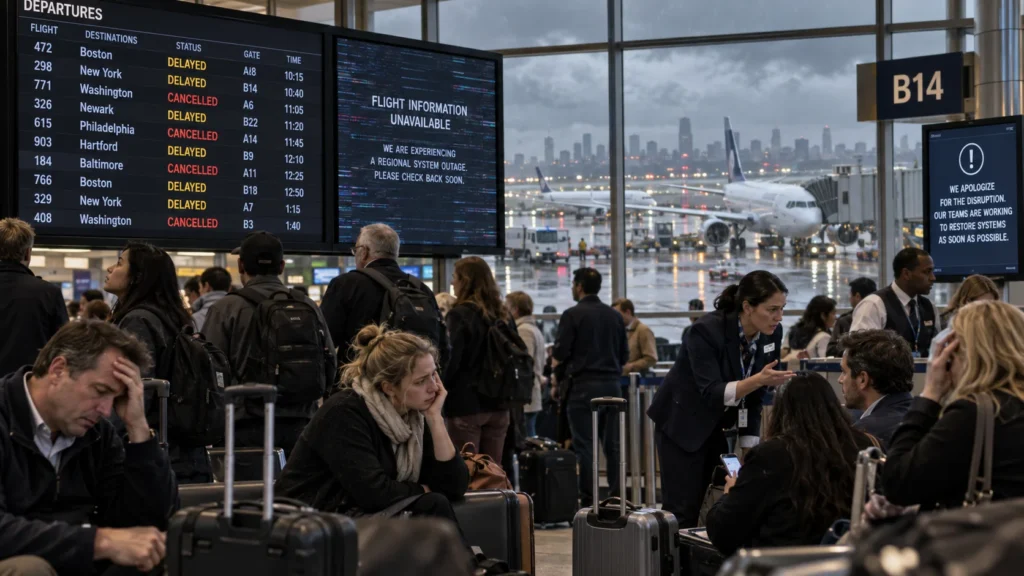
Travelers navigating major airports across the Northeastern United States face extensive travel disruptions following an unexpected telecommunications system failure that halted commercial air traffic across key travel hubs. Official notices from the Federal Aviation Administration (FAA) confirmed that widespread ground stops were implemented across several primary airports, including Newark Liberty International Airport, John F. Kennedy International Airport, LaGuardia Airport, Philadelphia International Airport, and Teterboro Airport.
The region-wide grounding affected thousands of domestic and international passengers, leading to extensive flight delays, diversions, and cancellations during a peak period of international travel. While civil aviation authorities eventually lifted the ground stops, administrative statements warn that flight schedules will experience lingering operational delays as airlines work to restore normal flight flows.
Primary Telecommunications Failure Triggers Air Traffic Management Pauses
The operational disruption originated from a telecommunications failure within regional air traffic control infrastructure serving the Philadelphia Terminal Radar Approach Control (TRACON) facility. Official updates from aviation authorities indicate that the facility lost its primary communications circuit, which is crucial for managing approach and departure pathways across multiple major East Coast airports.
Under standard safety protocols, secondary backup systems are designed to seamlessly maintain air traffic communication. However, official statements confirmed that a secondary fiber-optic cable in New Jersey had been accidentally severed during construction work along rail infrastructure, rendering the redundant network temporarily unavailable.
This simultaneous double-system disruption forced air traffic controllers to issue immediate ground stops to preserve complete air traffic safety. Ground stops were first issued for Newark, Philadelphia, and Teterboro, before expanding to include John F. Kennedy International and LaGuardia. Flights bound for these airports were held on the ground at their origin points across North America, while incoming airborne flights were diverted to secondary regional airfields.
Passenger Impacts and Airline Travel Waivers
The multi-hour shutdown created a significant ripple effect across the broader transport grid. Commercial operations at Newark Liberty International Airport experienced prolonged pauses, with commercial arrivals coming to a standstill for several consecutive hours. Airline operators serving the Northeast aviation corridor reported hundreds of canceled flights and thousands of delays across their domestic and international networks.
Major air carriers issued flexible customer policies in response to the operational disruptions:
Travel Flexibility Waivers: Commercial airlines introduced temporary fee waivers, allowing affected passengers to reschedule flights or modify travel itineraries without paying standard change fees or fare differences.
Flight Status Monitoring: Aviation officials and airlines strongly advise all ticketed passengers to verify flight status online before traveling to departure terminals.
Airport Diversion Support: Transport networks and airport service teams worked to accommodate diverted aircraft and facilitate passenger transfers at secondary regional facilities.
Major hub carriers operating out of Newark and Philadelphia deployed additional customer service support to assist stranded passengers, arrange alternative flights, and process rebooking requests following the restoration of air traffic control communications.
Infrastructure Maintenance and Operational Recovery Efforts
Technical repair crews from telecommunication providers and transportation agencies were deployed immediately to locate and repair the severed fiber-optic link. Official communications from federal transportation leadership confirmed that the damaged telecommunication lines were successfully repaired, allowing air traffic control systems to resume standard operation and gradually lift flight holds.
Federal aviation administration leadership highlighted the critical importance of modernizing regional telecommunications design to enhance network redundancy and prevent future single-point failures. Ongoing investments in aviation infrastructure and air traffic control modernization remain a central priority for federal authorities working to ensure long-term travel reliability.
As commercial flight schedules gradually normalize, airport management authorities advise international and domestic travelers to remain patient. Travelers passing through Northeast hubs are encouraged to maintain flexible schedules, keep airline notifications active, and allow extra transit time when navigating major airport terminals.
For more travel news like this, keep reading Global Travel Wire