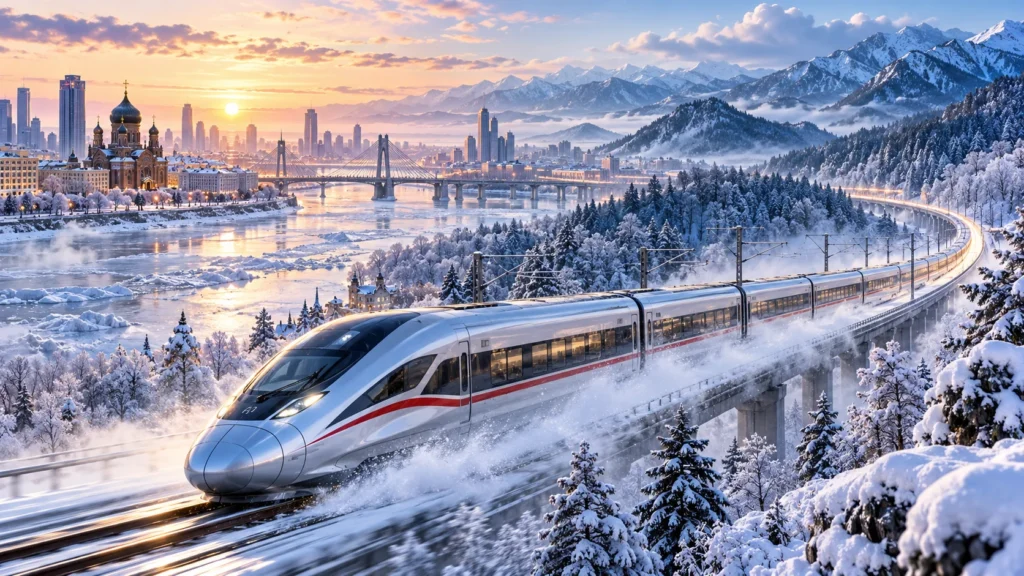
Official announcements from railway authorities confirm the official commencement of passenger service on China’s northernmost bullet train corridor, the Harbin-Yichun high-speed railway in Heilongjiang Province. Designed to operate at speeds of up to 250 kilometers per hour, the 318-kilometer line drastically reduces transit time between the provincial capital of Harbin and the forest city of Yichun from approximately seven hours down to under two hours.
The launch of the high-speed line marks a major engineering milestone, establishing a direct, high-capacity transport link into the central forest zones of Northeast China. By integrating remote regions into the national high-speed rail framework, public authorities aim to expand the regional visitor economy, facilitate winter recreation, and accelerate economic revitalization throughout the northeastern provinces.
Engineering Breakthroughs in Alpine Permafrost Conditions
Building China’s northernmost high-speed railway required addressing complex geological and climatic challenges. Running through deep alpine permafrost zones, the rail alignment features extensive elevated bridge structures that account for 72 percent of the line’s total length. Elevated bridging minimizes direct contact with sensitive frost-heave soils, preserving structural stability during seasonal freeze-thaw cycles.
To ensure operational safety, the entire rolling stock, signaling equipment, and power supply systems are engineered to withstand extreme winter conditions dropping to minus 40 degrees Celsius. Key engineering solutions deployed on the route include:
Freeze-Resistant Catenary Systems: Specially designed overhead power lines preventing ice buildup during heavy snowstorms.
Cold-Proof Electric Multiple Unit (EMU) Trains: Rolling stock equipped with thermal insulation, low-temperature lithium batteries, and automated de-icing mechanisms.
Permafrost Monitoring Networks: Integrated ground sensors tracking track stability and thermal shifts in real time to prevent structural displacement.
Prior to public operation, comprehensive cold-weather inspection trains capable of speeds up to 385 kilometers per hour completed rigorous trial runs across the nine station stops. The line includes Yichun West Station, which currently holds the distinction of being the highest-latitude high-speed railway station built in the country.
Boosting Regional Winter Tourism and Eco-Tourism Access
The opening of the Harbin-Yichun railway significantly enhances accessibility for domestic and international travelers seeking nature, wilderness, and seasonal winter sports experiences. Harbin, widely recognized for its annual ice and snow festivals, now serves as an immediate gateway for tourists venturing further north into Yichun’s vast forest reserves.
In initial service phases, railway authorities scheduled up to 38 EMU train runs daily, including cross-line connections to major metropolitan centers. Travel time from Yichun to Beijing Chaoyang Station has been compressed to under nine hours, while direct connections to the coastal hub of Dalian require just over six hours.
The dramatic reduction in travel times supports a new operational model linking high-speed rail mobility with health wellness retreats, forest eco-tourism, and winter sports destinations. Yichun’s high forest coverage, pristine air quality, and seasonal snow resources are expected to attract steady visitor volumes year-round, transforming ecological assets into sustainable economic opportunities for local mountain communities.
Economic Revitalization across Northeast China
Beyond immediate visitor growth, public planning reports highlight the railway’s strategic role in expanding Harbin’s regional economic influence. Connecting intermediate cities such as Suihua to the high-speed grid facilitates the efficient movement of people, goods, and capital across Heilongjiang Province.
Historically known as an industrial powerhouse driven by heavy manufacturing and natural resource extraction, the province continues to diversify its economic foundation. High-speed rail infrastructure acts as a primary catalyst for this transition, stimulating service sectors, hospitality investment, and regional supply chain integration.
By overcoming traditional transport bottlenecks in cold-climate regions, the Harbin-Yichun line establishes a reliable model for high-speed transport in extreme environments, proving that sustainable infrastructure development can unlock economic vitality in northern frontier destinations.
For more travel news like this, keep reading Global Travel Wire