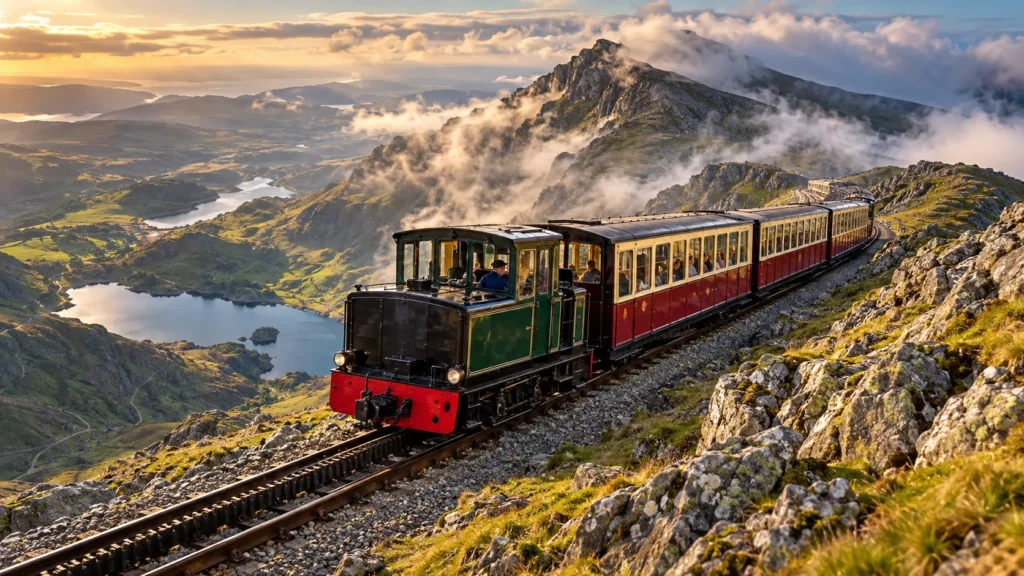
On April 6, 1896, the inaugural opening day of Britain’s only public rack-and-pinion mountain railway ended in immediate tragedy. Operating up the steep, mist-shrouded slopes of Yr Wyddfa, highest peak in Wales, a steam locomotive completed its initial ascent before suffering a mechanical failure during its second return run down the mountain. The engine lost engagement with the central rack system, derailed, and plunged down the hillside, leading to one fatality. In dense fog, a second ascending train subsequently collided with the wreckage on the tracks.
Despite an incident that could have permanently halted rail development on the 3,560-foot mountain, engineers conducted a thorough parliamentary inquiry, redesigned the safety mechanisms, and reopened the track. Modern operations now celebrate 130 years of continuous commercial service, transporting millions of global travelers along a scenic 4.7-mile alpine route from Llanberis to the summit.
Engineering Safety: Simple Innovations That Reshaped Mountain Travel
The official parliamentary investigation into the 1896 opening-day crash concluded that the newly laid trackbed had unseated under the combined weight of the heavy locomotive, saturated ground, and melting snowpack. Rather than attempting to alter the rugged mountain landscape, engineers implemented straightforward, robust technical adjustments that fundamentally redefined mountain transport safety standards.
To prevent future derailments and rack disengagements, the railway introduced key modifications:
Weight Reduction Directives: Regulations cut maximum allowable train weights by 50 percent, introducing lighter passenger carriages to reduce stress on the trackbed.
Speed Restrictions: Strict operational speed limits were established across all sections of the route, enforcing controlled descents.
Mechanical Gripper Systems: Engineers installed custom safety grippers fitted directly beneath locomotives and carriages. These steel brackets encase the central rail flange, physically preventing train wheels from lifting off the rack.
Uncoupled Train Operations: Locomotives were positioned purely to push carriages uphill rather than pulling them, allowing gravity to keep vehicles securely aligned during ascent and descent without mechanical coupling risks.
The line successfully reopened to the lower station in September 1896 and reached the summit in 1897. Over the following century, the railway has maintained an exceptional safety record, operating smoothly through generations of visitor arrivals with minimal interruptions outside of wartime pauses.
Sustainable Infrastructure and Modern Heritage Investment
Marking its 130th anniversary milestone, the operator of the Snowdon Mountain Railway has introduced strategic infrastructure enhancements across its route within Eryri National Park. These capital investments focus on blending digital automation with heritage preservation to ensure efficient visitor management.
Key operational updates deployed along the historic line include:
Automated Solar Points Systems: Upgraded tracking points at intermediate stations such as Clogwyn now utilize fully automated, solar-powered switching systems, replacing manual operations while reducing environmental impact in high-altitude zones.
Heritage Space Integration: Revamped arrivals facilities at Llanberis feature curated historical displays, original administrative artifacts, and WWII radar testing archives.
Summit Visitor Management: Expanded point-of-sale infrastructure at peak facilities streamlines visitor throughput during high-density summer travel periods.
Balancing Visitor Access with Environmental Preservation
As the railway marks 130 years of operation, the primary challenge facing Yr Wyddfa has shifted from engineering reliability to sustainable destination management. The peak attracts hundreds of thousands of hikers, rail passengers, and outdoor enthusiasts annually, placing significant demand on local transport networks and delicate mountain ecosystems.
National park authorities and regional partners are addressing capacity challenges through sustainable mobility frameworks, such as integrated electric bus networks that transport visitors from surrounding communities to trailhead locations without increasing private vehicle congestion.
By combining historic mechanical reliability with modern sustainable transit solutions, the Snowdon Mountain Railway remains a central pillar of Welsh heritage tourism, offering travelers an accessible and safe journey through the heart of the Eryri National Park landscape.
For more travel news like this, keep reading Global Travel Wire