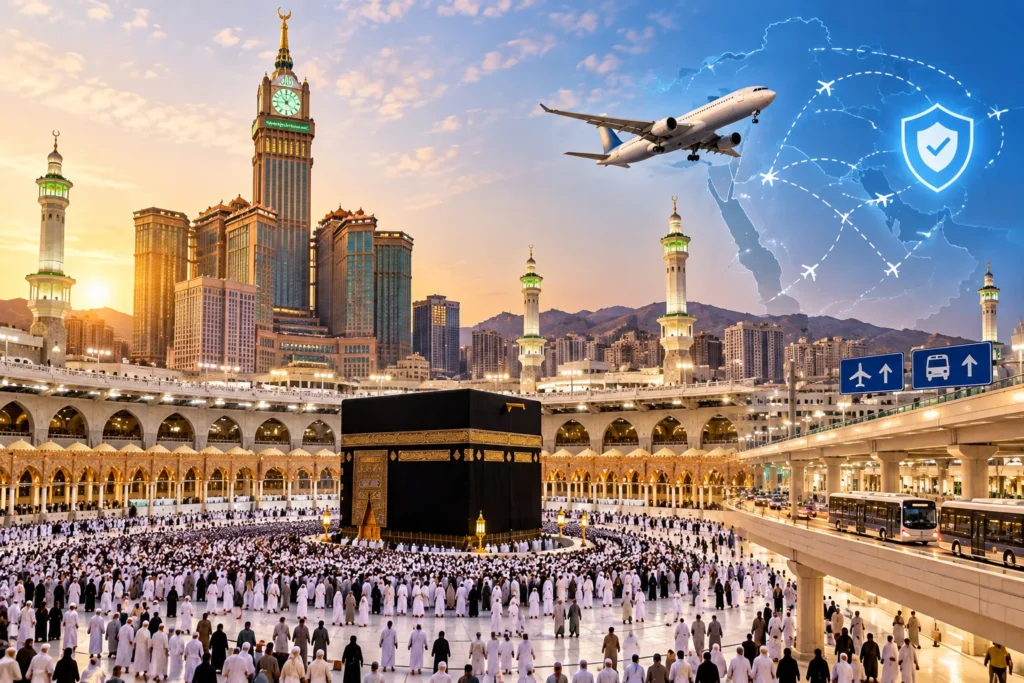
The management of international religious travel and aviation logistics across the Arabian Peninsula has entered a phase of reinforced vigilance as public authorities coordinate comprehensive civil protection measures. Following cross-border aerial escalations and subsequent defense interceptions, official state bodies in the Kingdom of Saudi Arabia, alongside national civil defense directorates and international civil aviation regulators, have initiated updated protocols to safeguard foreign visitors, pilgrims, and commercial aviation infrastructure.
As one of the world’s foremost destinations for faith-based travel, Saudi Arabia welcomes millions of overseas travelers annually for pilgrimage and heritage exploration. Ensuring the continuous protection of visitor corridors, particularly those leading toward the holy sanctuaries of Mecca and Medina, remains the foundational objective of the Kingdom’s civil safety and tourism administration.
Civil Protection Response in Mecca and Medina Regions
Official releases issued by the Saudi General Directorate of Civil Defence confirmed operational responses across the administrative regions of Mecca and Medina following the mid-air interception of ballistic targets. Defense authorities reported that falling shrapnel and intercepted debris landed in open zones, including Wadi Mughamas situated on the perimeter of Mecca. Civil emergency teams secured the impact zones swiftly, preventing casualties or structural damage to public heritage zones and sacred monuments.
Regional pilgrimage boards and municipal authorities continue to maintain full operational readiness across both holy cities. Comprehensive perimeter security networks, coordinated real-time airspace monitoring, and emergency response infrastructure around religious monuments operate continuously to insulate travelers from exterior disruptions. Ground monitoring confirmed that transportation networks, local hospitality operations, and religious sites inside the central precincts of Mecca and Medina remain fully accessible, supported by ongoing guidance from municipal safety officers.
Operational Adjustments at King Khalid International Airport
Air passenger gateways serve as the primary conduit for international visitor arrivals into the Kingdom. Following temporary disruptions to commercial operations at King Khalid International Airport in Riyadh, civil aviation authorities have moved to restore orderly passenger traffic under reconfigured terminal arrangements.
Under the operational plan announced by airport management authorities, scheduled movements are being consolidated across dedicated processing hubs. Terminal 1 has been assigned to facilitate domestic air travel, connecting regional urban centers and provincial visitor destinations. Concurrently, Terminal 2 has been designated for international operations conducted by national carriers, allowing inbound and outbound international passengers to transit under focused security protocols.
Aviation authorities are maintaining enhanced surveillance, rigorous apron inspections, and continuous coordination with regional air traffic control centers. These measures ensure that scheduled departures and arrivals proceed with strict adherence to international civil aviation security benchmarks, prioritizing passenger wellbeing during transitional operational phases.
International Travel Advisories and Passenger Protection
The shifting security dynamics across regional flight paths have prompted civil aviation regulators and international flag carriers to activate passenger assistance guidelines. Official advisories issued by civil aviation operators, including Air India, provide flexible ticketing provisions for passengers traveling to and from Saudi destinations.
Under official carrier notifications, passengers holding confirmed bookings on routes impacted by operational reviews have been granted options for full fare refunds without cancellation penalties. Airlines are also offering one-time complimentary rebooking alternatives to alternative operational hubs within the Kingdom, enabling religious travelers and business visitors to adjust itineraries without administrative friction.
Consular services and international travel departments advise citizens to monitor official government flight schedules, maintain active communication with ticketed airlines, and register itineraries with national foreign affairs portals before embarking on transit through regional hubs.
Safeguarding National Infrastructure and Coastal Gateways
Beyond passenger terminals, coastal industrial cities and maritime facilities in western and eastern provinces remain critical to regional logistics and maritime tourism. State announcements indicate that public security services and defense units maintain heightened monitoring around strategic industrial centers, including Yanbu and Rabigh on the Red Sea coast, as well as eastern commercial centers in Dammam and southern transit corridors in Najran.
Preserving the stability of western coastal transit zones remains essential for the broader leisure and maritime travel sector. Coastal expansion programs along the Red Sea coast, cruise terminal operations, and cross-border maritime links rely on open, secure international waters. Public agencies continue to coordinate maritime border security to protect coastal shipping routes, regional port installations, and passenger ferry connections across the southern navigation basins.
Sustaining Tourism Confidence Through Institutional Coordination
The resilience of the international travel sector depends on institutional transparency, rapid civil defense deployment, and verified governmental communication. Saudi authorities, working alongside regional security partners, continue to prioritize the integrity of civilian skies, metropolitan centers, and historical pilgrimage sites.
By deploying responsive terminal management strategies, transparent passenger rebooking frameworks, and vigilant public defense systems, authorities aim to uphold traveler confidence across all entry points. For international pilgrims and visitors planning journeys to the Kingdom, official administrative channels advise ongoing consultation of verified ministerial statements and civil aviation bulletins to ensure seamless and secure passage throughout their travels.
For more travel news like this, keep reading Global Travel Wire