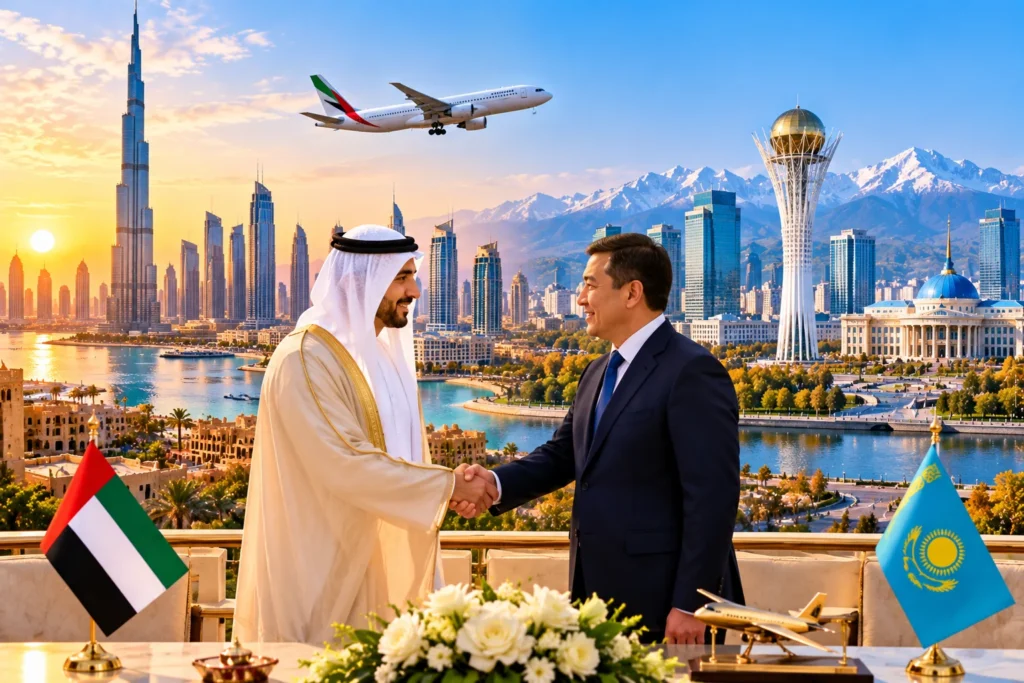
Diplomatic and economic cooperation between the United Arab Emirates and the Republic of Kazakhstan has marked a festive milestone following official congratulatory communications delivered by the highest levels of Emirati governance on the occasion of Kazakhstan’s Republic Day. Official announcements issued through sovereign state channels confirmed that President His Highness Sheikh Mohamed bin Zayed Al Nahyan conveyed warm greetings to President Kassym-Jomart Tokayev, extending sincere wishes for national prosperity, institutional advancement, and sustained bilateral solidarity.
Complementary messages of goodwill were dispatched by His Highness Sheikh Mohammed bin Rashid Al Maktoum, Vice President, Prime Minister, and Ruler of Dubai, alongside His Highness Sheikh Mansour bin Zayed Al Nahyan, Vice President, Deputy Prime Minister, and Chairman of the Presidential Court. The official greetings were addressed to President Tokayev, Prime Minister Oljas Bektenov, and national executive leadership in Astana. These top-tier diplomatic exchanges highlight an increasingly comprehensive strategic partnership, wherein civil aviation connectivity, reciprocal investment, and visitor exchanges have emerged as prominent drivers of international economic cooperation.
Bilateral Visa Exemptions and Expanding Aviation Networks
Over recent years, the relationship between Abu Dhabi and Astana has developed into a productive partnership bridging the Arabian Gulf with Central Asia. A cornerstone of this expansion has been the progressive dismantling of travel barriers. Under bilateral agreements established between respective foreign ministries, citizens of both nations enjoy visa-free entry privileges for designated short-term stays, facilitating smooth movement for leisure holidaymakers, commercial delegations, and cultural exchange tours.
Aviation authorities from both countries have systematically expanded direct flight corridors to meet growing passenger demand. National flag carriers and low-cost airlines, including Emirates, flydubai, Air Arabia, Air Astana, and FlyArystan, operate high-frequency direct scheduled flights connecting major Emirati hubs—including Dubai, Abu Dhabi, and Sharjah—with key Kazakh metropolitan centers such as Almaty, Astana, and Shymkent.
These point-to-point air links not only serve point-to-point passenger flows, but also position the United Arab Emirates as a premier global transit gateway for Central Asian travelers voyaging toward Europe, Africa, and North America. In turn, Kazakhstan serves as an inviting trans-Eurasian gateway for Middle Eastern travelers venturing into Central Asia’s vast landscapes, mountainous alpine reserves, and ancient Silk Road cultural hubs.
Surging Visitor Arrivals and Diverse Travel Segments
Official tourism releases and statistical publications from tourism promotion agencies reflect a steady surge in bilateral travel numbers. Inbound tourism statistics from Kazakhstan’s national tourism bodies confirm substantial annual increases in visitors arriving from the Gulf region, with travelers from the United Arab Emirates forming a primary contingent.
The diversity of tourism offerings plays a significant role in this mutual attraction. Travelers from the United Arab Emirates increasingly seek Kazakhstan’s temperate mountain escapes, ecotourism lodges, and winter sports destinations, such as the Shymbulak ski resort in Almaty, alongside the pristine wilderness of the Burabay National Nature Park and Charyn Canyon. The availability of family-oriented mountain retreats, cooler seasonal climates, and rich nomadic heritage appeals directly to regional holidaymakers seeking nature-based escapes.
Conversely, the Emirates remains an attractive year-round leisure and shopping destination for Kazakh tourists. From metropolitan cultural landmarks like the Louvre Abu Dhabi and Dubai’s world-renowned retail and architectural attractions to coastal beach resorts in Ras Al Khaimah and Fujairah, outbound Kazakh travelers represent an important, high-spending visitor segment across the UAE’s hospitality sector.
Fostering Cross-Border Tourism Investment and Infrastructure
The strong rapport celebrated on Republic Day also reflects shared economic interests in sustainable tourism development and infrastructure investment. Sovereign wealth funds, private investment consortiums, and hospitality management groups from the United Arab Emirates continue to explore large-scale development projects across Central Asia. These initiatives encompass modern urban hotel developments, transport infrastructure modernization, and high-end eco-lodges designed to preserve surrounding natural landscapes while generating local employment.
Joint governmental commissions and bilateral business councils regularly evaluate policies to align private-sector hospitality investment with national sustainability objectives. By sharing expertise in modern destination branding, convention bureau management, and international exhibitions, the United Arab Emirates and Kazakhstan are actively shaping an integrated tourism environment.
These collaborative efforts extend to business and conference tourism. Both Astana and Dubai have positioned themselves as international event hubs, hosting prominent intergovernmental summits, trade expos, and sustainability forums. Coordinated civil aviation schedules and streamlined border processing ensure that conference delegates and corporate teams can navigate between the two regions efficiently.
Strategic Outlook for Central Asian Travel Growth
As diplomatic declarations reinforce mutual trust and shared strategic priorities, the long-term outlook for cross-regional travel remains exceptionally strong. Tourism ministries continue to organize joint promotional roadshows, familiarization tours for travel agencies, and cooperative marketing campaigns highlighting regional culinary traditions, outdoor adventures, and cultural landmarks.
The enduring relationship celebrated on Kazakhstan’s Republic Day serves as an operational catalyst, ensuring that commercial aviation networks, hospitality partnerships, and leisure corridors continue to flourish. With modern airports, open visa access, and expanding flight frequencies linking the Gulf to the heart of Eurasia, the ongoing cooperation between the United Arab Emirates and Kazakhstan provides an enduring framework for sustainable economic growth and cultural exchange across the global visitor economy.
For more travel news like this, keep reading Global Travel Wire