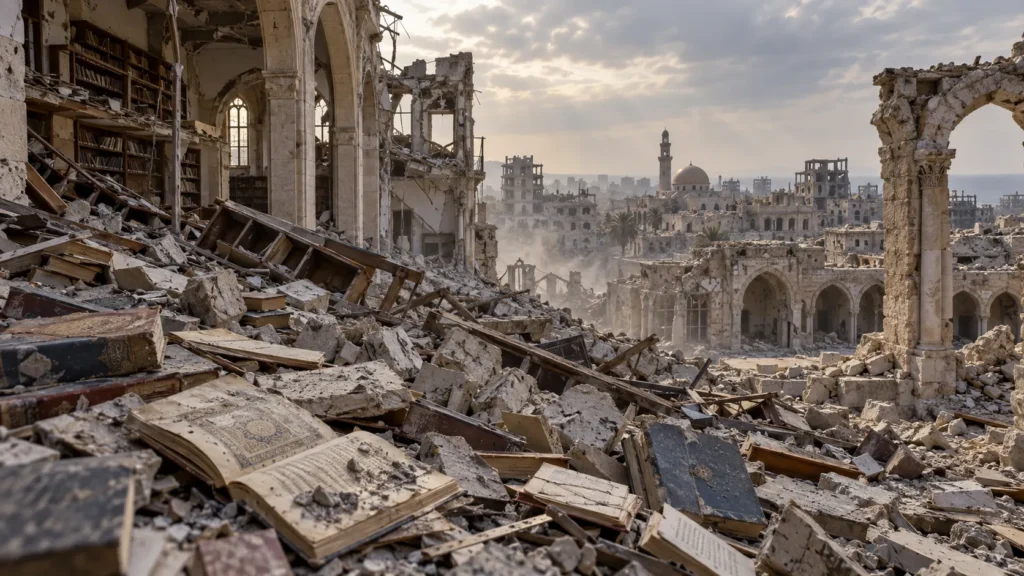
The protection of cultural assets, academic foundations, and historic civil infrastructure has emerged as an urgent priority for global destination planners following recent air operations across educational facilities in Gaza City. Emergency departments and civil defense authorities reported that an aerial strike targeting administrative and university buildings resulted in multiple fatalities and left several individuals injured, with medical teams at local treatment complexes receiving casualties directly from campus premises.
Official communiqués from education authorities and ministry representatives highlighted that academic staff and students were present during the incident. Ministry statements emphasized that the educational landscape has experienced acute infrastructure devastation, with approximately 95 percent of higher education properties reporting structural damage or operational disruption. Beyond the immediate humanitarian toll, global cultural agencies and tourism bodies observe that the destruction of scholarly centers, archival libraries, and academic complexes strikes at the core of regional cultural tourism, wiping out resources essential for historic preservation and scholarly exchange.
Academic Institutions as Anchors of Heritage Tourism and Documentation
In historical regions throughout the Levant, universities and research institutions serve as vital repositories for regional tourism development and archaeology. Academic departments document centuries-old cross-cultural exchange, train field curators, restore classical artifacts, and catalog heritage trails that draw international researchers and cultural travelers.
When university campuses suffer physical strikes, the resulting loss extends far beyond physical brickwork. Historic documentation, manuscript archives, and specialized research facilities that support museums and antiquities authorities are severely degraded. Statements by official United Nations cultural monitors observe that academic centers are integral to sustaining living heritage and training the custodial professionals needed to welcome future educational expeditions and cultural tourism delegations.
The devastation of academic centers directly impairs the capacity of local tourism boards and antiquity departments to maintain preservation registries, protect ancient trade hubs, and design conservation strategies for future international visitor corridors.
Severe Repercussions for Historic Assets and Destination Recovery
The ongoing crisis across the Gaza Strip has inflicted unprecedented damage on the region’s ancient built heritage, severely curtailing future prospects for tourism-led economic recovery. Official damage and risk assessments conducted by Palestinian antiquities authorities in partnership with cultural preservation organizations have documented that hundreds of culturally significant sites have sustained severe or moderate structural damage.
Centuries of Mediterranean, Byzantine, Roman, and Islamic architectural heritage are threatened. Landmark locations that formed the bedrock of regional educational and cultural tourism—including ancient pilgrimage routes, Roman-era necropolises, historic coastal port foundations, and foundational places of worship—have suffered extensive physical impairment.
Official declarations from the United Nations Educational, Scientific and Cultural Organization (UNESCO) have repeatedly emphasized that cultural property is protected under international legal conventions during armed conflict. Cultural monitors underline that historical monuments, places of worship, libraries, and museums are irreplaceable communal assets. When these structures are damaged, destination communities forfeit the educational and economic dividends generated by cultural tourism, creating generational gaps in historical continuity and community regeneration.
Broader Economic Strains on Middle East Tourism Flows
The compounding destruction of historic urban fabric and academic infrastructure reverberates throughout the wider regional travel market. Statistical releases from the United Nations World Tourism Organization (UN Tourism) indicate that geopolitical instability across the Eastern Mediterranean continues to exert downward pressure on consumer confidence and cross-border itinerary bookings.
While international travel globally has demonstrated post-pandemic resilience, regional visitor arrivals across affected corridors experience elevated sensitivity to security alerts. Transcontinental itineraries that historically bundled cultural heritage sites across Jordan, Egypt, and neighboring territories have experienced cancellations, revised schedules, and heightened aviation insurance premiums.
Official tourism ministry releases from neighboring destinations confirm that while core coastal and desert resort hubs retain baseline visitor traffic, cultural exploration circuits and religious pilgrimage corridors face pronounced hesitation from long-haul source markets. The erosion of shared educational and cultural networks discourages multi-destination travel programs, limiting the regional distribution of international visitor expenditure.
International Frameworks for Heritage Rehabilitation
Restoring the viability of cultural tourism in post-conflict environments relies entirely on adherence to international heritage protection conventions. Cultural preservation bodies consistently advocate for the implementation of the 1954 Hague Convention for the Protection of Cultural Property in the Event of Armed Conflict, which explicitly prohibits targeting educational, artistic, and historic monuments.
International tourism authorities stress that post-crisis destination recovery requires meticulous baseline documentation, stabilization of fragile ruins, and substantial multilateral capital investment to rebuild educational infrastructure. Restoring academic institutions is widely viewed by tourism economists as a mandatory first step toward training local guides, curating archaeological museums, and establishing the foundational safety standards required to welcome international delegations back to historical transit corridors.
As emergency agencies manage the immediate civilian impacts of recent campus strikes, global cultural institutions maintain that safeguarding academic centers and historic landmarks remains non-negotiable. Protecting these sacred and educational spaces is fundamental to upholding cultural memory, supporting regional stability, and preserving the shared human history that underpins global cultural tourism.
For more travel news like this, keep reading Global Travel Wire