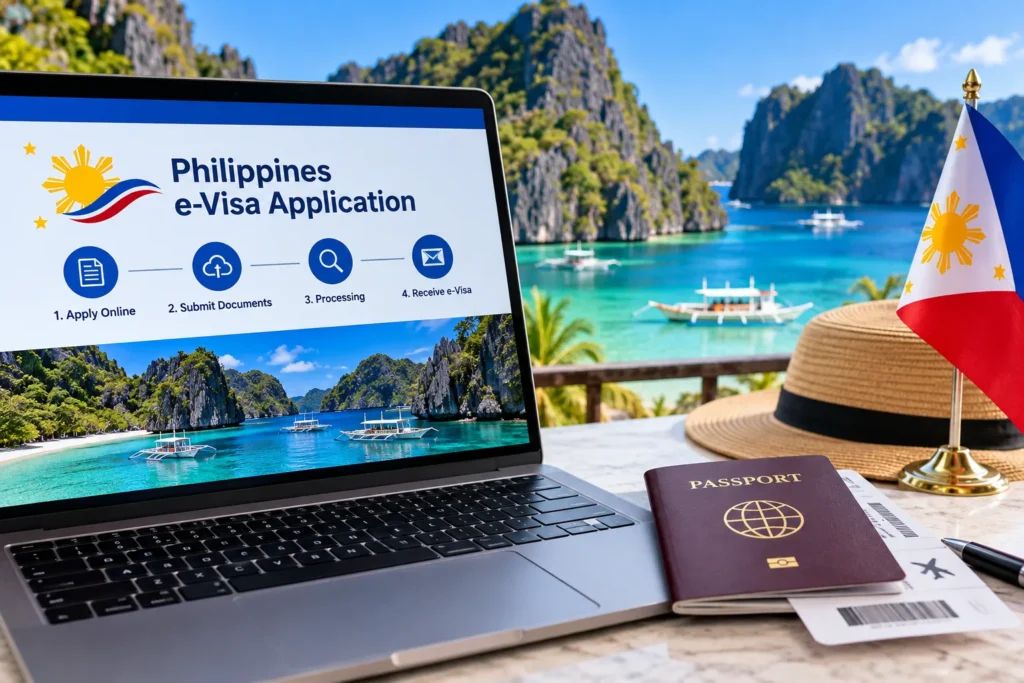
The Philippines has expanded digital travel access through its new e-Visa service at the Philippine Consulate General in Dubai. The initiative officially began on 26 October 2026, following a two-week testing period.
The launch allows eligible foreign residents in Dubai and the Northern Emirates to submit Philippine visa applications electronically. Applicants can also receive approved visas digitally without obtaining traditional passport stickers.
The development marks another step towards modernising Philippine immigration services and improving international visitor convenience. It also supports the country’s broader ambitions to strengthen tourism, business travel and international connectivity.
For UAE-based travellers, the system introduces an alternative application process while retaining existing consular visa services.
The Philippines continues to expand travel accessibility through electronic immigration systems and targeted visa-free policies for important international markets.
Digital Visa Services Cover Tourism, Business and Medical Travel
The new electronic platform supports temporary visitor visas under the Philippine 9(a) immigration category.
Eligible travellers can apply for tourism, business meetings, professional training, conferences, medical treatment, workshops and seminars.
Applicants submit their required information and supporting documents through the electronic application system. Following approval, authorities issue the visa electronically.
This arrangement reduces the need for traditional passport-sticker issuance and creates a more convenient application experience.
However, electronic processing does not guarantee visa approval or admission into the Philippines. Immigration authorities retain responsibility for assessing travellers against applicable entry requirements.
The Philippine Consulate General will continue offering conventional sticker visas alongside the digital service.
Importantly, electronic visas carry different conditions from traditional visas.
Travellers cannot extend or convert e-Visas issued through the new platform. Eligible holders of conventional sticker visas may pursue extensions or conversions under applicable immigration procedures.
Visitors should therefore select the visa category that matches their intended activities and length of stay.
Philippines e-Visa Fees and Processing Times Confirmed
The Dubai consulate has maintained its existing visa fee structure following the electronic service launch.
A single-entry visa costs AED 260, while a six-month multiple-entry visa costs AED 420.
Applicants seeking a one-year multiple-entry visa must pay AED 580.
The announced processing period for single-entry applications ranges from seven to 12 working days.
Multiple-entry applications require approximately 15 to 40 working days, depending on the assessment process.
Travellers should allow sufficient time before purchasing non-refundable travel arrangements.
Processing periods represent administrative estimates rather than guaranteed approval deadlines.
Applicants should also check the electronic portal for applicable payment arrangements and any additional processing charges.
Mandatory eTravel Registration Remains Essential
Receiving an approved electronic visa does not complete every Philippine entry requirement.
Travellers must also register through the government’s eTravel system or the eGovPH mobile application when applicable.
Authorities require registration within 72 hours before arrival in the Philippines.
The registration process is free and supports digital collection of passenger arrival information.
Visitors should prepare their passport details, flight information and accommodation arrangements before completing registration.
Airlines and immigration officials may request proof of registration during travel.
The digital visa initiative primarily benefits UAE residents whose nationalities require advance permission to enter the Philippines.
Nationality, rather than UAE residency alone, determines whether a traveller qualifies for visa-free entry.
Indian Travellers Benefit From Expanded Visa-Free Entry
The Philippines has also introduced significant entry concessions for Indian passport holders.
Since 8 June 2025, eligible Indian nationals have qualified for 14-day visa-free visits for tourism or business.
The government does not permit extensions or conversion of this visa-free admission into another immigration category.
Indian travellers must carry passports valid for at least six months beyond their intended stay.
They must also provide confirmed accommodation, evidence of sufficient financial resources and return or onward travel tickets.
Furthermore, Indian nationals holding valid visas or residence permits from specified countries enjoy additional privileges.
These countries include the United States, Japan, Australia, Canada, Singapore, the United Kingdom and Schengen member states.
Eligible Indian visitors can enter the Philippines without a visa for up to 30 days.
Both arrangements permit entry through Philippine international ports, subject to immigration clearance.
However, travellers seeking employment, education or longer-term residence must obtain appropriate immigration authorisation.
These policies strengthen the Philippines’ appeal among Indian holidaymakers and business visitors.
Philippines Expands Visa-Free Access for Chinese Tourists
The Philippines introduced another important visitor entry reform on 16 January 2026.
Under the policy, eligible Chinese nationals can enter without a visa for up to 14 days.
The arrangement covers tourism and short-term business visits.
Unlike the broader Indian visa-free arrangements, this particular Chinese entry privilege applies only through two airports.
These are Ninoy Aquino International Airport in Manila and Mactan-Cebu International Airport.
Visitors must satisfy passport validity, accommodation, onward travel and immigration clearance requirements.
The 14-day admission period cannot be extended or converted into another immigration status.
The airport restriction makes advance itinerary planning particularly important for Chinese travellers.
Digital Immigration Reform Supports Philippine Tourism Growth
The Dubai e-Visa launch highlights the Philippines’ continuing efforts to improve international visitor accessibility.
Electronic applications can simplify travel preparations for tourists, conference participants and eligible business visitors.
Meanwhile, visa-free arrangements for Indian and Chinese nationals reduce entry barriers across major Asian outbound markets.
These initiatives may help Philippine destinations attract additional visitors to Manila, Cebu, Palawan, Boracay and other established tourism centres.
Hotels, airlines, tour operators and destination businesses could benefit as easier travel procedures support international trip planning.
However, improved immigration access alone does not guarantee higher tourist arrivals.
Air connectivity, competitive travel costs, destination infrastructure and visitor experiences will remain important growth factors.
The latest digital initiative nevertheless strengthens the country’s framework for more convenient international travel.
For eligible UAE residents, the Philippines e-Visa introduces a practical alternative to conventional applications while supporting the country’s long-term tourism development ambitions.