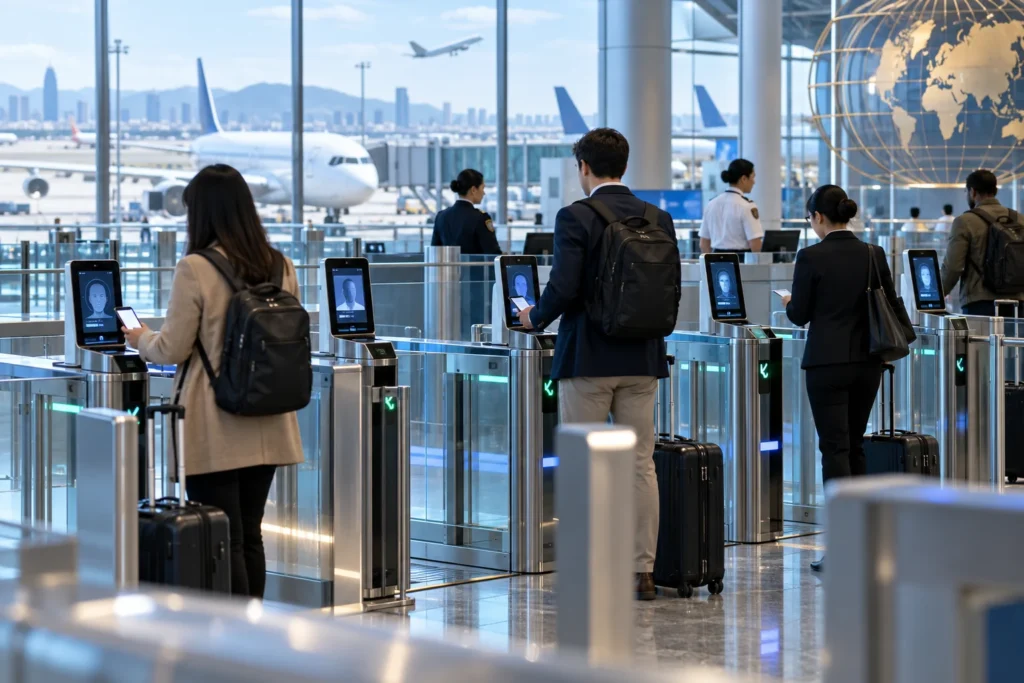
Aviation regulatory authorities and international border protection agencies continue to expand the deployment of digital travel credentials across international terminals and domestic transport checkpoints. Official public guidance issued by civil aviation governing bodies, transport security departments, and immigration ministries shows an accelerating move toward digitized verification. The declared public objective focuses on easing passenger processing bottlenecks, shortening terminal dwell times, and strengthening security verifications ahead of expected global passenger increases. However, the rapid rollout of computerized passenger tokens and automated facial biometric matching is generating substantial debate among public policy officials, legal authorities, and consumer travel advocates regarding personal data privacy, administrative transparency, and practical operational effectiveness.
Upstream Border Verification and Technical Standards
The push toward digitized documentation is anchored by formal standards developed through the International Civil Aviation Organization. Global civil aviation protocols outline specifications for digital travel credentials that allow passenger identity verification to occur upstream, well before an individual arrives at an airport terminal. Under these international parameters, identity data traditionally embedded in physical electronic passports is converted into verified digital certificates that can be stored securely on mobile operating devices or transmitted directly to sovereign border systems.
International aviation management releases emphasize that shifting document auditing upstream allows border agencies and air carriers to pre-clear passenger eligibility. Under this structure, encrypted verification tokens confirm admissibility before departure, enabling carriers to replace paper boarding cards and multiple physical passport checks with automated facial biometric matching. Terminal operators tout this process as a modern contactless system, where an individual’s facial biometric serves as a single validation token at baggage check-in points, central security checkpoints, and aircraft boarding gates.
Border management agencies, including United States Customs and Border Protection and the Transportation Security Administration, highlight national security advantages in their administrative filings. Public agency statements explain that automated biometric matching accurately confirms passenger identity while reducing manual document fraud. With global passenger numbers expanding steadily across international networks, regulatory bodies state that automated identity processing is vital for managing infrastructure capacity without causing extreme checkpoint delays.
Jurisdictional Handoffs and Consumer Privacy Concerns
Despite the operational benefits outlined in official public agency announcements, digital identity systems present complex jurisdictional and administrative privacy questions. Travelers moving through modern transit hubs navigate multiple legal jurisdictions over the course of a single journey. Inside public terminal lobbies, travelers are protected by municipal privacy statutes and constitutional rights. Once individuals enter federal screening lanes, administrative regulations take precedence. During international boarding and transit through sovereign foreign airspace, regulatory frameworks shift again, ending with the sovereign border authority of the arrival nation.
Public interest groups, privacy specialists, and statutory researchers emphasize that this fragmented framework complicates genuine consent. Because privacy protections and data-retention mandates change across borders and operational checkpoints, determining how personal biometric data is stored, handled, and shared remains a significant challenge. Federal regulatory policies governing domestic airport facial recognition mandate that matching systems delete passenger facial imagery within twelve hours of verification. Nevertheless, legal observers point out that the transmission of personal credentials across private airline computer networks raises unresolved questions regarding data security and statutory oversight.
Concerns also extend to administrative device inspections at international ports of entry. Border customs agencies maintain statutory authority to conduct administrative searches of mobile electronics at official entry points without judicial warrants. If travel credentials and primary identity verifications are housed solely within a personal mobile device, temporary device detention or technical failure can place travelers in difficult administrative situations.
The Physical Credential Mandate and Operational Redundancy
A central reality emphasized in official civil aviation agency updates is that digital systems do not currently replace traditional travel documents. The Transportation Security Administration explicitly mandates that all passengers carry physical government-issued identity cards or passports, regardless of whether they enroll in digital wallet programs or mobile identity pilots.
The ongoing necessity for physical credentials highlights the lack of universal technical harmonization among international aviation gateways. While major metropolitan hubs have installed automated camera systems and electronic readers, smaller regional terminals frequently lack the necessary scanning hardware. Furthermore, practical operational disruptions, such as depleted device batteries, hardware malfunctions, app connectivity errors, or network outages, can abruptly halt automated processing lanes.
Public policy guidelines published by transportation agencies emphasize that traveler participation in biometric screening programs remains entirely voluntary for domestic passengers. Official agency policies specify that individuals who decline automated facial scanning have the legal right to present standard physical credentials without receiving punitive secondary screening or being placed into alternative administrative queues. Despite these public assurances, traveler advocacy organizations continue to push for clearer terminal signage and consistent field training, citing reports that passengers often perceive biometric lines as mandatory rather than optional.
Legislative Scrutiny and Future Border Infrastructure Policy
The balance between passenger convenience and civil protections has reached legislative assemblies. Lawmakers have introduced formal statutory proposals aimed at regulating federal biometric expansion, mandating conspicuous opt-out notifications, and strictly limiting the long-term archiving of traveler biometric metrics. Airline industry groups and airport management councils have raised concerns that severe restrictions on automated screening could lead to terminal congestion, lengthened queues, and increased operational costs.
As civil aviation departments and sovereign border entities advance pilot programs into standard operational procedures, the balance between digitized efficiency and passenger rights remains under active review. The future of global airport identity verification will depend on transparent administrative rulemaking, standardized international protocols, and strict legal safeguards to ensure that traveler autonomy and data privacy are preserved.
For more travel news like this, keep reading Global Travel Wire