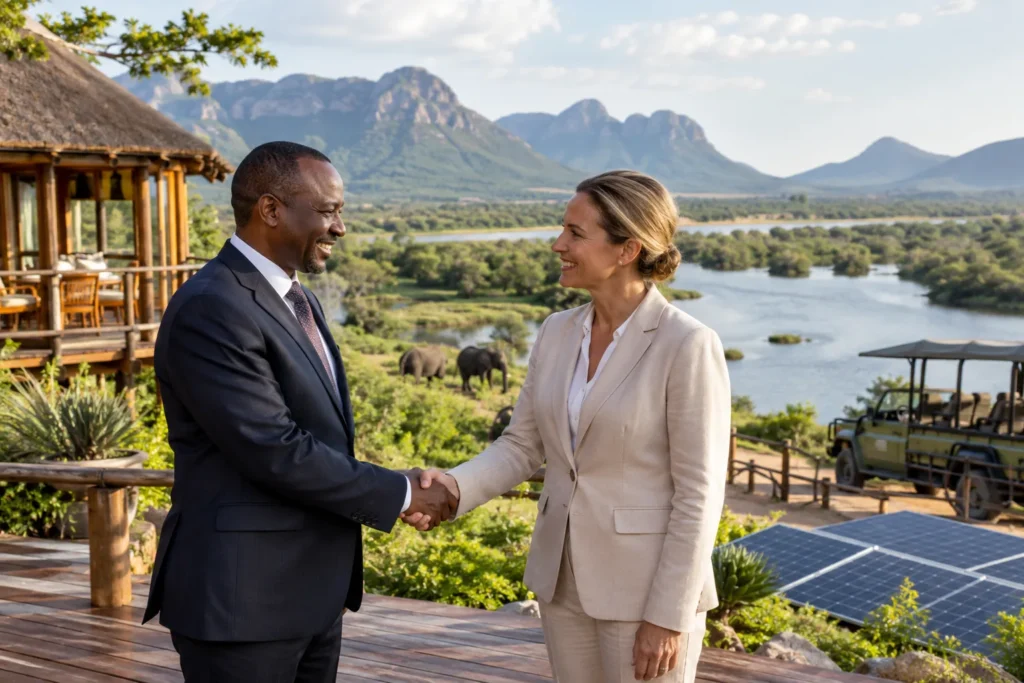
Official state announcements from the Office of the President in Georgetown confirm that the Co-operative Republic of Guyana has formally accepted the credentials of His Excellency Muhannad Sulaiman Al Naqbi as Ambassador of the United Arab Emirates. During the diplomatic presentation ceremony held at the State House, His Excellency President Dr. Mohamed Irfaan Ali reaffirmed the government’s commitment to providing comprehensive institutional support to facilitate this mission, emphasizing the shared objective of expanding bilateral relations across primary economic and development sectors.
Diplomatic representatives conveyed fraternal greetings from the highest leadership of the United Arab Emirates, including His Highness Sheikh Mohamed bin Zayed Al Nahyan, President of the UAE; His Highness Sheikh Mohammed bin Rashid Al Maktoum, Vice President, Prime Minister and Ruler of Dubai; and His Highness Sheikh Mansour bin Zayed Al Nahyan, Vice President, Deputy Prime Minister and Chairman of the Presidential Court. Both governments underscored that strengthening formal ties establishes a critical framework for expanding cooperative investment, sustainable economic diversification, and technical knowledge exchange.
Bilateral Cooperation Accelerates Sustainable Destination Development
As Guyana continues to experience rapid economic modernization, the national administration has prioritized sustainable tourism as a central pillar of economic diversification. Government policy directives emphasize that strategic international partnerships play an essential role in financing eco-friendly infrastructure, expanding regional aviation connectivity, and elevating the nation’s profile as a premier low-impact travel destination.
Official statements issued by the Ministry of Tourism, Industry and Commerce highlight that cross-border cooperation with global commercial hubs offers valuable avenues for joint ventures in hospitality management, air service expansion, and sustainable infrastructure development. The United Arab Emirates, globally recognized for international aviation networks, modern hospitality operations, and advanced transport infrastructure, presents valuable opportunities for institutional collaboration with Guyana’s emerging travel economy.
Public sector planning agencies emphasize that attracting foreign direct investment into specialized conservation tourism aligns directly with national climate priorities. Official development guidelines mandate that tourism development must safeguard local ecosystems while creating sustainable employment opportunities across urban, rural, and interior indigenous communities.
Historic Growth Recorded Across International Visitor Arrivals
The strengthening of diplomatic ties coincides with record-breaking performance benchmarks documented across the national tourism sector. Official statistics published by the Guyana Tourism Authority and the Department of Public Information confirm that the country registered an all-time record of 453,489 international visitor arrivals over the full annual cycle, representing an increase of twenty-two percent over the preceding operational period.
This upward trajectory established the country as the fastest-growing destination in regional tourism benchmarks compiled by the Caribbean Tourism Organization, which reported an overall arrival expansion of 23.8 percent during comparative monitoring periods. When measured against pre-pandemic baselines, the destination recorded an arrival recovery rate exceeding forty-five percent, placing it among the most resilient travel markets in the wider hemisphere.
Official monthly reporting highlights that performance gains have continued across current administrative quarters, with preliminary tracking recording more than 271,000 international visitors arriving through mid-year monitoring points. State tourism authorities are actively pursuing an operational target to surpass 500,000 annual visitor arrivals by the conclusion of the operating year, supported by expanded commercial flight routes, competitive airfares, and heightened interest in specialized biodiversity expeditions.
North American travelers continue to form a prominent segment of incoming traffic, led by the United States and Canada, alongside substantial arrivals from Caribbean neighbors, Europe, and Latin America. Government analysts attribute these gains to sustained diaspora engagement, expanding commercial travel linked to national industrial growth, and targeted promotional campaigns spotlighting natural attractions.
Conservation Frameworks and Heritage Stewardship
At the core of the country’s travel offering is an intact tropical forest cover encompassing over eighty-seven percent of national landmass, representing more than 18.4 million hectares of untouched forest canopy. Official environmental data released under the national Low Carbon Development Strategy highlights that these territories host extraordinary biological diversity, including more than 800 recorded bird species, 225 mammal varieties, and extensive protected freshwater river basins.
State preservation guidelines concentrate traveler distribution around globally recognized natural assets, including the 226-meter single-drop Kaieteur Falls within the Potaro corridor, the protected rainforest reserve of Iwokrama, and the expansive ecosystems of the Rupununi Savannahs. Public initiatives work closely with more than fifty community-operated indigenous eco-lodges, ensuring that tourism revenue flows directly into local educational facilities, health clinics, and conservation programs.
By pairing sovereign preservation policies with expanded international diplomatic engagement, national authorities aim to position the country at the forefront of global green tourism. The formal accreditation of foreign diplomatic leadership in Georgetown reinforces this developmental trajectory, establishing an institutional bridge to channel sustainable investment into community-led lodging, eco-transport infrastructure, and cultural heritage preservation.
Government ministers continue to affirm that responsible economic expansion requires balancing high-value visitor growth with uncompromising environmental protection. As bilateral talks progress into functional working groups, official public agencies project that cooperative initiatives will strengthen sustainable hospitality, open new global source markets, and showcase how conservation-first destination management can drive national prosperity.
For more travel news like this, keep reading Global Travel Wire