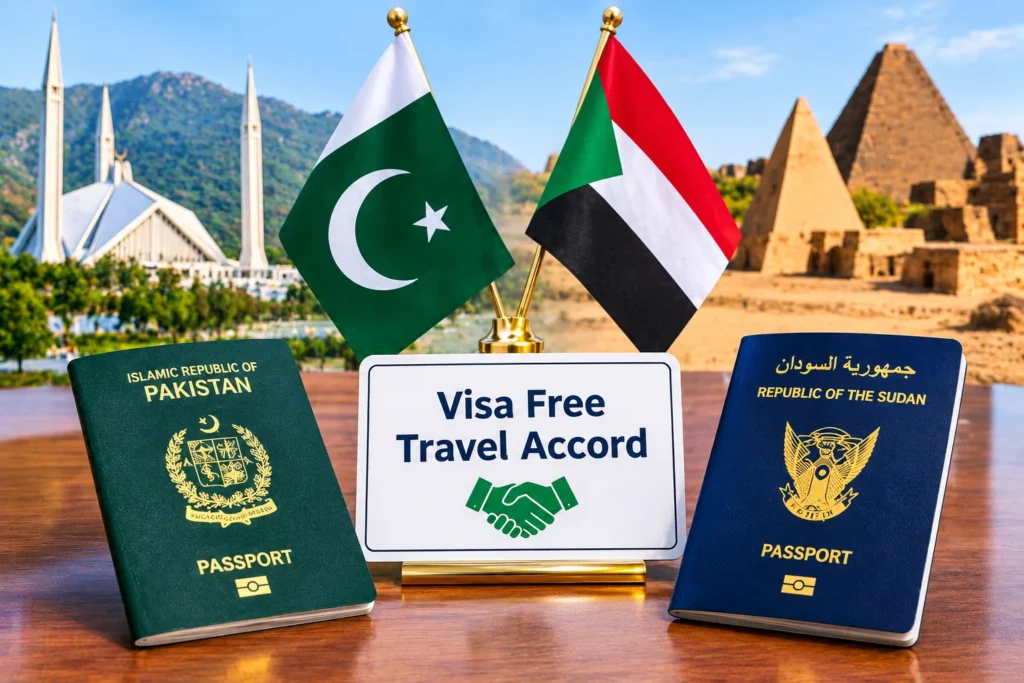
The governments of Pakistan and the Republic of the Sudan have formally signed an international bilateral accord granting mutual visa-free travel privileges for holders of valid official and diplomatic passports. The milestone diplomatic pact was ratified in Islamabad following high-level bilateral discussions between Pakistan’s Minister for Interior, Mohsin Naqvi, and the Sudanese Minister of Interior, Lieutenant General Babiker Samra Mustafa Ali.
The official agreement eliminates consular visa application requirements for civil servants, state envoys, and diplomatic delegations moving between both nations. Ministry statements confirm that the treaty is designed to eliminate bureaucratic hurdles, accelerate state-level exchanges, and establish a foundation for expanded bilateral cooperation, including trade missions, institutional development, medical travel, and cultural exchange programs.
Bilateral Mobility Accord and Administrative Facilitation
Under the terms established in the signed protocol, representatives carrying accredited diplomatic and official passports from either nation can transit, enter, and conduct official state visits without securing pre-entry visas or paying consular application fees. The Ministry of Interior noted that this agreement reflects a mutual commitment to modernizing travel procedures and deepening long-standing intergovernmental linkages.
The bilateral discussions also focused on improving civil registration systems and addressing family visa situations, including resolving residency documentation for Sudanese nationals residing in Pakistan. Furthermore, Pakistan offered technical assistance and institutional support in civil database management through the National Database and Registration Authority (NADRA), alongside capacity-building programs and specialized police training.
In addition to administrative travel facilitation, both delegations addressed access to healthcare services, with official assurances provided regarding streamlined assistance for foreign nationals visiting Pakistan for specialized medical care.
Expanding Pakistan’s Global Visa Exemption Framework
The signing of the mutual exemption treaty with Sudan aligns with Pakistan’s wider foreign policy directive to broaden diplomatic connectivity across Africa, the Middle East, Europe, and the Americas. Official passport holders from Pakistan currently enjoy reciprocal visa-free or visa-on-arrival entry under bilateral treaties signed with numerous global partners.
Across Europe, similar reciprocal agreements exist with several sovereign nations, including Denmark, Finland, Germany, the Czech Republic, Norway, and the Netherlands. Beyond the European continent, Pakistan maintains operational diplomatic visa-free agreements with countries such as South Korea, Brazil, Mexico, and Argentina. By incorporating Sudan into this established international mobility network, both governments aim to foster regular institutional communication, technical exchange missions, and state-level delegations without the delays associated with conventional visa processing.
Defense and Security Cooperation Highlighting Regional Stability
The signing of the mobility protocol was preceded by official defense talks between the visiting Sudanese delegation and Pakistani military leadership. Field Marshal Asim Munir, Chief of the Army Staff, received Lieutenant General Babiker Samra Mustafa Ali to evaluate shared defense priorities and regional security developments.
Official releases from Inter-Services Public Relations confirmed that the discussions focused on evolving global security dynamics, counterterrorism coordination, and avenues for mutual security collaboration. Both leaderships underscored the importance of institutional stability and security alignment, which serve as foundational pillars for peaceful cross-border mobility, commercial partnerships, and sustained regional reconstruction.
Tourism Infrastructure and Long-Term Visitor Mobility
While the immediate application of the newly ratified treaty focuses on official government personnel, diplomatic accords of this nature frequently serve as catalysts for broader public visa liberalization and tourism industry growth. International tourism boards and economic analysts emphasize that streamlining travel for state officials typically paves the way for simplified commercial business visas, electronic visa enhancements, and eventual leisure tourism promotion between partner states.
Both Pakistan and Sudan possess cultural, archaeological, and religious heritage assets that appeal to niche travelers, historians, and eco-tourists. Sudan’s Nubian archaeological reserves, including the ancient pyramids of Meroë along the Nile, represent key historical attractions in Northeast Africa. Similarly, Pakistan has invested heavily in modernizing its visitor infrastructure, promoting Gandhara Buddhist heritage corridors, Mughal historical monuments, and high-altitude trekking across the Karakoram and Himalayan ranges.
By removing initial travel barriers for official delegations, both administrations create predictable avenues for bilateral trade missions, tourism delegations, and civil aviation discussions. As regional governments continue to modernize consular frameworks and digital visa systems, the Pakistan-Sudan travel agreement reinforces how bilateral diplomacy actively facilitates cross-border connection, economic development, and international travel security.
For more travel news like this, keep reading Global Travel Wire