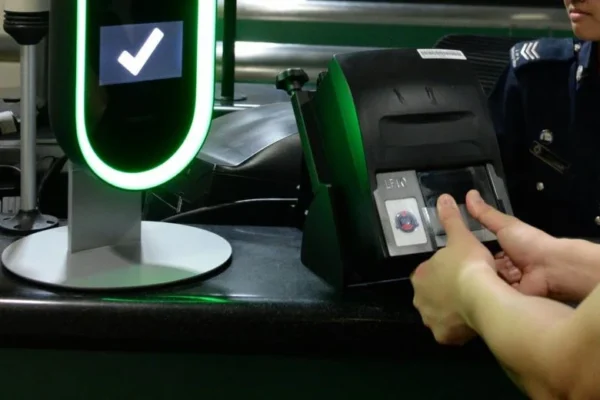
At Singapore’s Changi Airport, eligible passengers can clear immigration using facial and iris recognition without taking out their passports. Dubai International Airport also uses biometrics for eligible travellers at immigration, while Japan’s Face Express system applies facial recognition to selected departure procedures. The technology can save time at individual checkpoints, but where it works depends on the airport, airline and stage of the journey.
Singapore speeds up immigration clearance at Changi
Singapore’s Immigration & Checkpoints Authority introduced passport-free clearance across Changi’s four terminals in 2024. Singapore residents can use the process on arrival and departure, while eligible foreign visitors can use it when departing. Foreign visitors generally still need to present a passport when entering Singapore.
The authority reported that the average clearance time fell from 25 seconds to 10 seconds per traveller after the rollout. That figure measures processing at immigration. Queue lengths, security screening and boarding can still affect how much time passengers need at the airport.
For visitors flying home from Changi, the practical change comes at departure immigration. An eligible traveller can use an automated lane without presenting a passport at that checkpoint. Airlines and authorities at the destination may still ask to see the document, so travellers need to carry it throughout the journey.
Dubai uses Smart Gates for eligible travellers
At Dubai International Airport, registered and eligible passengers can use Smart Gates for immigration clearance. The gates use biometric recognition to match travellers to their records. For passengers who qualify, this can reduce the time spent presenting documents at an immigration counter.
Eligibility matters for families and groups because members of the same party may have different options at the checkpoint. A traveller who can use a Smart Gate may be accompanied by someone who needs staff assistance or a conventional document check. Dubai’s facilities also vary by checkpoint, so the experience depends on where passengers enter or leave the airport.
Japan applies facial recognition to departure procedures
At participating facilities at Narita and Haneda, Japan’s Face Express service lets eligible passengers register their face at the start of the departure process. They can then use facial recognition at supported points, which may include baggage drop, entry to security screening and boarding. Availability depends on the airport, terminal and airline.
The benefit is most apparent when several stages of the same departure support the service. A passenger who has enrolled can move from a compatible bag-drop station to a participating boarding gate with fewer repeat document checks. Immigration has its own procedures, and travellers still need to carry the documents required for their destination.
Europe explores digital travel credentials
In Europe, work on digital travel credentials addresses a different part of the journey. A digital credential can allow a traveller to share verified information from a passport electronically before reaching a border checkpoint. That could give border authorities more time to review certain details before arrival.
The European Commission has proposed a framework for digital travel credentials and a common application for submitting them. The work remains distinct from a Schengen-wide system that travellers can already use in place of a passport. Estonia’s experience with digital public services provides context for the initiative, while the acceptance of travel credentials depends on the rules and systems used at each border.
What biometric checks mean for international travellers
For a traveller connecting through several airports, the most useful question is which part of the itinerary supports biometrics. A facial scan may be sufficient at a departure gate in Japan, while an immigration officer at the destination may need to inspect the traveller’s passport. Even within one airport, airline check-in, immigration and boarding can follow different procedures.
Travellers can check whether their airline and terminal support biometric processing, whether enrolment is required and whether everyone in their party is eligible. Those who prefer a manual check or need assistance can ask airport staff which lane to use.
Singapore, Dubai and Japan show where biometrics can make an immediate difference. At Changi and Dubai, the main opportunity is faster immigration clearance for eligible passengers. In Japan, it is fewer repeated document checks during supported departure procedures. For now, the most reliable way to plan is to carry the required travel documents and use biometric checks wherever they are available along the route.
For more travel news like this, keep reading Global Travel Wire