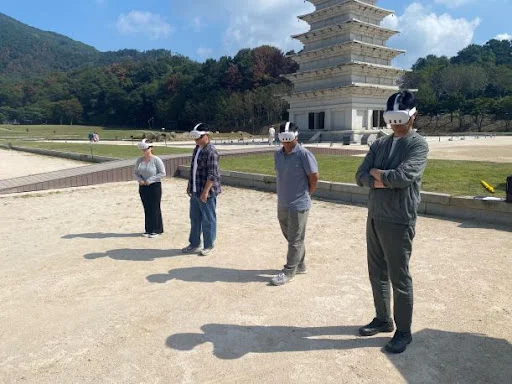
South Korea has tested an outdoor headset experience that reconstructs parts of the historic Mireuksa temple complex in Iksan. The November 2026 demonstration placed digital buildings over the surviving archaeological landscape, helping visitors picture the site at its former scale. Heritage authorities aim to begin regular operation in the first half of 2027, following an evaluation.
In Algeria, Tunisia and Morocco, separate digital heritage tourism initiatives are helping travellers explore museums and monuments before leaving home. Their tools range from virtual museum walks and a 3D amphitheatre tour to maps that can help travellers identify potential stops.
South Korea Recreates a Nine-Storey Pagoda at Mireuksa
The Korea Heritage Service and the National Research Institute of Cultural Heritage held the demonstration on 6 November. Visitors wore headsets that showed a reconstructed nine-storey wooden pagoda, along with gates and corridors. Digital guidance explained the evidence behind the reconstruction, giving visitors a way to connect the surviving remains with the original complex.
The trial builds on tablet-based augmented reality introduced at Mireuksa in 2024. The November session was a demonstration, with regular headset access planned for 2027. Travellers choosing dates around the experience can use the planned opening window as a starting point and check availability once operating details are published.
South Korea also maintains an online heritage catalogue with more than 28,000 3D assets. The catalogue includes photographs, drawings and research reports that can help visitors understand a site before arriving. Some files are available for direct download, while specialist material requires an application.
Algeria Opens Six Regional Museums to Virtual Visitors
Six museums in eastern Algeria feature in a digitisation project documented by the country’s territorial planning research centre. The project covers the regional Moudjahid museum in Skikda and partner institutions in Constantine, Guelma, Jijel, Mila and El Tarf.
The team used laser scanning and photography to document museum spaces and collections. The resulting virtual experiences give visitors a way to explore Algeria’s revolutionary history across several cities. For tour planners, the previews can help identify collections that fit a particular itinerary or educational visit.
Algeria’s National Tourism Office also lists virtual experiences for destinations including Ghardaïa, Timimoun and the Palais des Raïs in Algiers. Availability varies across the directory. The entry for El Mechouar Palace in Tlemcen, for instance, lists its virtual tour as unavailable.
Tunisia Adds Historical Context to El Jem’s Roman Amphitheatre
Tunisia’s National Heritage Institute presented its completed El Jem digital project in April 2026. The experience lets online visitors explore 3D spaces within the Roman amphitheatre and learn about the design of the arena. It also explains how ancient roads connected the area and how conservation work helps protect the monument today.
For travellers planning a visit, the preview can help them decide which features to look for on site. Tunisia also publishes geographic coordinates for protected monuments through its national open-data platform. That information can help map a route, while opening hours and admission arrangements need to be checked with individual sites.
Morocco Maps Archaeological Sites and Previews Rabat Exhibitions
Morocco’s national archaeological mapping initiative includes published records for areas such as Dakhla, Essaouira, Casablanca, Asilah and the Oriental region. These records can help route planners locate sites beyond familiar city-centre attractions. Public access varies, especially where sites are fragile or lack visitor facilities.
The National Foundation of Museums offers a different experience through its online exhibition directory. The five virtual tours and exhibitions listed in the supplied material are associated with the Mohammed VI Museum of Modern and Contemporary Art in Rabat. They give prospective visitors a sense of the museum’s exhibitions and provide remote access for people who cannot visit in person.
What Digital Heritage Tools Offer Travellers
The immediate benefit is better information about what visitors can see and why it matters. A museum preview can help a tour operator choose a stop for a group. A reconstruction can help a visitor understand how a temple once stood. A map can show how several sites fit into a day’s journey.
Each tool also places different demands on the visitor. Online previews depend on usable controls and clear language options. Headset experiences depend on equipment availability, staff support and how many visitors can take part at once.
The documented projects establish what visitors can explore today and what South Korea plans to introduce in 2027. Their impact on bookings, admissions and local spending remains unmeasured. At Mireuksa, the next milestone is whether visitors can reserve the headset experience as part of a regular trip to Iksan.
For more travel news like this, keep reading Global Travel Wire