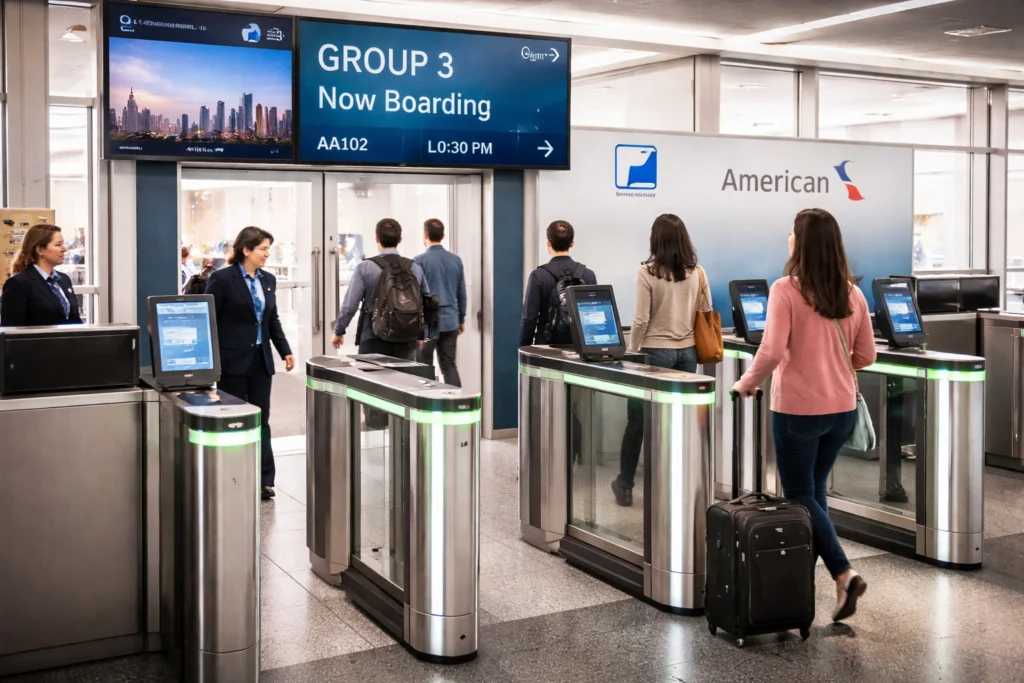
American Airlines is preparing to transform the airport experience in the United States with the launch of electronic boarding gates at Dallas Fort Worth International Airport. The new system will debut in summer 2026 inside the expanded Terminals A and C, making American the first major U.S. carrier to roll out the technology on a large scale.
The move signals a major shift in how passengers board aircraft, with faster processing, less congestion and a more seamless gate experience expected for millions of travelers using the airline’s largest hub.
For Dallas Fort Worth, already one of the busiest airports in the world, the upgrade strengthens its position as a leader in airport innovation.
A New Era of Boarding at DFW
Traditional boarding often depends on manual document checks, long queues and repeated passenger instructions at crowded gates.
American Airlines’ new electronic boarding gates aim to change that model completely.
The system will automatically validate boarding passes, guide customers through the gate process and help regulate boarding flow more efficiently. Instead of relying solely on staff to scan passes and manage queues, travelers will move through automated entry points designed for speed and clarity.
That can reduce bottlenecks at busy departures and create a more orderly boarding environment.
Why This Matters for Travelers
For passengers, boarding is one of the most stressful parts of the airport journey. Crowds gather quickly, overhead bin competition rises and delays at the gate can create frustration before the flight even begins.
The new technology addresses those pain points directly.
Travelers can expect faster movement through the gate area, clearer instructions on when to proceed and fewer pauses caused by manual processing. A smoother gate experience can also improve punctuality by helping flights depart on schedule.
For families, business travelers and tight connections, even small time savings can make a noticeable difference.
More Time for Customer Service
The system does not remove the human element. Instead, it allows airport staff to focus more on customer support rather than repetitive scanning tasks.
Gate agents may spend less time handling routine boarding actions and more time assisting passengers with seating issues, special requests, upgrades or disrupted travel plans.
That balance between automation and service is becoming increasingly important across global aviation.
When technology handles simple steps efficiently, staff can concentrate on higher-value interactions.
Why DFW Is the Perfect Launch Site
Dallas Fort Worth International Airport serves as the heart of the American Airlines network.
The airport connects domestic and international traffic across North America, Latin America, Europe and Asia. With massive daily passenger volumes, DFW offers the ideal environment to introduce technology that can scale quickly and prove value in a high-demand setting.
If the system performs well at DFW, it can become a blueprint for future deployment across the airline’s wider network.
Because so many passengers pass through Dallas Fort Worth, the visibility of the project will also be significant.
Part of a Bigger Digital Strategy
The boarding gate rollout fits into a broader modernization push by American Airlines.
The carrier has already invested in touchless security processes, mobile app enhancements, digital disruption management and wider self-service tools. It has also expanded onboard technology offerings, including improved connectivity and digital customer features.
Together, these upgrades show how airlines now compete not only on fares and routes but also on ease of travel.
Passengers increasingly value convenience from check-in to arrival.
Benefits for Airport Operations
Beyond customer experience, the new gates could improve day-to-day airport efficiency.
Faster boarding helps aircraft push back on time. Better passenger flow can reduce gate crowding during peak periods. More consistent processes also help staff manage multiple departures with fewer disruptions.
At a hub as busy as DFW, small efficiency gains repeated across hundreds of daily flights can create major network benefits.
That includes improved schedule reliability and better aircraft utilization.
What Other Airports Will Watch Closely
The aviation industry will likely monitor the DFW rollout carefully.
If successful, electronic boarding gates may become more common at major hubs across the United States. Airports and airlines worldwide continue searching for ways to process rising passenger numbers without sacrificing service quality.
Smart gate systems could become a key part of that future.
For travelers, widespread adoption would mean shorter lines, less confusion and more predictable departures.
Potential Impact on Travel Demand
Modern airport experiences can influence traveler loyalty.
Passengers who enjoy smooth journeys are more likely to rebook with the same airline or choose the same hub in the future. That matters in competitive markets where customer retention is essential.
For Dallas Fort Worth, better boarding technology can further strengthen its appeal as a preferred connection point.
Hotels, local tourism and business travel may also benefit when hub efficiency improves.
Outlook for Summer 2026
The launch of American Airlines electronic boarding gates at DFW marks more than a terminal upgrade. It represents a new direction for airport travel in the United States.
If the rollout meets expectations, American Airlines could set a new benchmark for smart boarding and passenger convenience across the industry.
For now, travelers heading through Dallas Fort Worth next summer may be among the first to experience what the future of boarding looks like.
For more travel news like this, keep reading Global Travel Wire