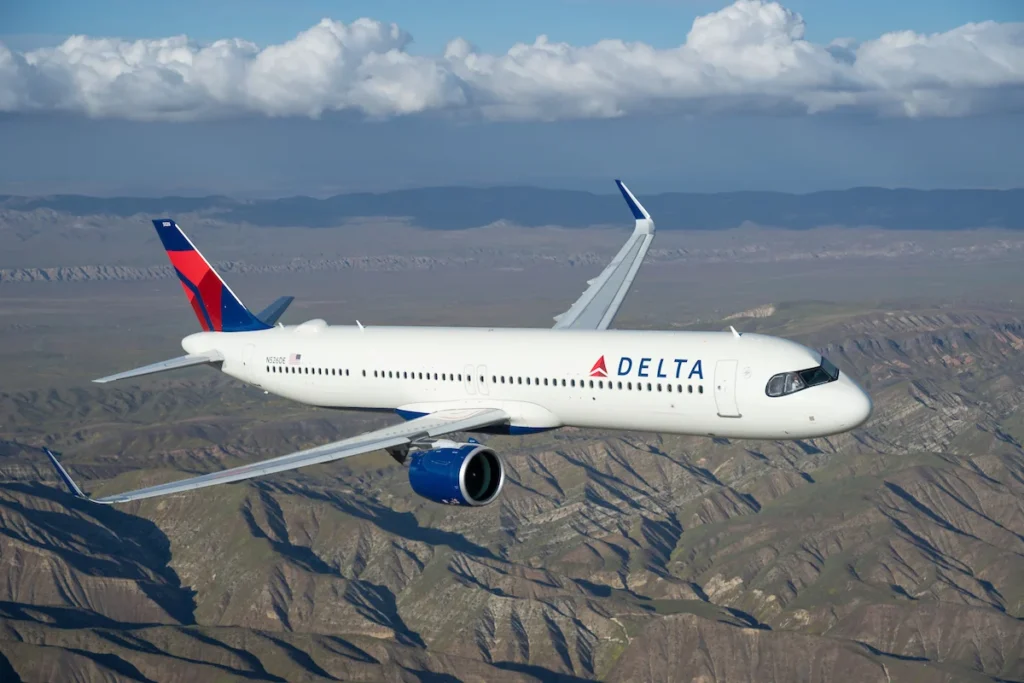
Delta Air Lines has outlined five new international services for 2027 after reporting record September-quarter adjusted revenue of US$17.6 billion. The planned routes connect American cities with destinations in Japan, the Philippines, France, Greece and Italy.
Announced in Atlanta on 9 October 2026, the results showed approximately 16% revenue growth despite broadly unchanged overall capacity. Premium passengers, corporate bookings and international markets supported the increase, while higher fuel expenses pressured profitability.
For tourism businesses, the expansion creates potential opportunities to reach American travellers through additional air connections. However, the financial results measure airline performance rather than destination visitor growth.
Five Planned Routes Broaden Tourism Access
Delta’s announced additions include Seattle–Tokyo-Narita, Los Angeles–Manila and Austin–Paris-Charles de Gaulle. The airline also plans Detroit–Athens and Boston–Venice services.
Together, these routes would widen travel options between the United States and established Asian and European destinations. They could support leisure holidays, business trips and visits to friends and relatives.
The connections also offer potential benefits for hotels, attractions, local transport providers and destination management companies. Easier access can help travel sellers develop itineraries around specific American departure markets.
Nevertheless, the supplied announcement does not detail launch dates, frequencies or aircraft assignments for each service. Travellers will need those details before coordinating flights with accommodation and onward transport.
Delta also announced extensions to selected seasonal transatlantic services, providing additional scope for travel between North America and Europe.
International Markets Strengthen Commercial Performance
Delta reported a 12% increase in international unit revenue during the September quarter. Latin America recorded the strongest regional improvement, with unit revenue rising 22%.
Transatlantic unit revenue increased 11%, highlighting stronger commercial performance across the airline’s Europe-facing network.
Across the Pacific, total revenue rose 13%, alongside an 8% increase in capacity. Additional Asian connections supported that performance.
Meanwhile, domestic unit revenue increased 16%, showing that revenue improvements extended across the airline’s American network.
These measures reflect earnings relative to capacity or total market revenue. They do not establish equivalent increases in passenger numbers.
Higher fares, changes in cabin mix and stronger seat utilisation can all influence airline revenue. Tourism stakeholders therefore need destination-level data to assess actual visitor growth.
Premium And Corporate Travel Support Demand
Premium cabin revenue increased 18%, while premium seating capacity grew 6%. Stronger yields and higher load factors contributed to the result.
Main Cabin unit revenue also rose 17%, despite a low-single-digit reduction in available seats. The figures indicate stronger revenue performance across different passenger segments.
Corporate sales increased at double-digit rates across all sectors, led by banking, technology and energy. Boston and Los Angeles delivered particularly strong results.
Delta’s corporate survey found that more than 90% of respondents expected travel to increase or remain unchanged in 2027.
That outlook may interest hotels and other businesses serving corporate travellers. However, survey expectations represent intentions and could change with economic conditions.
Higher Fuel Expenses Reduce Operating Margins
Revenue growth came alongside a substantial increase in operating costs. Adjusted fuel expenditure climbed 62% to US$4.1 billion.
The average adjusted fuel price rose 60% to US$3.61 per gallon. Meanwhile, adjusted operating expenses reached US$15.9 billion.
Non-fuel unit costs increased 7.3%, reflecting crew expenses, revenue-related costs and disruption from summer storms.
Consequently, Delta’s adjusted operating margin declined from 11.1% to 9.4%. The airline nevertheless reported adjusted operating income of US$1.7 billion.
Adjusted pre-tax income reached US$1.5 billion, while quarterly free cash flow totalled US$463 million. These results show continued cash generation despite the more demanding cost environment.
Fleet And Digital Services Support Expansion
Delta received 13 aircraft during the quarter, including Airbus A350-900, A321neo and A220-300 models. The deliveries form part of its wider fleet investment programme.
The airline is also preparing its largest Los Angeles schedule, including new and increased domestic services.
Passenger-facing investment included the rollout of Delta Concierge to SkyMiles members and continued expansion of fast, free onboard Wi-Fi.
A strategic relationship with Hyatt broadened the airline’s loyalty offering. These developments connect flight services with digital assistance and hospitality benefits.
Year-End Outlook Keeps Costs In Focus
Delta forecasts approximately 20% revenue growth for the December quarter, with planned seat growth below 2%. Its outlook includes reduced Main Cabin capacity.
The airline expects an adjusted operating margin between 7% and 9%. Its guidance assumes an all-in fuel price of approximately US$4.25 per gallon.
For tourism markets, the 2027 route plans provide the clearest opportunity for additional connectivity. Their eventual impact will depend on operating schedules, fares, passenger demand and destination spending.
For more travel news like this, keep reading Global Travel Wire