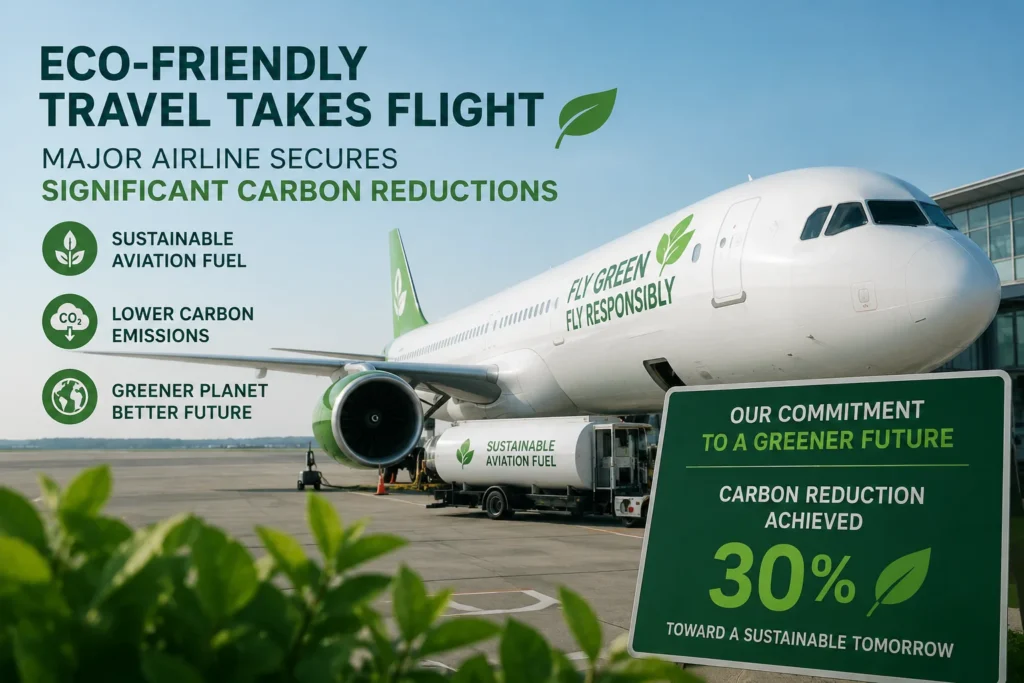
Global aviation infrastructure is undergoing a rapid transition toward ecological sustainability as passenger demands shift toward eco-conscious travel options. In a major move for the international tourism sector, British Airways has successfully finalized an expansive, multi-year sustainable aviation fuel agreement with global biofuels platform EcoCeres. This extended supply framework secures a reliable volume of low-carbon fuel through the year 2030, marking a critical step forward in the decarbonization of long-haul tourism corridors.
According to official fleet optimization logs and airline data models, the extended procurement strategy will successfully prevent approximately 198,000 metric tonnes of lifecycle carbon dioxide emissions from entering the atmosphere when compared directly to the usage of traditional, fossil-based jet fuel. To contextualize this reduction within the tourism economy, the saved emissions are equivalent to the net environmental footprint generated by transporting roughly 341,000 economy-class holidaymakers on round-trip international flights between London Heathrow and New York John F. Kennedy International Airport. By lowering the environmental impact of these primary travel pathways, the initiative provides a major boost to regional tourism boards seeking to balance international arrival volumes with stringent localized net-zero mandates.
Advanced Biofuel Technology Transforms Commercial Aviation
The modern tourism landscape relies heavily on rapid, high-capacity international transit, making the deployment of drop-in renewable fuels essential for near-term conservation goals. The sustainable aviation fuel utilized under this agreement is manufactured using 100 percent waste-based biomass feedstocks. This technical process relies heavily on reclaimed household and industrial waste, primarily used cooking oil collected from commercial hospitality sectors, effectively turning urban food waste into high-grade energy resources.
Data verified through the International Sustainability and Carbon Certification system demonstrates that this specific classification of waste-derived fuel delivers an expansive lifecycle carbon reduction of up to 94 percent compared to standard petroleum-derived aviation fuels. Because the chemical composition of hydrotreated vegetable oil and renewable synthetic kerosene mirrors conventional petroleum closely, the fuel acts as a direct, seamless substitute. It can be integrated directly into pre-existing airport fuel hydrants, regional distribution pipelines, and standard commercial aircraft engines without requiring complex mechanical retrofits or secondary logistical adjustments. For international travel markets, this technological compatibility ensures that high-volume tourist routes can reduce their carbon footprint instantly without disrupting flight schedules, decreasing passenger capacities, or altering baggage allowances.
Corporate Targets Align With Strict Government Net Zero Policies
This commercial transaction represents a major component of a larger, coordinated push by the parent organization of British Airways, the International Airlines Group, to completely overhaul its environmental output. The corporate group has established strict public metrics, targeting a baseline configuration where at least 10 percent of its total operating fuel consists of sustainable aviation fuel variants by 2030. Furthermore, the organization aims to consume a minimum of one million metric tonnes of renewable aviation fuel annually by the same deadline, serving as a stepping stone toward its ultimate statutory target of absolute net-zero carbon operations across all flights by the year 2050.
Recent global fuel distribution audits indicate that the airline group has successfully driven the market forward, utilizing approximately 15 percent of the total available global supply of certified sustainable aviation fuel over the past calendar year. Corporate compliance statements indicate that through aggressive forward-purchasing mechanisms and multi-year supply partnerships, the carrier has already firmly secured roughly 42 percent of the total renewable fuel volume required to meet its mandatory 2030 environmental thresholds.
This market expansion aligns directly with major regulatory changes occurring throughout European and British transit hubs. The United Kingdom Department for Transport has established a dedicated sustainable aviation fuel mandate designed to scale up clean energy integration systematically over the coming decades. Under this regulatory layout, fuel suppliers are legally required to ensure that sustainable aviation fuel accounts for a minimum of 2 percent of total aviation fuel supplies, with the threshold climbing steadily to reach 10 percent by 2030, and eventually hitting 22 percent by 2040.
To support the scaling up of domestic production and keep travel accessible, the state has launched a specialized 219 million pound Low Carbon Fuels Fund. This initiative provides strategic public financing over the next two fiscal years to fast-track advanced refining facilities that are closest to commercial production. By combining independent commercial supply agreements with robust state-backed funding mechanisms, the aviation sector is establishing a stable, scalable framework capable of preserving global leisure travel and international hospitality networks for future generations.
For more travel news like this, keep reading Global Travel Wire