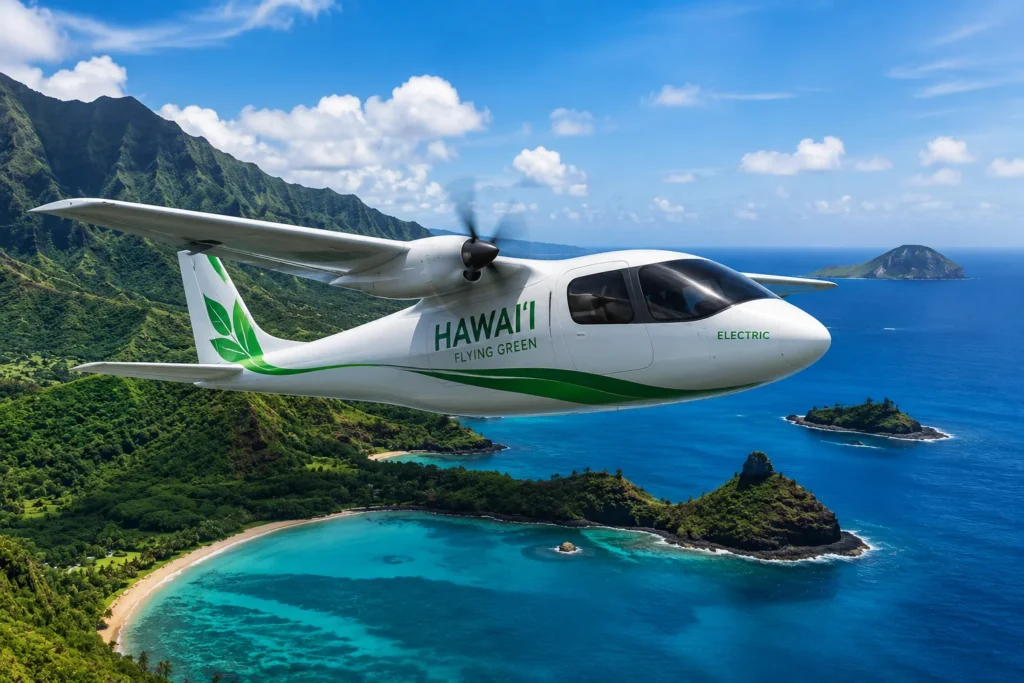
The future of sustainable tourism and regional transportation is taking flight in the skies above Hawaiʻi. In a landmark move for global aviation, Surf Air Mobility and BETA Technologies have officially launched an electric aircraft demonstration program across the Hawaiian Islands. Backed by foundational operational support from Hawaiian Airlines, this initiative marks a monumental shift toward clean energy transit. The program establishes the archipelago as a global testing ground for zero-emission commercial aviation, offering a glimpse into a future where vacationers can hop between islands with a minimal environmental footprint.
The demonstration phase, which kicked off with an official launch event at the Charles I. Elliott Maintenance and Cargo Facility at Daniel K. Inouye International Airport in Honolulu, is scheduled to run for approximately six to eight weeks. During this campaign, BETA’s state-of-the-art ALIA conventional takeoff and landing (CTOL) electric aircraft will conduct specialized flight evaluations. This data-gathering mission will analyze the operational, infrastructural, and economic viability of scaling electric air networks across the region’s unique geography.
Harvesting Real-World Data for Next-Generation Transit
For decades, the aviation sector has viewed electric flight as a long-term aspiration. This joint demonstration bridges the gap between theory and real-world commercial application. Hawaiʻi’s distinct geographical makeup—characterized by short distances between islands, high-frequency regional demand, and delicate ecosystems—makes it the absolute ideal testing environment to prove the capabilities of advanced electric air mobility.
Throughout the multi-week flight campaign, the collaboration will systematically evaluate a variety of critical performance metrics. Specialized teams will collect data on how the electric propulsion systems handle Hawaiʻi’s specific marine weather patterns, varying crosswinds, and unique microclimates. Beyond the physics of flight, the program is designed to measure real-world direct operating costs, battery degradation rates, energy consumption across representative interisland flight paths, and maintenance requirements for commercial scheduling.
Crucially, the initiative will also lay the groundwork for the physical infrastructure needed to support green aviation. The partners are assessing the regional airport network’s power grid compatibility, charging infrastructure requirements, ground handling protocols, and specialized crew safety training. By gathering these concrete data points, the program aims to establish an optimized, highly scalable framework that can eventually be replicated in tourist destinations worldwide.
Boosting Regional Economies and Protecting Island Ecosystems
The integration of electric aircraft holds profound benefits for the Hawaiian tourism sector, local communities, and the environment. Interisland aviation serves as the primary economic and social lifeline connecting the distinct cultures, workforces, and landscapes of the islands. However, traditional aviation fuel remains vulnerable to global price volatility, which directly impacts cargo transport costs and passenger airfares.
Transitioning toward localized, electric alternatives offers the dual advantage of stabilizing regional travel costs while completely eliminating tailpipe emissions over vulnerable island ecosystems and marine sanctuaries. The introduction of these ultra-quiet, highly efficient aircraft could revolutionize the way international visitors experience the islands, opening up quieter, more frequent, and highly sustainable access points for eco-conscious travelers.
Surf Air Mobility plans to fully integrate these cutting-edge BETA electric aircraft into its permanent commercial fleet in Hawaiʻi following certification by the Federal Aviation Administration (FAA). Operating through its Mokulele Airlines subsidiary—which currently stands as the state’s largest commuter air network by scheduled departures and airports served—the company possesses the robust, pre-existing operational foundation necessary to scale these new technologies rapidly.
To ensure long-term operational resilience, plans are already underway to establish a dedicated Maintenance, Repair, and Overhaul (MRO) facility within the state. Once fully certified, this hub will function as the factory-authorized service and support center for BETA aircraft in the region, fostering local high-tech job creation and securing the specialized technical infrastructure required to sustain an all-electric regional aviation ecosystem.
A Shared Vision for Sustainable Skies
This program underscores a shared commitment across the aerospace sector to protect the natural beauty that draws millions of visitors to the Pacific each year. By combining the technical manufacturing prowess of BETA, the extensive commuter networks of Surf Air Mobility, and the deep-rooted regional heritage of Hawaiian Airlines, the initiative demonstrates that cross-industry alignment is the most effective vehicle for meaningful environmental change.
As global travelers increasingly prioritize destinations and transportation providers that actively reduce their carbon footprints, Hawaiʻi’s bold leap into electric aviation positions the state at the absolute vanguard of responsible tourism. The insights harvested during these historic flight trials will not only redefine the future of interisland travel but will also serve as a blueprint for the global travel industry as it flies toward a cleaner, quieter, and more sustainable future.
For more travel news like this, keep reading Global Travel Wire