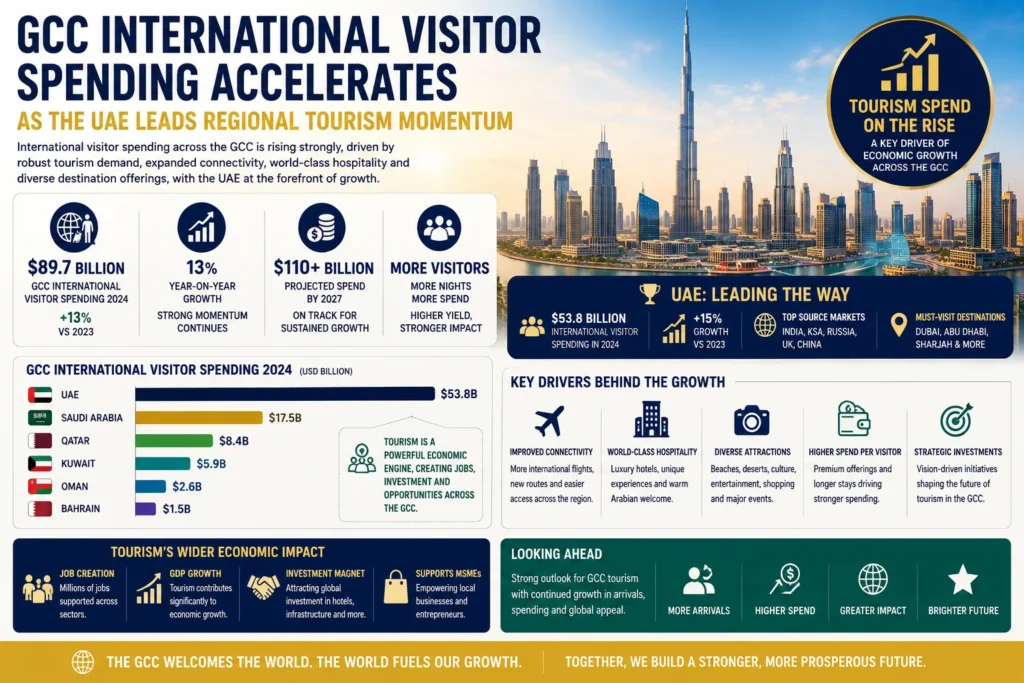
Official performance indicators confirm that the United Arab Emirates and the wider Gulf Cooperation Council region are demonstrating remarkable strength in capturing global visitor expenditure. Driven by strategic investments in hospitality infrastructure, expanded air connectivity, and targeted visa facilitation, the region has established a strong baseline that positions it among the world’s highest-yielding travel destinations.
Data published by national tourism authorities underscores a structural expansion in inbound tourism receipts. With primary destinations skewing heavily toward high-value leisure, luxury retail, and international business travel, the GCC continues to outperform several mature long-haul markets, reinforcing its status as a central anchor for international travel growth.
Exceptional Performance Base Positions UAE as a Regional Spending Engine
Official figures released by the Emirates Tourism Council show that the United Arab Emirates recorded a record performance in its national hospitality sector. The country welcomed 32.34 million hotel guests, representing a 5.2 percent year-on-year increase. Total national hotel revenues surged by 9.7 percent to reach 49.21 billion dirhams, supported by an average national occupancy rate of nearly 80 percent across more than 217,000 available rooms.
Dubai, serving as the region’s premier urban tourism hub, achieved a third consecutive record year for international arrivals. Official statistics from the Dubai Department of Economy and Tourism confirm that the emirate received 19.59 million international overnight visitors, marking a 5 percent annual rise. Hotel sector indicators demonstrated high guest spend, with Average Daily Rates increasing to 579 dirhams and Revenue per Available Room growing by 11 percent. This sustained momentum reflects the long-term effectiveness of the Dubai Economic Agenda D33, which aims to consolidate the city among the top global destinations for business and leisure.
GCC Tourism Hubs Outpace Traditional International Destinations
The broader GCC region continues to secure an expanding share of global cross-border visitor outlays. Multilateral travel data highlights that while the Middle East accounts for a moderate share of total global volume, its proportional share of global international tourism receipts is substantially higher. This trend is propelled by high average lengths of stay, premium airline network connectivity, and expanding luxury entertainment portfolios across the UAE, Saudi Arabia, and Qatar.
In contrast to the rapid spending momentum recorded across Gulf markets, traditional long-haul travel markets face shifting economic patterns. Official international travel reports indicate that visitor spending in North America and parts of Western Europe experienced plateauing growth due to currency adjustments, inflation, and shifting consumer perceptions of travel value. As a result, international hospitality groups and airline networks are increasingly prioritizing capital deployment toward high-yield GCC destinations.
Navigating Geopolitical Headwinds with Strategic Policy Resilience
While geopolitical shifts and airspace adjustments present localized operational challenges, regional tourism ministries are deploying proactive policy frameworks to maintain market stability. The Emirates Tourism Council convened multi-agency reviews to implement new action plans designed to strengthen sector preparedness, diversify tourism source markets, and support long-term industry resilience.
Strategic initiatives emphasize product diversification across eco-tourism, sports management, cultural heritage districts, and wellness travel. Furthermore, major capital developments roll forward across Ras Al Khaimah, Sharjah, and Umm Al Quwain, signaling strong public and private sector confidence in the medium-term fundamentals of the tourism economy.
A foundational pillar of the UAE’s market resilience remains its forward-thinking visa framework. The continued expansion of multi-entry tourist visas, remote work permits, and long-term residency options has effectively blurred the lines between short-term leisure visits and extended stays. This policy mix protects inbound visitor spending by attracting higher-income global citizens who remain less sensitive to short-term market fluctuations.
Strong Aviation Infrastructure and Global Economic Positioning
The GCC’s long-term competitive advantage remains anchored by world-class civil aviation infrastructure. Global aviation statistics confirm that regional carrier networks and hub airports continue to expand direct non-stop capacity connecting the Gulf with primary population centers across Asia, Europe, Africa, and the Americas.
According to international tourism development assessments, including the World Economic Forum’s Travel and Tourism Development Index, the UAE ranks first across the Middle East and North Africa region and 18th globally. Sister GCC states, including Saudi Arabia and Qatar, have also achieved significant ranking gains, reflecting widespread regulatory reforms and multi-billion-dollar investments in destination infrastructure.
As global travelers seek high-quality, secure, and seamlessly connected destinations, the GCC is well-positioned to compete directly with traditional global centers such as London, Singapore, and New York for premium travel market share. Backed by robust government commitment, modern transport links, and a clear vision for economic diversification, the region sets a high benchmark for international visitor yield and sustainable tourism growth.
For more travel news like this, keep reading Global Travel Wire