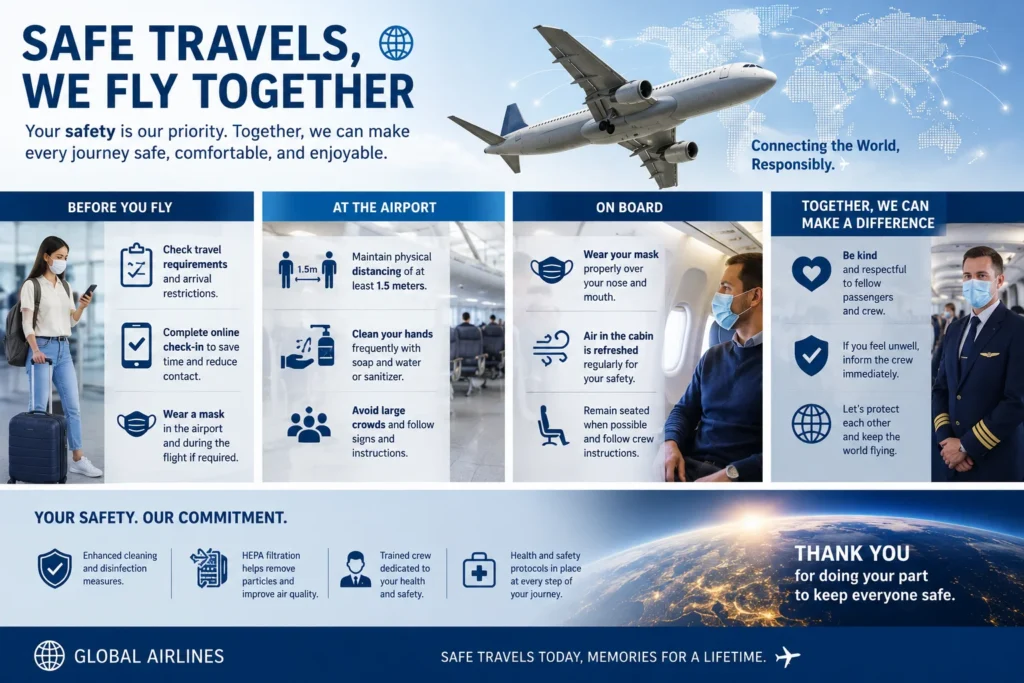
The preservation of global air connectivity remains a top priority for international transit networks amid evolving regional public health challenges. Following the official declaration by the World Health Organization (WHO) identifying the current Bundibugyo virus disease outbreak in Central and East Africa as a Public Health Emergency of International Concern, global transport authorities have moved swiftly to protect the travel ecosystem. The International Civil Aviation Organization (ICAO) has publicly reinforced the safety of international commercial flights, urging all civil aviation stakeholders to stringently align with proactive containment mandates.
For the international tourism sector, which relies entirely on reliable cross-border transit pipelines, this coordinated response demonstrates a robust infrastructure engineered to manage risks without resorting to widespread border closures. Through modern framework integration, global aviation bodies are balancing essential local health containment with the preservation of unhindered travel options for international tourists worldwide.
Enhanced Safety Networks and Coordinated Public Health Responses
According to epidemiological data released by regional health ministries, the outbreak involving the specific Bundibugyo strain has resulted in a high number of suspected cases and related deaths within localized zones of the Democratic Republic of the Congo, alongside a limited volume of imported cross-border cases confirmed in neighboring Uganda. Because this strain is transmitted exclusively through direct contact with compromised bodily fluids rather than through casual contact or airborne vectors, the risk matrix for typical commercial airline passengers remains exceptionally low.
To maintain this low-risk environment, ICAO is leveraging its specialized Collaborative Arrangement for the Prevention and Management of Public Health Events in Civil Aviation (CAPSCA) framework. This structural platform links international health experts with civil aviation administrators to deploy risk-based, evidence-informed mitigation strategies across global air networks.
By coordinating directly with health authorities, the agency ensures that airports and international airlines maintain high levels of clinical vigilance without triggering disruptive, panic-driven route cancellations that harm global travel momentum.
Leveraging Pandemic-Era Innovations for Safer Cross-Border Crossings
The structural resilience currently demonstrated by international carriers stems directly from the regulatory frameworks modernized during the COVID-19 pandemic. The disruptions observed during that era prompted ICAO to permanently update the Convention on International Civil Aviation’s Annex 9, which focuses specifically on international facilitation and public health response integration.
These modernized provisions rely heavily on digital solutions and automated infrastructure designed to track data and minimize physical contact during border checks:
Digital Self-Declaration Forms: National civil aviation directorates are mandating the collection of electronic health declaration profiles prior to passenger disembarkation. This allows immigration teams to instantly identify and review passengers arriving from or transiting through monitored health zones.
Contactless Border Management: Airports are expanding the deployment of automated biometric gates and touchless digital kiosks, drastically lowering the density of physical contact points inside international arrivals terminals.
Standardized Information Architectures: Restructured tracking protocols enable instant, standardized data transmission between regional airport health offices, international carriers, and global public health tracking networks.
Operational Directives for Onboard Management and Border Screening
National civil aviation ministries globally have started issuing detailed Standard Operating Procedures (SOPs) to guide airlines through day-to-day cabin management and terminal screenings. Civil aviation directives require flight crews operating on regional networks to deliver targeted inflight health announcements. These notifications instruct passengers to immediately report symptoms consistent with the viral infection, such as sudden fever, fatigue, or acute muscle pain, to the onboard crew or border medical staff upon arrival.
The updated guidelines also outline exact spatial isolation protocols for handling any passenger who displays signs of unexplained illness mid-flight. Operating crews are trained to relocate the individual to a designated zone at the rear of the cabin, keeping adjacent seating configurations vacant whenever possible.
Furthermore, international airlines are keeping a surplus of essential protective equipment on hand—including triple-layer surgical masks and disposable medical gloves—to ensure that both cabin personnel and travelers remain fully protected during transit.
Protecting the Vital Pipeline of Global Leisure Travel
The unified approach taken by ICAO and the WHO serves as a vital reassurance mechanism for the international leisure and hospitality sectors. Current travel guidance explicitly counsels countries against closing sovereign borders or enforcing sweeping trade and travel restrictions outside affected epicenters. Instead, the focus remains on implementing targeted exit screenings at primary international gateways within the affected regions, ensuring that any symptomatic individuals are isolated before boarding commercial flights.
By replacing broad travel bans with precision-based digital tracking and strict cabin hygiene standards, international aviation protocols successfully preserve the continuity of global tourism. This systematic approach allows travelers to book their international itineraries with confidence, secure in the knowledge that global air transit corridors remain safe, monitored, and thoroughly protected against cross-border health disruptions.
For more travel news like this, keep reading Global Travel Wire