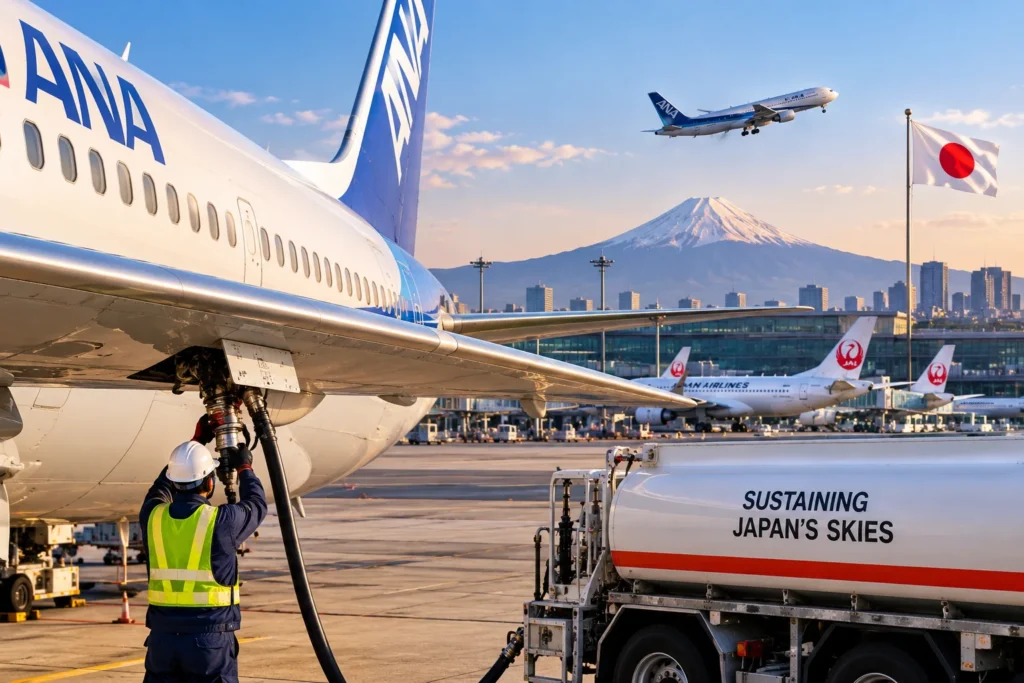
The Japanese government has officially implemented a major shift in its national aviation energy framework. Under revised measures from the Ministry of Economy, Trade and Industry, Japan has doubled its domestic aviation fuel subsidy rate from 40 percent to 80 percent of the government gasoline benchmark. The recalibrated formula delivers ¥20.9 per litre in wholesale price mitigation for domestic air travel while completely terminating government fuel subsidy provisions for international flights arriving in or departing from Japan.
The policy pivot aims to safeguard domestic regional route capacity, protect remote island connectivity, and insulate internal transit lines across the archipelago from global crude oil market volatility. By shifting financial assistance exclusively toward domestic infrastructure, state agencies aim to stabilize passenger travel costs across Japan’s main islands and isolated prefectures.
Recalibrated Fuel Relief Framework and Allocation Structure
The wholesale mitigation strategy alters how petroleum subsidies are distributed across the transportation sector. Government funds flow directly to certified domestic petroleum refineries and fuel importers to suppress the initial procurement costs paid by commercial airlines.
Official government policy details specify the support rates across primary energy categories:
| Fuel Product Category | Support Rate | Policy Focus & Strategy |
| Domestic Jet Fuel | ¥20.9 per litre | 80% benchmark rate to protect internal domestic air corridors |
| Gasoline | ¥26.2 per litre | Standard national price-stabilization benchmark for motor transport |
| Diesel & Kerosene | ¥26.2 per litre | Ground logistics and residential heating price mitigation |
| Heavy Fuel Oil | ¥26.2 per litre | Maritime cargo transport and manufacturing infrastructure support |
| International Flights | ¥0.0 (Terminated) | Support ended as carriers utilize published international surcharges |
While domestic jet fuel receives ¥20.9 per litre in primary wholesale relief alongside procurement adjustments, international long-haul operations will no longer receive state fuel aid. Policymakers noted that international airlines maintain flexibility through published international fuel surcharge bands and financial hedging tools, allowing public funds to focus entirely on maintaining domestic regional stability.
Impact on Domestic Passenger Fares and Airline Operations
The expanded wholesale fuel relief directly benefits major carriers—including Japan Airlines, All Nippon Airways, Skymark Airlines, Peach Aviation, and Jetstar Japan—by absorbing wholesale energy cost surges.
Rather than providing immediate passenger rebates at checkout, the government framework reduces operational overhead for airlines. The strategic benefits for domestic travel include:
Insulation Against Global Energy Shocks: Wholesale price caps protect domestic carriers from sudden spikes in global jet fuel prices.
Preserving Regional Route Frequencies: Regional airlines serving non-trunk destinations can maintain regular flight schedules without incurring severe operational deficits.
Mitigating Base Fare Escalations: Lower wholesale procurement costs reduce the necessity for airlines to raise baseline domestic ticket prices during off-peak travel periods.
Consumer airfares remain subject to dynamic pricing models based on booking velocity, seasonal demand periods such as Golden Week and Obon, seat inventory management, and airport operation charges. However, absorbing wholesale fuel costs provides essential pricing stability across national route networks.
Safeguarding Island Lifelines and Regional Connectivity
Air transport across Japan serves as essential civic infrastructure rather than optional leisure travel. In northern expanses such as Hokkaido, mountainous regions throughout Tohoku and Shikoku, and inhabited island chains across Okinawa and Kagoshima Prefectures, air routes provide vital lifelines for medical transport, local commerce, and regional tourism.
Complementing the fuel subsidy adjustments, the Ministry of Land, Infrastructure, Transport and Tourism is advancing policy proposals to delay a scheduled domestic aviation fuel tax increase planned for fiscal year 2027. The statutory tax rate stands at ¥26,000 per kilolitre, which was temporarily reduced to ¥15,000 per kilolitre for fiscal years 2025 and 2026. Official transport petitions seek to maintain the tax rate at ¥15,000 per kilolitre for fiscal year 2027 while keeping lower preferential tax rates of ¥7,500 per kilolitre for Okinawa routes and ¥11,250 per kilolitre for remote island routes.
By combining expanded wholesale fuel subsidies with proposed tax relief freezes, Japanese transport authorities aim to maintain reliable, affordable domestic air networks, supporting both local residents and international visitors exploring regional destinations across the country.
For more travel news like this, keep reading Global Travel Wire