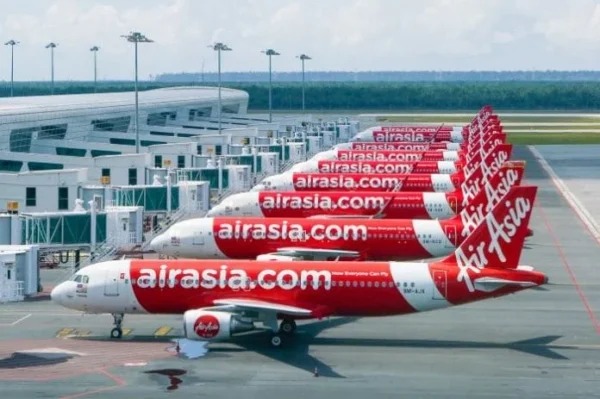
Financial pressure surrounding AirAsia has raised important questions about Malaysia’s domestic flight network, but travellers should not interpret the situation as an announced shutdown.
Contingency discussions are reported to have involved the Malaysian government, Malaysia Airlines, Batik Air and Malaysia Airports Holdings Berhad. The talks reportedly examine how domestic routes and passengers could be accommodated if AirAsia eventually reduces operations.
However, Malaysia’s government has not announced that AirAsia will stop flying. No general transfer of passengers to another carrier has been confirmed.
Travellers with existing reservations should therefore continue following their current itineraries unless AirAsia directly communicates a schedule change.
The broader concern is what could happen to affordable domestic connectivity if Malaysia’s largest low-cost operator were required to make substantial reductions.
AirAsia supports a major domestic network
AirAsia says it accounts for approximately 60% of Malaysia’s domestic air travel. That market position makes the airline particularly important for residents, international visitors and tourism businesses.
Its network connects Kuala Lumpur with prominent destinations across Peninsular and East Malaysia. Official air-traffic-rights records include services linking the capital with Penang, Kota Kinabalu and Sandakan. Other routes connect regional cities within Sabah and Sarawak.
Replacing a large part of that network would involve more than allocating routes to competing airlines.
Alternative operators would need aircraft, trained crews, airport slots and enough daily frequencies to meet passenger demand. Those resources cannot always be deployed immediately, especially during holiday periods or on heavily travelled routes.
Malaysia Airlines and Batik Air could add capacity organically if needed. However, any large-scale transfer would become more complicated without access to the aircraft currently supporting AirAsia’s operations.
Financial pressure drives contingency planning
AirAsia recorded a net loss of RM831 million during the second quarter of 2026. Its current liabilities stood at approximately RM18.4 billion at the end of June.
Sharp increases in jet-fuel costs added further pressure, with the carrier reporting average fuel prices of around US$183 per barrel during the quarter.
The airline has maintained that it remains focused on business continuity and stable operations. It is also pursuing financing, debt restructuring and cost-management measures.
Consequently, the contingency discussions should be viewed as advance planning rather than evidence of an immediate operational collapse.
Authorities regularly assess scenarios that could affect nationally important transport capacity. Such planning allows airlines, airports and regulators to consider how essential connectivity might be protected if circumstances change.
Travellers could face fewer choices
If AirAsia eventually makes significant network cuts, passengers could experience changes in flight choice, frequency and price.
Malaysia Airlines, Batik Air or other operators may add services on affected routes. Nevertheless, replacing low-cost seats across a large network could take time.
Reduced capacity could place upward pressure on fares, particularly during festivals, school holidays and major tourism events. Passengers might also encounter less convenient departure times or longer waits between flights.
The effects would extend beyond Kuala Lumpur. Travellers often use inexpensive domestic services to combine the capital with Langkawi, Penang, Johor, Kuching or Kota Kinabalu during one holiday.
If fewer flights are available, visitors may shorten their itineraries or concentrate spending in destinations with the strongest connections.
Sabah and Sarawak face higher stakes
Reliable air travel is especially important between Peninsular Malaysia and the eastern states of Sabah and Sarawak.
AirAsia connects Kuala Lumpur with several East Malaysian destinations, supporting residents and tourists travelling across the South China Sea. These services also help visitors reach beaches, rainforests, wildlife attractions and indigenous cultural experiences.
A significant capacity reduction could make multi-destination holidays more expensive or difficult to organise. Hotels, guides, restaurants and tour companies outside Kuala Lumpur could consequently feel the effects.
Maintaining affordable links is therefore important for distributing tourism spending across Malaysia instead of concentrating visitor activity around major entry gateways.
Visit Malaysia 2026 increases urgency
The uncertainty arrives during Visit Malaysia 2026, when the country is working to increase international arrivals and encourage travellers to explore more destinations.
India remains an important source market. Malaysia welcomed more than 1.5 million Indian visitors in 2025, followed by over 600,000 between January and May 2026.
More than 190 direct flights currently operate each week between India and Malaysia, providing over 37,000 seats. AirAsia, Malaysia Airlines, Batik Air and IndiGo contribute to this international connectivity.
However, visitors arriving from overseas often depend on domestic flights to continue towards Sabah, Sarawak, Langkawi, Penang and Johor. International seat growth therefore needs a dependable internal network to deliver benefits across the tourism economy.
Existing passengers should monitor bookings
Passengers holding AirAsia tickets do not currently need to cancel solely because contingency discussions are taking place.
They should check their flight status through official AirAsia channels, confirm that their contact information is current and monitor messages before travelling to the airport.
Travellers using separate tickets should consider leaving generous time between flights. Independent bookings may offer less protection if disruption causes a missed onward connection.
Under Malaysia’s aviation consumer-protection framework, passengers affected by a cancellation can choose a full refund, including applicable taxes and fees, or rerouting under comparable transport conditions. Assistance may also apply during extended delays.
For now, AirAsia continues operating. The central question is whether the airline can secure sufficient financing while preserving its network.
The answer will matter far beyond one company. It could shape domestic fares, destination access and Malaysia’s ability to convert Visit Malaysia 2026 arrivals into wider tourism growth.
For more travel news like this, keep reading Global Travel Wire