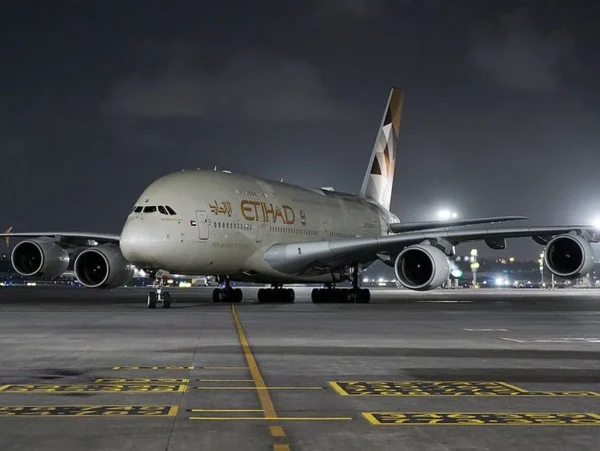
Etihad Airways is adjusting Airbus A380 operations between Abu Dhabi and Singapore, replacing the superjumbo with a Boeing 787-9 on selected services during the 2026 summer period.
The aircraft change does not mean Etihad is cancelling its Singapore route. Flights will continue, preserving direct connectivity between the United Arab Emirates and one of Southeast Asia’s most important aviation and tourism centres.
However, passengers may notice differences in cabin layouts, premium-seat availability and onboard facilities. Travellers who booked specifically for the A380 experience should check the aircraft listed in their latest reservation.
The change highlights how global airlines are managing their largest aircraft more selectively. Passenger demand, fuel costs, fleet availability and premium travel patterns can all influence where an Airbus A380 operates.
Singapore service remains operational
Etihad introduced the A380 between Abu Dhabi and Singapore in February 2025, adding the city-state to its flagship aircraft network.
The deployment gave travellers access to Etihad’s distinctive double-deck cabin environment. It also added capacity on an important route connecting Southeast Asia with the Middle East, Europe and other destinations through Abu Dhabi.
The latest adjustment returns affected services to the Boeing 787-9 Dreamliner. This aircraft remains a modern long-haul widebody designed to serve international markets efficiently.
For most passengers, the central point is continuity. Singapore remains within Etihad’s network, while Abu Dhabi continues to provide onward connections across the airline’s international schedule.
Aircraft assignments can change for operational reasons. Passengers should therefore confirm their flight details before selecting seats or paying for aircraft-specific experiences.
Boeing 787 offers greater flexibility
The Boeing 787-9 has a smaller seating capacity than the Airbus A380. However, it gives airlines greater flexibility when passenger demand does not require a superjumbo.
Its twin-engine design supports long-distance flying while generally requiring fewer seats to be filled for commercially sustainable operation. This allows an airline to retain a route without deploying more capacity than the market needs.
For travellers, the Dreamliner still provides a widebody experience suitable for long-haul journeys. Nevertheless, its cabin arrangement and amenities differ from those aboard Etihad’s A380.
The A380 is particularly recognised for its spacious two-deck design and extensive premium accommodation. Consequently, travellers may find fewer seats available in certain cabins after an aircraft substitution.
Passengers should review updated seat maps and booking information. Anyone affected by a substantial cabin change should contact Etihad directly to understand the available options.
A380 becomes a targeted network asset
Etihad’s adjustment reflects a wider transformation in the role of the Airbus A380.
The aircraft can move large numbers of passengers through airports where slots are limited. It also provides enough interior space for distinctive premium cabins, making it attractive on routes with strong luxury and business demand.
However, the four-engine aircraft requires substantial and consistent passenger volumes. Airlines must balance its popularity against fuel use, maintenance requirements and operating economics.
Etihad gradually returned A380s to service as international demand recovered. Rather than restoring the aircraft across a broad network, the airline has concentrated it on selected markets capable of supporting high capacity and premium traffic.
The Singapore change demonstrates how that strategy can evolve. A route may remain commercially and strategically important even when a smaller aircraft offers a better seasonal capacity match.
Tourism links remain important
Singapore is a major leisure, business and meetings destination with extensive air connections across Asia and the wider world.
International aviation supports hotels, attractions, restaurants, cruise activity and the meetings, incentives, conferences and exhibitions sector. Direct Gulf connectivity also helps Singapore attract visitors from the Middle East while providing connections from Europe and Africa.
The Abu Dhabi service supports these tourism flows even without an A380 on every flight. For many travellers, schedule reliability, connection times and fare availability remain more important than aircraft size.
Passengers travelling through Zayed International Airport can connect with Etihad services across several global regions. The route therefore serves more than point-to-point demand between Abu Dhabi and Singapore.
It supports multi-sector journeys involving destinations across Europe, Africa, North America, Asia-Pacific and the Middle East.
Abu Dhabi strengthens its hub role
Zayed International Airport’s Terminal A opened in 2023 with expanded capacity and upgraded passenger facilities. The infrastructure supports Abu Dhabi’s development as an international aviation and tourism hub.
Etihad plays a central role in that strategy. Efficient aircraft allocation helps the airline maintain connectivity while responding to changing demand across its network.
Using a Boeing 787-9 on Singapore services can protect route continuity without committing A380 capacity that may generate stronger returns elsewhere.
That approach has become increasingly common across aviation. Airlines are using efficient twin-engine aircraft such as the Boeing 787 and Airbus A350 to serve long-distance markets with greater flexibility.
What Singapore passengers should expect
Travellers should not assume that the route adjustment means their flight has been cancelled. Instead, they should check whether their aircraft, seat assignment or cabin has changed.
An equipment substitution may affect the availability of specific premium products. It can also require passengers to select new seats if the replacement aircraft uses a different configuration.
Those with connecting flights should continue monitoring official schedule notifications through Etihad’s website or application.
The A380 remains an important part of Etihad’s premium identity, but its future depends on targeted deployment. Singapore’s aircraft adjustment shows that long-haul aviation is increasingly built around matching capacity with demand.
For tourism, the essential connection remains intact: Singapore and Abu Dhabi continue to be linked, even as the aircraft serving that journey changes.
For more travel news like this, keep reading Global Travel Wire