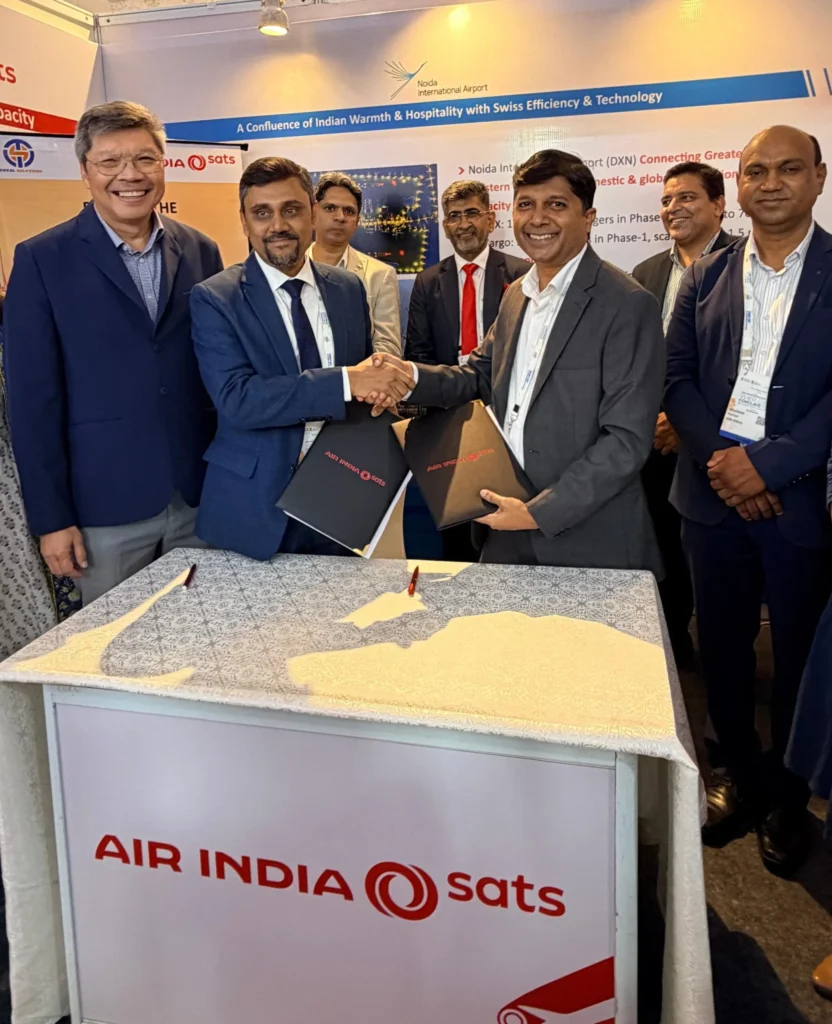
Noida International Airport is strengthening its position as an emerging cargo and logistics gateway for North India after Air India SATS Airport Services signed separate agreements with SpiceXpress and Total Solutions to explore and expand freighter operations.
The Memoranda of Understanding were signed during the Air Cargo Forum India World Conclave 2026 in New Delhi. The agreements focus on developing specialised and general cargo opportunities through the AISATS Multi Modal Cargo Hub at Noida International Airport.
The SpiceXpress partnership is aimed at creating a framework for livestock freighter operations. Around 200 freighter movements are planned between September 2026 and August 2027.
Meanwhile, the agreement with Total Solutions will explore broader scheduled and non-scheduled freighter opportunities as cargo activity at the airport continues to increase.
SpiceXpress targets specialised livestock operations
The SpiceXpress collaboration is particularly significant because it introduces a specialised cargo segment to Noida International Airport.
AISATS said the partnership will lay the foundation for livestock freighter operations using the airport’s cargo infrastructure and digital capabilities.
The location provides an important advantage. Noida is positioned close to major livestock-producing areas in Uttar Pradesh and Haryana, potentially reducing ground transport times before animals are transferred to aircraft.
Livestock transportation requires carefully controlled handling procedures because timing, welfare requirements and operational coordination are more demanding than for conventional cargo.
Developing specialised handling capabilities could therefore broaden the airport’s cargo portfolio while creating new international trade opportunities for businesses across northern India.
Around 200 freighter movements planned
The proposed SpiceXpress programme is expected to involve approximately 200 freighter operations between September 2026 and August 2027.
If implemented as planned, the programme would provide an important source of recurring cargo activity for the airport during its early growth phase.
Regular freighter operations can help establish predictable cargo flows, attract freight forwarders and create demand for additional logistics services around an airport.
They can also complement passenger aviation by strengthening the overall commercial ecosystem supporting airlines, ground handlers, warehouses and transport providers.
For Noida International Airport, diversification between passenger and cargo traffic could become an important part of its long-term development strategy.
Total Solutions explores wider cargo network
AISATS has also signed an MoU with Total Solutions to examine new freighter operations from the Multi Modal Cargo Hub.
The partnership will explore both scheduled and non-scheduled cargo services.
Scheduled operations can provide consistent capacity along established trade lanes, while non-scheduled freighters allow operators to respond to changing market demand, specialist shipments and seasonal requirements.
This flexibility could increase Noida’s attractiveness to cargo airlines, logistics companies and freight forwarders seeking alternatives within the National Capital Region.
The agreement also supports AISATS’ ambition to establish the facility as a major regional freighter hub.
Multi Modal Cargo Hub brings integrated infrastructure
The AISATS cargo development forms a major part of Noida International Airport’s wider logistics strategy.
The airport selected AISATS to develop the Multi Modal Cargo Hub across approximately 80 acres, combining an integrated cargo terminal with warehousing and logistics facilities.
The development has been designed to support road-to-air, air-to-road and road-to-road cargo movements.
The airport’s current cargo infrastructure includes around 22,000 square metres of warehouse space and two dedicated freighter bays capable of supporting round-the-clock operations.
The facility also includes truck docks, X-ray equipment, Unit Load Device handling systems and digital cargo technologies designed to improve visibility and processing efficiency.
Direct access through the Yamuna Expressway further strengthens connections with industrial and production centres.
Cargo growth supports wider regional economy
The impact of stronger cargo operations could extend well beyond the airport boundary.
Western Uttar Pradesh and the wider National Capital Region contain major manufacturing, agricultural and commercial clusters. Faster air freight connectivity can reduce delivery times and provide businesses with improved access to domestic and international markets.
This can encourage further investment in warehousing, distribution, cold-chain infrastructure and specialised logistics around the airport.
The aviation ecosystem can also generate additional demand for hotels, restaurants, business travel and transportation services as airline crews, logistics executives and commercial partners move through the region.
As a result, cargo development can indirectly support tourism and hospitality growth alongside traditional trade activity.
Noida emerges as North India aviation gateway
Noida International Airport began commercial passenger operations in June 2026, opening a new aviation gateway for the National Capital Region and western Uttar Pradesh.
The latest freighter partnerships add another dimension to that expansion.
By combining passenger connectivity with integrated cargo infrastructure, the airport is positioning itself to compete for a wider share of India’s rapidly developing aviation market.
For AISATS, the partnerships with SpiceXpress and Total Solutions represent an opportunity to build early momentum at the Multi Modal Cargo Hub.
For Noida International Airport, growing freighter activity could strengthen its role as a logistics gateway linking North Indian businesses with international markets.
If the proposed operations expand successfully, Noida could increasingly develop into an important centre where aviation, trade, logistics and tourism-related commerce converge within one growing regional transport ecosystem.
For more travel news like this, keep reading Global Travel Wire