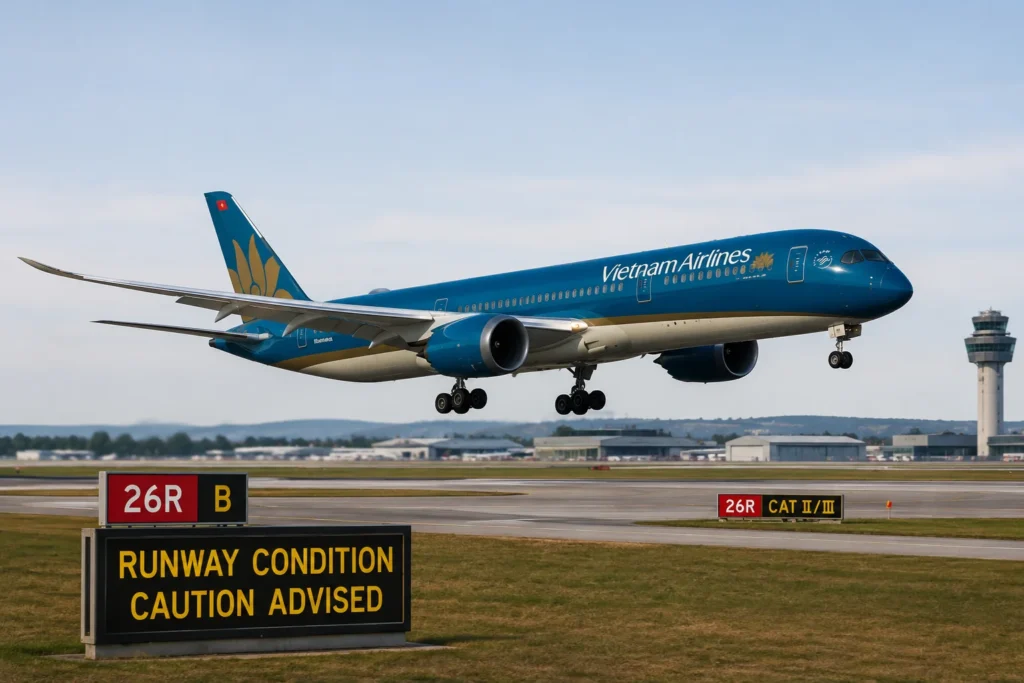
Official aviation authorities have confirmed that a long-haul international flight bound for Southeast Asia was forced to return to its origin airport in Germany following technical alerts triggered during departure. The Civil Aviation Authority of Vietnam issued a formal statement outlining the sequence of events involving a flagship Boeing 787 widebody aircraft operated by national carrier Vietnam Airlines. Shortly after taking off from Munich Airport on Sunday, crew members received automated flight deck warnings indicating potential contact between the aircraft tail structure and the runway surface, alongside secondary alerts signaling low pressure in the landing gear tires.
Following established international aviation safety protocols, the flight crew immediately initiated emergency procedures and notified local air traffic control authorities in Germany. The aircraft, which was carrying international passengers on the direct long-haul route connecting Munich to Hanoi, entered a holding pattern in designated airspace near the airport. Aircrew operated the twin-engine jet for more than two hours to safely burn off excessive jet fuel, reducing the overall weight of the aircraft to meet mandatory landing parameters before returning to Munich Airport for a safe touchdown and comprehensive ground inspection.
SEO Headline: Safety Protocols Initiated for Vietnam Airlines Boeing 787 Departure Incident
The Civil Aviation Authority of Vietnam reported that the technical alerts occurred immediately after the aircraft lifted off from the runway in Munich. The primary safety system alerted the cockpit crew to a tail strike condition—an event where the aft fuselage makes physical contact with the tarmac surface during the rotation phase of takeoff. Almost simultaneously, secondary warning indicators signaled abnormal pressure readings across the main landing gear assembly.
Flight crews operating modern widebody jets such as the Boeing 787 Dreamliner are trained to respond immediately to post-takeoff structural and mechanical alerts. Because long-haul international flights carry large volumes of fuel designed for multi-hour intercontinental journeys, landing immediately at maximum takeoff weight presents structural risks. By remaining airborne in a controlled holding pattern, the crew successfully reduced fuel weight, ensuring a controlled and standard landing approach back at Munich Airport. Ground support teams, local emergency service units, and airport operational personnel were placed on standby to assist upon arrival, though the aircraft landed without further complication.
SEO Headline: Official Investigation Underway into Long-Haul Aviation Incident in Munich
Government aviation officials and regulatory authorities have launched a formal technical review to examine the root causes behind the takeoff alerts and runway parameters. The Civil Aviation Authority of Vietnam stated that inspectors are reviewing flight data logs, cockpit voice records, aircraft sensor readouts, and physical evidence on both the Boeing 787 fuselage and the Munich runway surface to confirm the precise nature of the event. Technical teams are conducting detailed examinations of the landing gear tires and tail section to assess potential structural impact and determine operational readiness.
Vietnam Airlines operates long-haul routes connecting major European destinations to key hubs across Southeast Asia, utilizing modern long-range aircraft to serve international business travelers, holidaymakers, and cargo supply chains. Official statements from civil aviation regulators emphasize that passenger safety remained the top priority throughout the operational decision to turn back. Passengers aboard the affected flight were provided with ground assistance, accommodation, and alternative flight arrangements in accordance with international air passenger rights standards while the aircraft undergoes mandatory maintenance evaluation.
SEO Headline: International Air Safety Standards and Industry Impact for Travelers
Incidents involving runway surface contact and tire pressure variations on widebody airliners are subject to strict international reporting and investigation rules established by global aviation governing bodies. Official releases from civil aviation regulatory authorities stress that redundant safety mechanisms, early warning sensors, and rigorous pilot training standards exist specifically to mitigate operational risks during complex long-haul departures.
As government regulators complete their joint assessment of the incident in Munich, official updates will guide any necessary maintenance actions or operational adjustments for the affected airframe. The timely execution of fuel-burn procedures and the safe return of the flight reflect the stringent safety frameworks governing modern international commercial aviation between Europe and Asia. Further official reports detailing the physical inspection outcomes and flight data analysis will be published by civil aviation authorities upon the conclusion of the formal inquiry.
For more travel news like this, keep reading Global Travel Wire