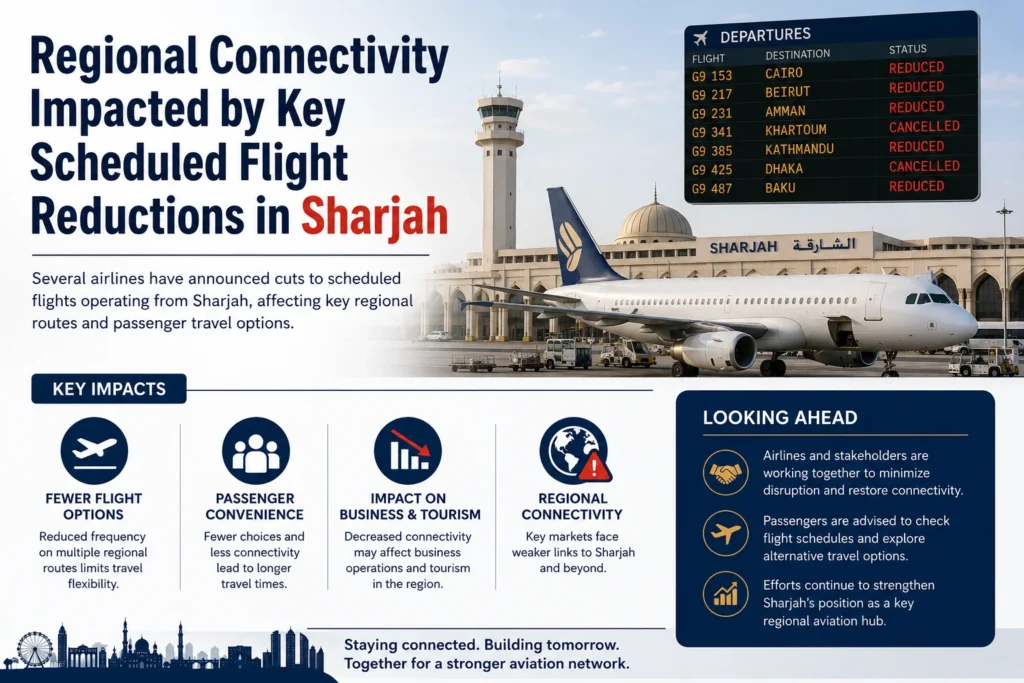
Aviation operations across the United Arab Emirates are experiencing localized schedule adjustments this season. In recent structural schedule updates verified via regional transit databases, Sharjah International Airport has experienced strategic operational shifts resulting in the cancellation of two prominent international departures. The affected services were bound for Kuwait International Airport and Sialkot International Airport in Pakistan. Both routes function as crucial aerial highways, facilitating essential labor movement, regional corporate travel, and family reunification within the broader Middle East and South Asian transit corridors.
While the total volume of cancellations remains highly contained relative to the facility’s vast daily flight log, the broader impact of these individual service updates is magnified by the exceptionally high demand characteristic of these specific routes. The localized service gaps underscore the intricate balance required to manage dense short-to-medium haul aviation networks. In these high-utilization environments, isolated scheduling reconfigurations or equipment realignments can create immediate ripples across regional travel pipelines.
Critical Analysis of Specific Flight Adjustments and Route Schedules
The two disrupted international services were scheduled to operate utilizing standard narrow-body aircraft, which serve as the primary foundational fleet model for regional short-haul connectivity. Official timetable listings identify the affected operations as follows:
Flight ABY121: A prominent scheduled regional operation bound for Kuwait International Airport, originally designated for a late afternoon departure slot at 04:00 PM.
Flight PIA210: A scheduled international service operated by Pakistan International Airlines, bound for Sialkot International Airport, holding a mid-afternoon departure time of 03:30 PM.
Because both international flight cancellations occurred on high-density paths, local civil aviation trackers note that passenger loads were projected to be near maximum capacity. Consequently, the sudden removal of these frequencies from the weekly departure board required immediate logistical intervention, leaving affected travelers to coordinate with respective carrier help desks to secure alternative routing through adjacent UAE gateways or subsequent weekly departures.
Strategic Importance of the Affected Passenger Corridors
The suspension of these specific routes carries notable sociological and economic implications due to the precise demographics reliant on these air links. The sector linking Sharjah to Kuwait operates as a primary conduit for professional and labor migration within the Gulf Cooperation Council region. It facilitates rapid, budget-conscious transit for corporate managers, technical consultants, and public sector employees navigating regular inter-gulf business cycles.
Simultaneously, the route connecting the Sharjah aviation hub to Sialkot International Airport holds immense industrial importance. Sialkot represents one of Pakistan’s most vital manufacturing and export epicenters, famous globally for its production of sports equipment, surgical instruments, and leather goods. The direct flight options to this region are heavily utilized by expatriate industrial workers, traders, and entrepreneurs who maintain deep commercial ties with manufacturing enterprises in the Punjab province. Due to the time-sensitive nature of employment visas and manufacturing contracts, even temporary schedule suspensions can cause noticeable interruptions in corporate timelines and personal travel plans.
Systemic Sensitivity in High Efficiency Narrow Body Networks
Aviation safety and logistics analysts emphasize that while specific technical causes for individual flight groundings remain subject to internal carrier management, such events are structurally indicative of the intense operational pressures faced by regional low-cost and national flag carriers alike. The reliance on uniform aircraft fleets, while highly cost-effective for maintenance and crew training, creates an operational environment with very slim margins for scheduling variances.
Several structural variables typically contribute to sudden network adjustments in busy modern hubs. Chief among these is tight aircraft rotation, where individual airframes are scheduled with minimal ground buffer time between incoming arrivals and subsequent departures. Under these conditions, a minor delay at an outbound station can cascade across multiple subsequent flight segments.
Furthermore, strict civil aviation safety mandates require unscheduled technical inspections or mandatory component checks if any automated onboard system flags a variance, immediately removing that specific aircraft from active service. Combined with international regulatory limits on maximum crew duty hours—which legally prevent flight crews from departing if previous delays have extended their active shift—regional hubs must constantly balance fleet availability against fixed timetables.
As a highly optimized secondary aviation center within the United Arab Emirates, Sharjah International Airport relies on rapid turnaround times to maximize passenger throughput. When unexpected fleet constraints alter the daily departure grid, the localized effect emphasizes the ongoing need for resilient scheduling models and enhanced communication channels to support international travelers during unexpected itinerary changes.
For more travel news like this, keep reading Global Travel Wire