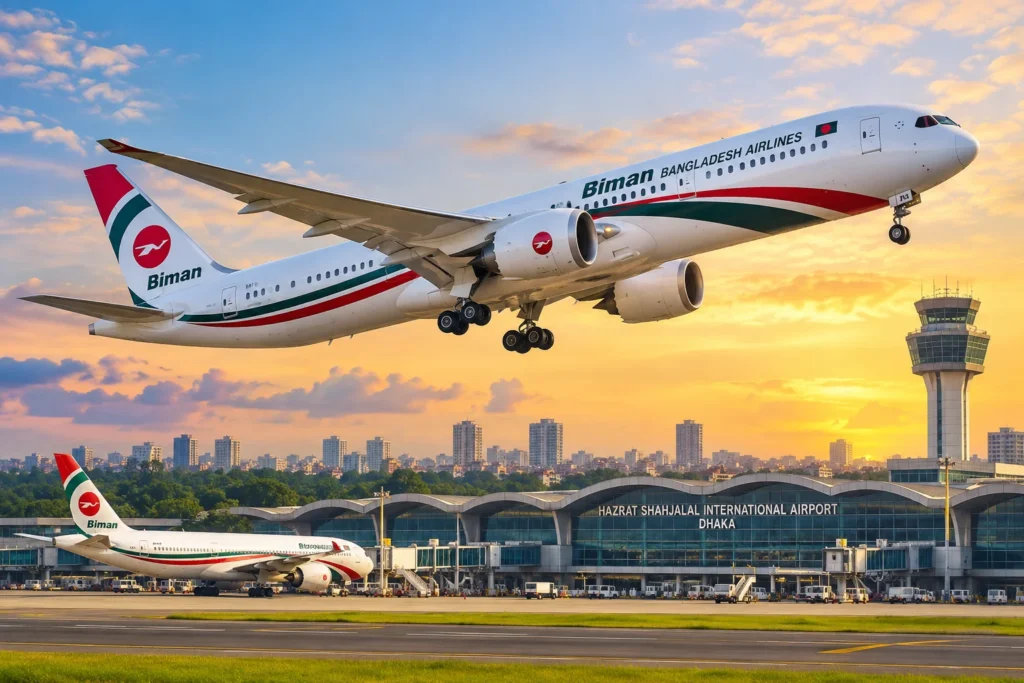
Biman Bangladesh Fleet Expansion to Catalyze Long-Term Growth
The decision by Biman Bangladesh Airlines to acquire 14 new aircraft from Boeing at an estimated value of $3.7 billion has sparked widespread dialogue across economic and commercial transportation sectors. While some critics express caution regarding immediate financial commitments under current macroeconomic pressures, industry experts view the investment through a long-term strategic lens. Rather than evaluating the agreement solely on upfront expenditure, aviation authorities are assessing where the national flag carrier must position itself over the next two decades.
Leading global destinations have demonstrated that international hub status cannot be achieved through airport infrastructure alone. World-class transit centers require sustained investments in modern aircraft, route development, and seamless regional connectivity. Although the operational environment of South Asia presents unique dynamics, the overarching principle remains clear: international aviation demands forward-looking capital allocation to capture future market demand that may take years to mature.
Strategic Aircraft Mix for Extended Route Connectivity
Official figures from the Ministry of Civil Aviation and Tourism outline a structured procurement strategy designed to serve diverse route categories. The approved fleet mix includes eight Boeing 787-10 Dreamliners, two Boeing 787-9 Dreamliners, and four Boeing 737-8 MAX aircraft. This combination allows the national carrier to optimize operations across high-density Middle Eastern sectors, expand regional networks, and launch extended long-haul intercontinental routes.
Boeing 787-10 Dreamliners (8 Units): Assigned to high-volume trunk routes and major international commercial nodes.
Boeing 787-9 Dreamliners (2 Units): Tailored for long-haul intercontinental routes across Europe and North America.
Boeing 737-8 MAX Aircraft (4 Units): Dedicated to enhancing regional frequencies across South Asia and Southeast Asia.
Scheduled deliveries will begin toward the end of 2031 and extend through 2035. This operational timeline underscores that current policy decisions are aimed at establishing competitive advantage for the post-2030 travel environment.
Economic Advantages of Early Procurement and Fleet Commonality
Proactive fleet modernization offers substantial financial advantages by hedging against long-term cost escalation. Global aerospace manufacturing faces persistent supply chain bottlenecks, rising material costs, and lengthy production backlogs. Securing commercial terms and manufacturing delivery slots well in advance shields the carrier from potential price surges in subsequent years.
Furthermore, operational synergy remains a primary advantage of the selection. Biman already maintains and operates Boeing 787 and 737 platforms. Expanding an existing architecture reduces capital outlay required for flight crew transition training, ground support infrastructure, and spare-parts inventory management. The introduction of next-generation aircraft also yields up to 20 percent better fuel efficiency compared to legacy models, delivering structural operational cost reductions over the multi-decade lifespan of the airframes.
Strong Financial Performance Supports Capital Investment
Financial reports published by the airline demonstrate operational stability capable of supporting long-term expansion goals. During FY 2024–25, Biman recorded:
Total Operating Revenue: Tk 11,559 crore
Operating Profit: Tk 1,602 crore
Net Profit: Tk 785 crore
Passenger Volume: 3.4 million passengers carried
Cargo Earnings: Tk 925 crore
Maintaining continuous profitability over five consecutive fiscal years provides a solid foundation for capital investments rather than remaining static in a rapidly evolving market. Additionally, the procurement agreement aligns with broader bilateral commercial frameworks and trade commitments between Bangladesh and the United States, extending economic benefits beyond the airline’s immediate balance sheet.
Establishing Dhaka as an Emerging Aviation Transit Hub
While fleet expansion provides the physical assets, long-term success hinges on post-delivery operational execution. Transforming Hazrat Shahjalal International Airport in Dhaka into a competitive transit point requires rigorous route management, high passenger load factors, optimized cargo yields, and seamless flight scheduling. Government oversight ensures that final contractual terms, financing structures, and repayment schedules remain transparent and subject to public accountability.
The long-term vision of the Ministry of Civil Aviation and Tourism targets a total fleet of 47 aircraft by 2035. By committing to advanced wide-body and narrow-body platforms today, Bangladesh is positioning its civil aviation sector to capture expanding international passenger traffic, boost inbound tourism, and build a profitable national airline capable of competing on the global stage.
For more travel news like this, keep reading Global Travel Wire