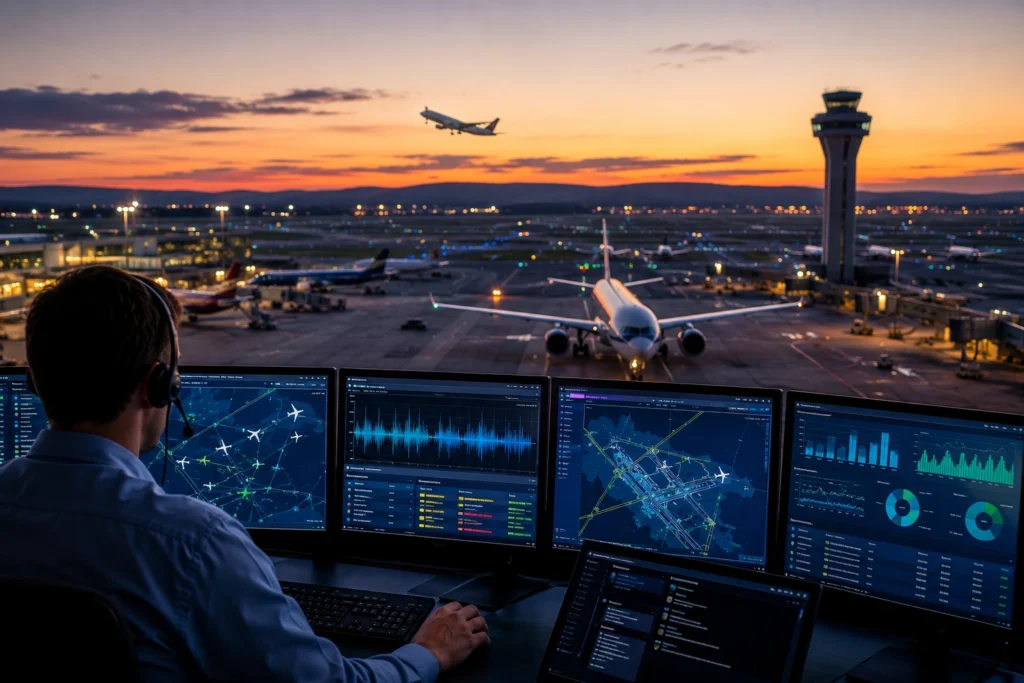
United Airlines Ventures, the investment arm of United Airlines, is backing aviation technology startup Enhanced Radar as airlines and airports increasingly turn to artificial intelligence to improve operational efficiency, air traffic coordination, and passenger experience across the global aviation sector. The investment highlights growing industry demand for advanced AI systems capable of delivering faster, clearer, and more actionable insights from complex air traffic control communications.
Enhanced Radar recently secured $7 million in new funding to expand its AI-driven aviation platform, which transcribes and analyses millions of daily air traffic control transmissions across North America. The company plans to accelerate deployment of its technology at airports while expanding its software engineering and operational teams.
The funding round included participation from United Airlines Ventures alongside Initialized Capital, Y Combinator, Decisive Point, ForeFlight co-founder Tyler Weihs, and several technology-focused investors connected to major artificial intelligence companies.
The investment reflects broader changes across the aviation industry as airlines, airports, and regulators increasingly adopt AI tools to manage rising passenger traffic, reduce operational disruptions, and improve decision-making during complex travel conditions.
AI Platform Designed to Improve Airport and Airline Operations
Enhanced Radar’s enterprise platform uses proprietary artificial intelligence models to monitor, transcribe, and organise air traffic control communications into searchable operational insights for airlines and airport personnel.
Instead of simply tracking whether a flight is delayed, the platform allows operational teams to understand the underlying cause of disruptions in real time. This capability enables faster responses to changing airport conditions, weather events, congestion, and operational bottlenecks.
The company’s software analyses large volumes of ATC transmissions and converts them into simplified data that airport operations teams, airline dispatchers, and aviation managers can quickly interpret.
By improving situational awareness, airlines can optimise gate assignments, reduce turnaround delays, manage crew scheduling more effectively, and minimise disruptions for travellers.
Enhanced Radar has already installed its proprietary audio collection hardware at approximately 80 airports across North America, expanding its real-time operational monitoring network.
The company says each additional airport installation strengthens its AI model by providing more aviation-specific training data covering various accents, communication styles, weather conditions, and operational environments.
Viral ATC App Expanded Into Enterprise Aviation Technology
Many aviation enthusiasts and social media users first became familiar with Enhanced Radar through its popular ATC app, which shares real-time air traffic control conversations combined with aircraft tracking information.
The app gained significant online attention through viral videos featuring emergency situations, unusual pilot-controller interactions, and major aviation incidents.
Enhanced Radar co-founder and chief executive Eric Button described the app as a smaller side project compared with the company’s broader enterprise aviation platform.
The ATC application combines real-time aircraft location data with AI-powered voice transcription technology, allowing users to follow air traffic control communications alongside live flight movements.
This same AI technology now forms the foundation of the company’s commercial aviation platform, which aims to deliver deeper operational intelligence to airports and airlines managing large-scale passenger and cargo traffic.
Airlines Seek Greater Operational Efficiency
The aviation industry is increasingly investing in AI-powered technologies as airports worldwide experience growing passenger volumes, operational complexity, and staffing challenges.
For airlines, operational efficiency directly affects profitability, passenger satisfaction, and schedule reliability. Delays caused by weather, airspace congestion, or communication inefficiencies can create ripple effects across global route networks.
Enhanced Radar’s software is designed to help airlines react more quickly to disruptions while improving coordination between airport teams, dispatchers, and flight operations centres.
Airport operators also benefit from improved awareness of runway conditions, traffic flow, and operational constraints that influence aircraft movement and passenger experience.
As international travel demand continues to recover and expand, aviation technology firms are competing to deliver digital tools capable of supporting smarter and more predictive airport operations.
AI Expands Across US Aviation Infrastructure
The investment in Enhanced Radar comes as the Federal Aviation Administration and the US Department of Transportation continue exploring artificial intelligence applications across the National Airspace System.
US transportation officials have already begun testing AI systems designed to identify airport “hot spots,” improve airspace routing, and reduce delays across congested aviation corridors.
The FAA is also modernising air traffic control infrastructure through its multi-billion-dollar Brand New ATC System initiative, which includes transitioning communications from analog to digital systems.
Another major initiative under development is the Strategic Management of Airspace Routing Trajectories system, known as SMART. The AI-powered project is expected to help predict weather disruptions, traffic congestion, and airspace conditions months in advance.
Industry officials emphasise that these technologies are intended to support operational planning rather than replace human air traffic controllers in safety-critical decision-making roles.
Future Focus Includes Safety and Air Traffic Support
Although Enhanced Radar’s initial focus remains operational efficiency, the company indicated that future versions of its platform could eventually assist with broader aviation safety functions.
The company recently introduced a new AI model called Y4, specifically designed to address aviation communication challenges including noisy audio, overlapping transmissions, rapid speech patterns, and regional accents.
According to the company, the updated system can differentiate between pilots and controllers with more than 98% accuracy, helping operational teams process communications more effectively during high-traffic periods.
As airports and airlines continue adopting advanced AI technologies, investments such as United Airlines Ventures’ backing of Enhanced Radar demonstrate how digital innovation is reshaping the future of global aviation operations, airport management, and passenger travel experiences.
For more travel news like this, keep reading Global Travel Wire