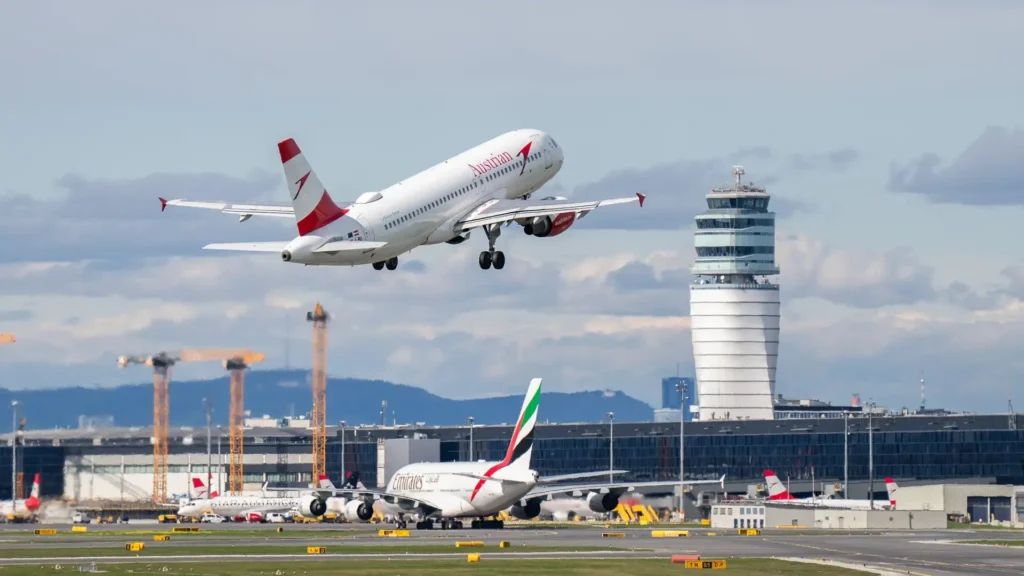
Passengers traveling through Vienna International Airport faced a fresh wave of disruption on June 10, 2026, after an operational snapshot showed four canceled flights and 62 delayed services involving Austrian Airlines and airBaltic.
Austrian Airlines accounted for two cancellations and 52 delays, while airBaltic recorded two cancellations and 10 delayed services. Although the number of canceled flights remained limited, the volume of delays created significant pressure on travelers using Vienna as a major connecting hub between Europe, the Middle East, North America and Asia.
The disruption affected routes linked with Germany, the United Kingdom, Denmark, Egypt, the United Arab Emirates and the United States, alongside several major European leisure destinations. Passengers faced longer waiting times, possible missed connections and uncertainty around onward travel plans.
Delays Spread Across a Wide International Network
Vienna Airport plays a central role in regional and long-haul connectivity. As a result, operational problems can quickly create knock-on effects across multiple markets.
Affected destinations included Berlin, Frankfurt, Cologne, Munich, Stuttgart, Hanover, Hamburg and Düsseldorf in Germany, as well as London, Copenhagen, Brussels, Helsinki, Oslo, Stockholm, Riga, Vilnius and Warsaw.
The wider disruption footprint also extended to major tourism and business routes involving Cairo, Abu Dhabi, Chicago, Delhi, Baku, Istanbul, Tel Aviv, Paris, Barcelona, Madrid, Lisbon, Athens, Rome, Milan and Zurich.
Popular holiday markets were also affected, including Tenerife, Malaga, Palma de Mallorca, Valencia, Kos, Mykonos, Rhodes, Santorini, Bari, Catania, Palermo and several Adriatic destinations.
For passengers connecting through Vienna, even a short delay can create complications. Travelers may miss onward flights, face rebooking queues or experience changes to airport transfers, hotel check-ins and pre-arranged tours.
Austrian Airlines Faces the Highest Number of Delays
Austrian Airlines, the largest hub carrier at Vienna Airport, recorded the most significant operational pressure in the June 10 snapshot. Its two cancellations were accompanied by more than 50 delays, highlighting the importance of aircraft rotations and tightly connected schedules at a major international hub.
When one inbound aircraft arrives late, the next outbound service may also be delayed. The effect can continue through the day as crews, airport teams and ground-handling operations work to restore schedules.
The disruption did not indicate a permanent reduction in services. However, the concentration of delays created a challenging travel environment for passengers with short connection times.
airBaltic Passengers Also Face Schedule Changes
airBaltic also experienced disruption, with two canceled flights and 10 delays recorded in the operational snapshot.
The airline connects Vienna with Baltic and northern European markets, making schedule reliability important for travelers using onward connections. Passengers affected by cancellations or significant delays should check their reservation details and monitor official airline updates before leaving for the airport.
Airport schedules can change throughout the day, particularly when airlines adjust operations for safety, aircraft availability or network recovery.
Travelers Should Check Flight Status Before Departure
Vienna Airport advises passengers to check the status of their flight directly with their booked airline before traveling to the terminal. Travelers should also allow additional time for their journey and monitor email, mobile notifications and booking apps for changes.
Austrian Airlines advises passengers affected by cancellations that rebooking is often arranged automatically and free of charge. Travelers who do not receive an update should check the latest status of their booking and review available alternatives.
Passengers should keep their booking confirmations and receipts for any additional expenses. Those with onward connections should speak with airline staff as early as possible if a delay creates a risk of missing the next flight.
EU Passenger Rights May Apply
Travelers departing from Vienna Airport are protected by European Union air passenger rules. Depending on the circumstances, passengers affected by cancellations or long delays may be entitled to assistance, rerouting, reimbursement or compensation.
Eligibility depends on factors including the length of the delay, the reason for the disruption and the timing of the airline notification.
Passengers should request written information from their airline and keep records of all schedule changes.
Tourism and Business Travel Face Knock-On Effects
The June 10 disruption highlights how delays at a major European hub can affect the wider travel economy. Hotels, airport transfer providers, tour operators and conference organizers may all experience last-minute changes when visitors arrive late or miss connections.
Vienna remains a critical gateway for international tourism and business travel. For passengers, the most practical response is to remain flexible, check official updates frequently and allow extra time when traveling through the airport.
For more travel news like this, keep reading Global Travel Wire