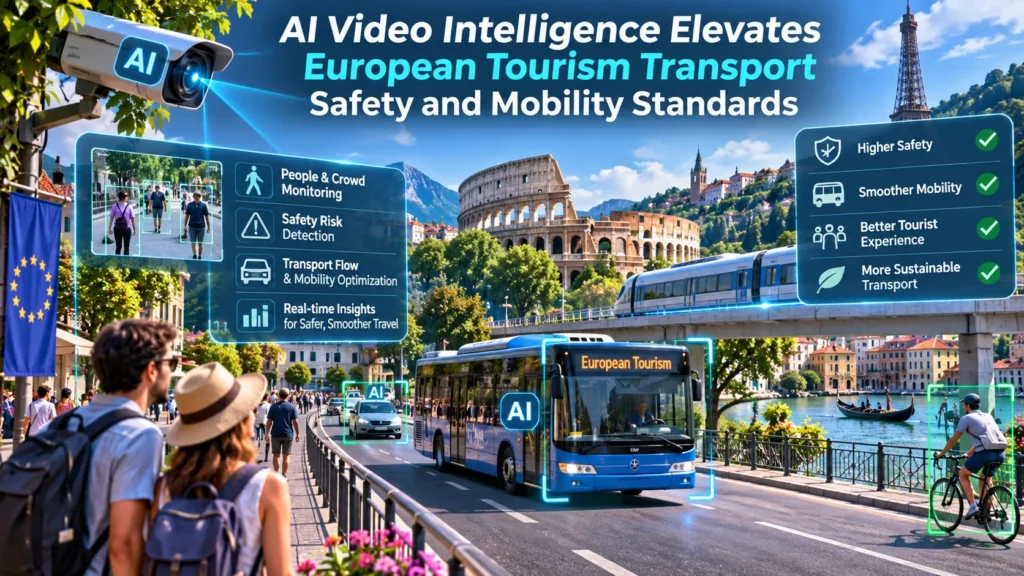
As international travel across the European Union reaches historic milestones, the operational resilience of passenger coaches, shuttle networks, and regional tour fleets has become a central priority for destination management. According to the European Commission Communication on the EU Sustainable Tourism Strategy, the European Union welcomed close to 600 million international tourists in 2025, representing nearly 40 percent of global international arrivals and contributing 10.1 percent to total European gross value added when accounting for indirect and induced expenditure. With more than 20 million people employed across roughly five million tourism enterprises, safe and reliable ground transit forms the backbone of Europe’s visitor economy. Integrating artificial intelligence video intelligence into commercial passenger and tour fleets is now transforming how operators protect travellers, control volatile running costs, and support long-term European road safety targets.
Aligning Tourism Transport with European Vision Zero Goals
Road safety remains a critical pillar of public transport policy across the European Union. Under the EU Road Safety Policy Framework 2021–2030, European institutions and Member States have committed to halving road deaths and serious injuries by 2030 while progressing toward Vision Zero by 2050. Official statistics published by the European Commission Directorate-General for Mobility and Transport confirm that while road fatalities across the European Union continued to decline in 2025, seasonal travel peaks during summer months still correlate with elevated traffic incidents. Furthermore, Eurostat regional transport statistics highlight that several tourist-intensive regions record elevated motorisation rates driven partly by rental vehicles and seasonal visitor fleets, placing heightened operational responsibility on professional tour and transfer operators.
For small and medium-sized transport enterprises—which represent 99 percent of businesses within the European tourism ecosystem—maintaining spotless safety records while managing daily operational expenditures is a primary challenge. Traditional passive vehicle tracking merely logs historical coordinates on a map, offering limited protection once an incident occurs. Modern AI-powered video telematics shifts fleet management from reactive monitoring to proactive risk prevention, safeguarding passengers and protecting corporate margins simultaneously.
Proactive Driver Coaching Enhances Passenger Confidence
The foundation of safe tourist transport lies in alert, well-supported professional drivers navigating unfamiliar mountain passes, congested historic city centres, and cross-border highway corridors. Unlike conventional telemetry that only flags harsh braking or sudden acceleration after the fact, dual-facing machine vision cameras integrated with vehicle diagnostics identify subtle behavioural precursors such as driver distraction or fatigue in real time.
When an intelligent cabin sensor detects signs of drowsiness or visual distraction during long-distance sightseeing itineraries, instant in-cab audio alerts allow drivers to self-correct immediately. Industry telemetry benchmarks show that automated visual coaching systems enable fleets to reduce driver fatigue incidents by up to 60 percent. By fostering supportive, real-time accountability rather than punitive post-trip reviews, tour operators strengthen safety culture and ensure passengers enjoy smooth, stress-free journeys across European destinations.
Financial Resilience Through Verified Telemetry and Fleet Longevity
Beyond protecting human lives, AI video intelligence delivers substantial financial insulation for hospitality and transport operators facing rising insurance premiums and maintenance expenses. When traffic disputes or minor collisions occur in busy metropolitan transit hubs or multi-border corridors, high-definition video telemetry provides insurers and transport authorities with objective, indisputable visual verification.
Access to verifiable safety data enables commercial transport operators to secure more favourable underwriting terms, with 45 percent of fleets utilising video telematics reporting improved insurance conditions and significant reductions in false liability claims. Overall safety incident expenditures drop by an average of 63 percent when intelligent camera systems are deployed across commercial operations.
Simultaneously, smoother driving habits translate directly into mechanical preservation and lower environmental impact. Aggressive acceleration and late braking accelerate tyre wear, strain braking systems, and increase fuel burn—a critical concern given that fuel outlays and driver compensation represent the largest variable costs for European transport operators. Integrating intelligent camera alerts with engine diagnostics enables preventative maintenance workflows that cut average vehicle maintenance expenditures by 24 percent while lowering daily fuel consumption across small and medium-sized fleets. These efficiency gains directly complement the European Commission sustainable mobility targets aimed at curbing transport emissions and modernising commercial passenger fleets.
Rapid Return on Investment Across European Destinations
As national and regional authorities implement the EU Sustainable Tourism Strategy to spread visitor flows more evenly across seasons and rural, coastal, and mountainous regions, reliable local transport connectivity becomes indispensable. Connected safety platforms allow tour operators, municipal shuttle providers, and regional coach companies to scale operations safely without exposing lean budgets to unbillable downtime.
Empirical operational data indicates that 47 percent of European organisations adopting intelligent video solutions achieve a full return on investment within twelve months, driven by lower incident overheads, reduced fuel waste, and streamlined maintenance schedules. By combining predictive vision intelligence with disciplined safety governance, European tourism transport operators can elevate passenger protection, strengthen financial sustainability, and reinforce Europe’s standing as the world’s premier safe and welcoming travel destination.
For more travel news like this, keep reading Global Travel Wire