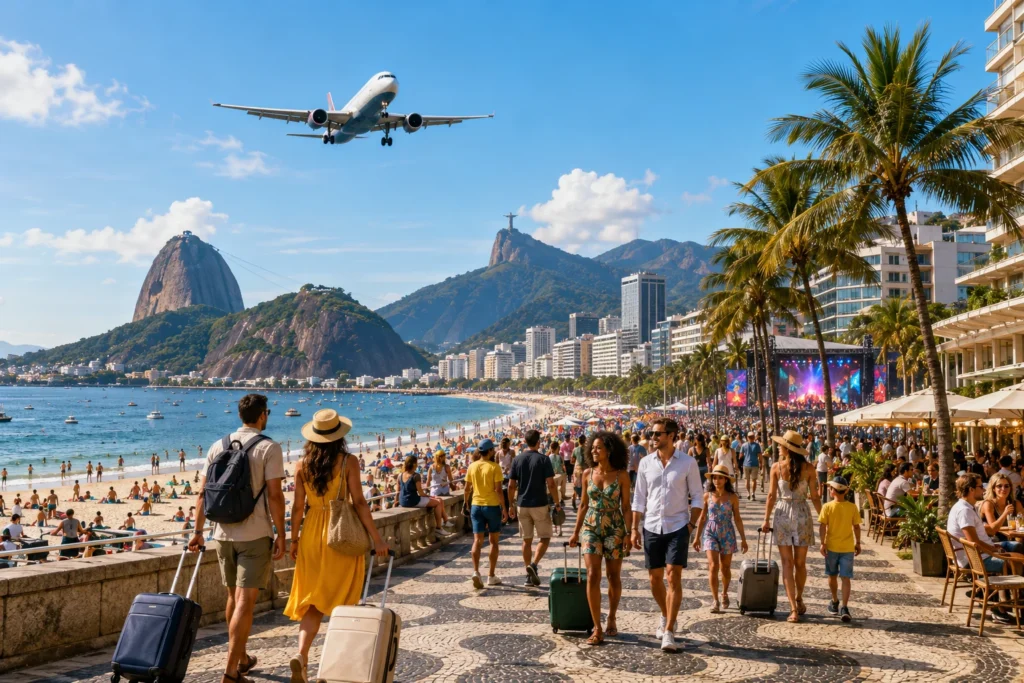
Official statistics released jointly by Visit Brasil (Embratur), the Ministry of Tourism, and the Federal Police reveal a remarkable expansion in international visitor arrivals across Brazil. During the first half of the year, the country welcomed 5,261,733 foreign tourists across all ports of entry, marking one of the strongest overall half-year results in national history. The surge was primarily propelled by unprecedented growth in aviation, with air arrivals rising 13.3 percent to hit 3,531,233 visitors—the highest volume ever recorded for the January-to-June period.
Air travel now accounts for 67 percent of all international tourist entries into Brazil. This rapid acceleration in air passenger traffic directly aligns with broader infrastructure modernizations, expanded long-haul flight capacities, and strategic promotion in key source markets across Latin America, Europe, North America, and Asia. Official financial data from the Central Bank of Brazil shows that international visitors injected billions of dollars into the national economy, reinforcing the travel sector as a vital engine for job creation, regional development, and foreign exchange revenues.
Strategic Aviation Upgrades Expand Direct International Connectivity
The record performance in foreign arrivals is intrinsically linked to deliberate aviation policies spearheaded by the Ministry of Ports and Airports and the National Civil Aviation Agency (ANAC). By fostering increased route frequency, approving new direct intercontinental corridors, and negotiating expanded bilateral frequency rights, Brazil has significantly reduced travel times and increased seat availability for long-haul travelers.
Aviation capacity has expanded across both primary global gateways and regional capitals. São Paulo continues to serve as South America’s dominant intercontinental transit hub, absorbing more than 2.7 million international arrivals. Meanwhile, Rio de Janeiro’s international airports processed thousands of additional international flights, providing expanded seat capacity connecting coastal Brazil directly with major hubs in North America and Western Europe. Secondary urban hubs and regional coastal gateways have similarly benefited, registering direct route expansions that allow international travelers to bypass traditional connection points and land directly near key ecotourism and heritage regions.
Cultural Immersion and Ecotourism Redefine Regional Travel Circuits
Data from Embratur and the Ministry of Tourism indicates a major diversification in visitor preferences. While famous urban beaches in Rio de Janeiro and Santa Catarina maintain strong appeal, international tourists are increasingly choosing immersive ecotourism expeditions, UNESCO heritage circuits, and authentic cultural itineraries across Brazil’s interior and northeast regions.
The growth in nature-based tourism is particularly evident in Foz do Iguaçu, which has emerged as one of the fastest-growing secondary destinations for long-haul visitors from Europe and North America. The region’s world-renowned waterfalls and biodiversity conservation zones have driven significant increases in hotel room demand. Similarly, the northeast cultural anchor of Salvador, Bahia, has captured a major share of European arrivals—notably from France, Germany, and Portugal—seeking authentic Afro-Brazilian heritage tours, regional culinary experiences, and historic architecture. By spreading international visitor arrivals into secondary cities and environmental reserves, national tourism authorities are successfully distributing economic benefits to local communities and supporting sustainable site management.
Foreign Visitor Market Breakdown and Key Source Country Drivers
Regional neighbors across South America continue to represent Brazil’s largest overall source markets, contributing over half of all international passenger traffic through Brazilian airports. Official arrival logs show that Argentina remains the leading source market, generating over one million visitor arrivals in the first six months. Colombia and Peru recorded the highest proportional growth rates among South American nations, with Colombian arrivals increasing by more than 33 percent year-over-year.
Long-haul arrivals from European and Asian markets have also demonstrated historic momentum. Inbound travel from Europe achieved its highest first-half volume in two decades, led by substantial growth from Portugal, Spain, Germany, the United Kingdom, and France. In Asia, arrival figures posted a record-breaking proportional surge, driven by a 55 percent increase in visitors from China following reciprocal visa facilitation initiatives introduced by the federal government. North America maintained its position as a critical high-yield market, with hundreds of thousands of travelers arriving for business, leisure, and major cultural gatherings.
High-Yield Event Tourism and Strategic Infrastructure Investments
Major international entertainment events and cultural spectacles have proven to be powerful immediate catalysts for tourism demand. Free multi-day concert events and global festival bookings staged on Copacabana Beach in Rio de Janeiro triggered massive spikes in foreign airline ticket reservations, with international flight bookings increasing by more than 80 percent during event weeks compared to standard seasonal baselines.
To sustain this growth trajectory, the Ministry of Tourism and municipal authorities are continuing to invest in land border modernization and airport infrastructure. Key land crossings, such as the Tancredo Neves Bridge connecting Brazil with Argentina and Paraguay, now process hundreds of thousands of cross-border entries smoothly through digitized immigration controls. By combining strategic mega-event scheduling with streamlined visa policies, modernized border crossing facilities, and targeted international marketing, Brazil is solidifying its standing as a premier global destination for high-yield, sustainable, and experiential travel.
For more travel news like this, keep reading Global Travel Wire