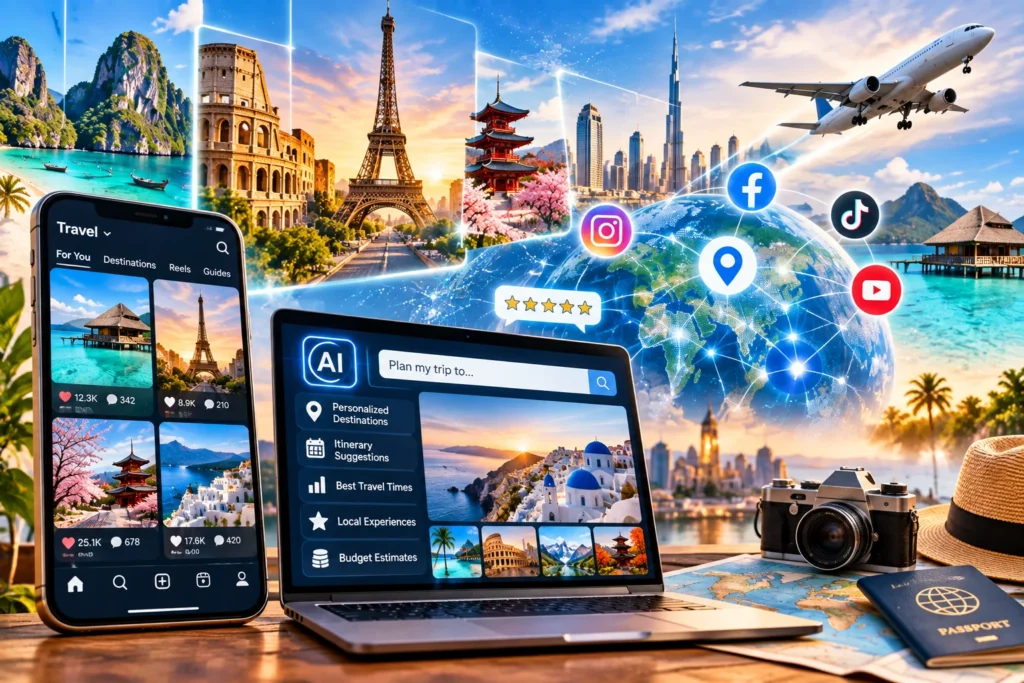
On World Tourism Day, observed globally on September 27 under the official theme “Digital Agenda and Artificial Intelligence to Redesign Tourism,” the intersection of technology and travel behavior takes center stage. Modern travelers are increasingly moving away from traditional travel planning methods, turning instead to visual content platforms and generative artificial intelligence tools to discover destinations, compare options, and build customized itineraries.
Comprehensive survey findings evaluating 2,371 domestic travelers between the ages of 18 and 40 reveal a significant structural shift in how journeys are conceptualized and booked. Digital media serves as the primary inspiration point, but verified information, logistics reliability, and local trust remain the final decision-making criteria for travelers across the country.
Short-Form Video and Visual Content Drive Destination Awareness
The survey indicates that 72 percent of respondents discover new and offbeat travel destinations through short-form online videos and social media reels. High-definition visual storytelling allows travelers to explore lesser-known regions virtually before making travel commitments. This rise in visual discovery highlights the growing influence of social media in shifting consumer focus away from heavily crowded commercial hubs toward offbeat locations.
However, online discovery represents only the initial phase of the travel decision process. The data shows that 31 percent of respondents actively conduct follow-up search queries immediately after coming across a destination online. This transition from passive content consumption to active research indicates that while engaging visual content creates initial interest, consumer action depends on finding reliable, real-world travel information.
Artificial Intelligence Emerges as a Key Travel Planning Assistant
Alongside social media discovery, artificial intelligence has established itself as an essential tool for trip planning. According to the survey, 61 percent of travelers have utilized artificial intelligence platforms to plan at least one journey over the past year.
The application of AI in travel is primarily focused on personalization and itinerary construction:
Platform Preferences: Among AI tools, 44 percent of respondents rely on conversational AI models as their primary planning assistant, while 23 percent utilize search-integrated AI overviews to compile destination data.
Customized Itineraries: 45 percent of travelers identify day-by-day itinerary creation as the most valuable function of artificial intelligence, citing its speed and ability to tailor schedules to individual preferences.
Despite the efficiency of automated itinerary generation, travelers continue to seek validation regarding physical ground reality. Automated systems provide rapid structured lists, but real-time variables such as local weather shifts, road conditions, and transport reliability require verified operational support.
Moving from Online Inspiration to Verified Curated Experiences
As digital tools streamline destination discovery and itinerary design, consumer demand is shifting toward integrated, end-to-end travel solutions. Modern travelers are increasingly seeking curated packages that combine transportation, vetted accommodations, and authentic local activities into a single, seamless booking.
Survey results highlight that 48 percent of respondents prefer verified, all-inclusive group or offbeat travel packages when transit and lodging are fully coordinated. Furthermore, 52 percent of travelers state that positive user reviews and ground-level credibility are critical requirements before confirming a final booking.
To address this demand, mobility and travel experience providers are expanding dedicated experiential offerings. Emerging destinations being integrated into structured, verified itineraries include:
Sethan and Sissu: High-altitude locations offering structured mountain experiences and local transit connectivity.
Jibhi and Tirthan Valley: Eco-tourism destinations centered on natural heritage, riverside activities, and homestay accommodations.
Kalpa and Munsiyari: Remote Himalayan regions offering regional culinary experiences, cultural heritage walks, and guided outdoor activities.
By combining reliable mobility services with verified local stays and immersive activities—such as kayaking, village walks, and traditional cooking—travel providers aim to bridge the gap between digital inspiration and seamless real-world execution.
The Future of Tech-Enabled Destination Growth
The integration of artificial intelligence and digital discovery platforms is reshaping the economic landscape of domestic tourism. While digital algorithms can surface unique destinations in seconds, long-term industry sustainability relies on establishing operational trust, transparent pricing, and dependable transport networks.
By connecting online destination discovery with verified ground infrastructure, the travel sector can broaden access to offbeat regions, distribute visitor traffic more evenly, and strengthen local community tourism ecosystems in alignment with global digital transformation initiatives.
For more travel news like this, keep reading Global Travel Wire