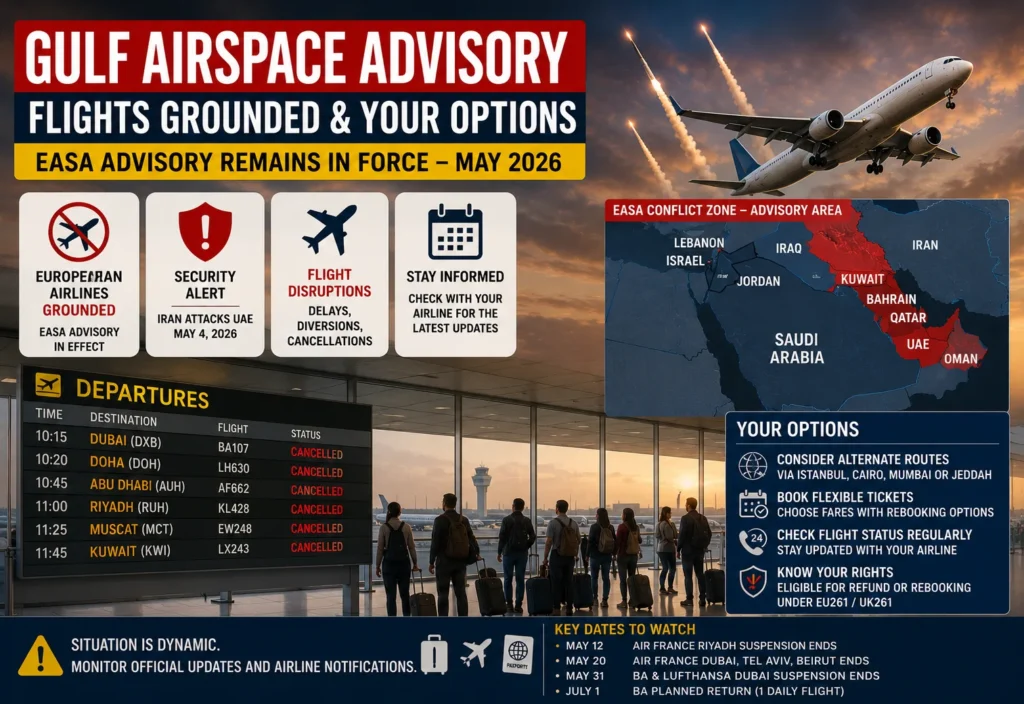
International aviation and tourism sectors continue facing major operational challenges as the European Union Aviation Safety Agency maintains its Gulf airspace advisory following renewed regional security concerns in the Middle East. Airlines, airports, tourism operators, and travelers across Europe and the Gulf region are adjusting plans as flight suspensions and airspace restrictions continue affecting major international routes.
The latest developments came after renewed missile and drone activity targeting the United Arab Emirates, creating fresh concerns about aviation safety and regional travel stability. Gulf airports remain operational, but airlines continue implementing extensive route changes, operational reviews, and schedule adjustments in response to evolving security conditions.
Tourism authorities and aviation regulators across the Middle East and Europe are closely monitoring the situation as millions of passengers prepare for summer travel, business events, and international tourism across Gulf destinations.
The ongoing advisory has significantly influenced airline scheduling, tourism flows, cruise operations, and international business travel throughout one of the world’s most important aviation transit regions.
EASA Advisory Keeps European Airlines Grounded on Gulf Routes
The European Union Aviation Safety Agency continues advising European-regulated airlines against operating across several areas of Middle Eastern airspace through its active conflict zone guidance bulletin.
The advisory currently affects aviation operations connected to Bahrain, Iran, Iraq, Israel, Jordan, Kuwait, Lebanon, Oman, Qatar, Saudi Arabia, and the United Arab Emirates.
As a result, several major European airline groups including Lufthansa Group, British Airways, Air France, KLM, Eurowings, and Wizz Air continue suspending or limiting Gulf operations.
Industry officials confirmed that the advisory remains one of the largest aviation disruptions affecting Europe-Middle East connectivity in recent years. Airlines are unable to resume normal operations until security conditions stabilize and aviation regulators reassess regional airspace safety.
Travel industry experts noted that Gulf routes represent some of the world’s most important international aviation corridors linking Europe with Asia, Africa, and Australia.
The ongoing restrictions continue affecting both leisure tourism and corporate travel markets throughout the region.
UAE Airports Remain Open Despite Operational Challenges
Despite the ongoing advisory and recent regional security incidents, airports in the United Arab Emirates continue operating with enhanced monitoring and contingency measures.
Dubai International Airport and Zayed International Airport in Abu Dhabi remain open and continue handling international passenger traffic, although some flights experienced temporary delays and diversions during recent security alerts.
The UAE General Civil Aviation Authority previously lifted precautionary airspace restrictions introduced earlier in the year, allowing major Gulf carriers to expand operations again. Airlines including Emirates, Etihad Airways, and flydubai have resumed significant portions of their global route networks.
Emirates currently operates one of the region’s largest international networks, reconnecting Dubai with destinations across Europe, Asia, Africa, and the Americas.
However, aviation authorities warned that flight schedules remain subject to short-notice operational changes depending on regional developments and security assessments.
Travelers flying through Gulf airports are also experiencing increased security procedures, enhanced monitoring systems, and updated travel advisories issued by multiple governments.
Gulf Tourism Industry Faces Ongoing Uncertainty
The continued airspace advisory has created uncertainty for tourism operators, airlines, hotels, and international travelers planning trips to Gulf destinations.
Dubai, Abu Dhabi, Doha, Riyadh, and other regional tourism centers have spent years building reputations as global transit hubs and luxury tourism destinations. The current aviation disruption is affecting visitor confidence and operational planning during a critical tourism recovery period.
Tourism authorities continue emphasizing that hotels, airports, attractions, and transportation systems remain operational, but airlines and travelers are increasingly prioritizing flexibility due to changing schedules and security conditions.
The tourism sector is also managing higher operating costs linked to increased aviation insurance premiums, rerouted flights, and longer travel times.
Industry analysts stated that uncertainty surrounding airspace access and regional security remains one of the biggest challenges facing Middle East tourism growth in 2026.
At the same time, Gulf tourism boards continue promoting regional resilience, hospitality infrastructure, and business continuity as governments work to stabilize travel operations.
Gulf Carriers Continue Expanding International Connectivity
While many European airlines remain grounded on Gulf routes, regional carriers are continuing operations and expanding selected international services.
Qatar Airways, Emirates, Etihad Airways, and flydubai remain among the strongest operators maintaining Europe-Gulf connectivity during the current disruption period.
Qatar Airways continues operating extensive international services through Doha’s Hamad International Airport, connecting passengers across Europe, Asia, Africa, and the Middle East.
Etihad Airways maintains growing operations from Abu Dhabi, while Emirates continues serving hundreds of international destinations through Dubai.
These Gulf-based airlines have become critical providers of international connectivity for travelers needing access to Middle Eastern destinations while European carriers remain suspended.
Airlines are also implementing flexible booking options, revised cancellation policies, and enhanced passenger communication systems to help travelers manage ongoing schedule adjustments.
Regional Airports Adapt to Changing Passenger Flows
Several Gulf airports are adapting operations to accommodate changing travel patterns caused by suspended European services and rerouted passenger flows.
Jeddah’s King Abdulaziz International Airport has emerged as one of the least disrupted hubs within the region due to its western location in Saudi Arabia. The airport continues serving as an important transit point for travelers connecting between Europe, Asia, and the Middle East.
Doha’s Hamad International Airport also remains operational with expanding schedules as Qatar Airways strengthens regional and global connectivity.
Kuwait International Airport continues operating under adjusted schedules while maintaining safety assessments and operational monitoring systems.
Airport authorities throughout the Gulf are coordinating closely with airlines, aviation regulators, and government agencies to maintain safe and stable operations despite the ongoing regional uncertainty.
Travelers Encouraged to Prioritize Flexibility
Tourism officials and aviation authorities continue advising travelers to prioritize flexible booking arrangements and closely monitor airline notifications before departure.
Flight schedules throughout the Gulf region remain highly dynamic, with some routes changing or adjusting at short notice based on evolving operational conditions and airspace assessments.
Passengers are encouraged to confirm flight status directly with airlines, review travel insurance coverage carefully, and remain aware of official travel advisories issued by their governments.
Tourism agencies also recommend that travelers allow extra time at airports due to enhanced security procedures and operational monitoring systems.
Airline groups confirmed that affected passengers remain eligible for refunds, rebooking assistance, or flexible travel arrangements under existing passenger protection regulations.
Future Recovery Depends on Regional Stability
Aviation experts believe full recovery of Gulf air travel operations will depend on long-term regional stability, improved airspace security assessments, and reduced operational risks for airlines and insurers.
The Gulf region remains one of the world’s most strategically important aviation corridors and tourism markets, serving millions of passengers annually through major global transit hubs.
Governments, airlines, airports, and tourism authorities continue working to preserve operational resilience while preparing for the eventual restoration of broader international connectivity.
Until aviation regulators ease current advisories and security conditions stabilize, the Middle East tourism and airline industries are expected to continue operating under heightened caution and flexible travel management strategies.