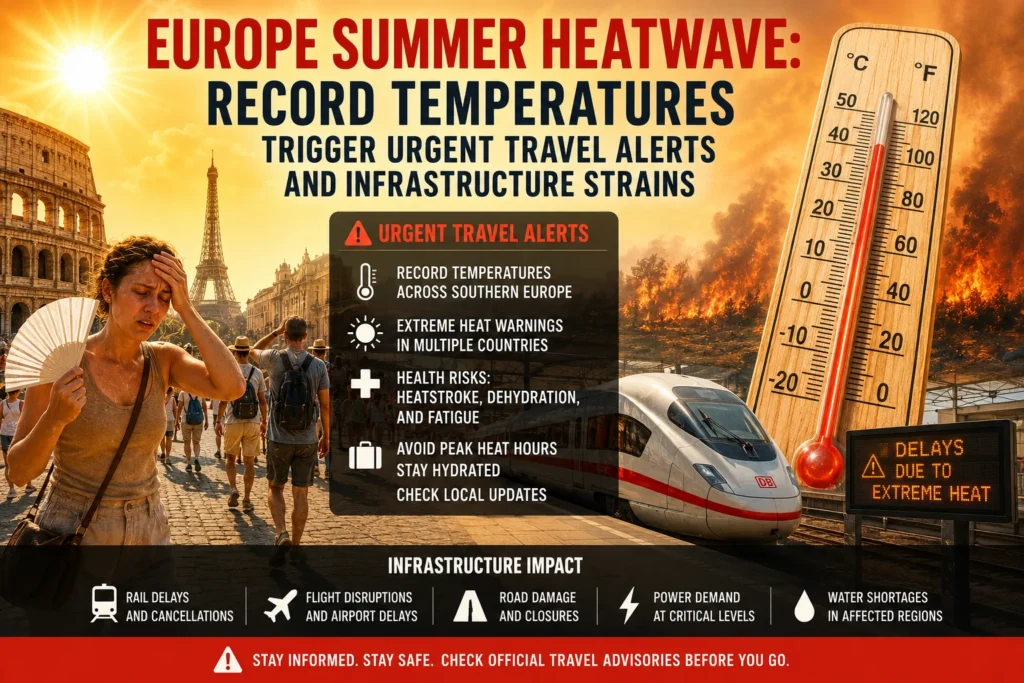
A historic and intense early summer heatwave is sweeping across Europe, shattering long-standing meteorological records and prompting government authorities to issue high-level safety alerts. From the Atlantic coast to the Mediterranean basin, an atmospheric weather pattern has trapped an immense mass of hot air over the continent, sending thermometers soaring past 40 degrees Celsius.
The extreme weather is directly impacting the region’s robust tourism sector. Across major destinations, the unrelenting conditions have forced historic cultural sites to alter their operating hours, strained regional rail networks, and prompted emergency services to issue strict safety guidelines for both international visitors and local residents.
Historic Temperature Thresholds Broken Across the Continent
Official data released by national meteorological agencies confirms that the intensity of this current weather system is unprecedented. Météo-France, the French national weather service, announced that the country has experienced its absolute hottest period since comprehensive national temperature tracking began in 1947.
The country’s national thermal indicator—a precise calculation that averages daytime and nighttime temperatures recorded across 30 synchronized tracking stations nationwide—reached a record-breaking 30 degrees Celsius. The localized peaks were even more severe. The town of Pissos in the southwestern Landes region registered a staggering 44.3 degrees Celsius, while the major cultural and wine tourism hub of Bordeaux sweltered under 42.1 degrees Celsius. Consequently, authorities placed more than half of the country under the strictest red heatwave alert level.
This environmental strain is visible across neighboring nations as well. Spain’s national weather agency reported that temperatures consistently surpassed 40 degrees Celsius across multiple provinces, warning that large swathes of the country will remain locked above 34 degrees Celsius even during typical cooling periods.
In Italy, health ministries issued red alerts for globally renowned tourist destinations including Rome, Florence, Milan, Turin, and Venice. Meanwhile, the UK Met Office reported unprecedented June heatwaves, noting that Britain is positioned precisely between the scorching continental air mass and cooler Atlantic systems, resulting in dramatic temperature variations and heightened warnings across southern England. High-level alerts have rapidly spread eastward, encompassing Germany, Belgium, Switzerland, Luxembourg, Poland, Croatia, and Hungary.
Disrupted Travel Itineraries and Landmark Closures
The sheer intensity of the weather is altering the day-to-day operations of the European travel and tourism industry. In Paris, management teams at the world’s most visited cultural institutions have taken steps to protect staff and international sightseers from thermal exhaustion. The Louvre Museum officially adjusted its operational hours, implementing early closures to limit exposure during peak afternoon temperatures, while the Eiffel Tower enacted similar temporary restrictions.
Cross-border and domestic public transit infrastructure is also feeling the strain of the high thermal load. Trans-Channel rail operator Eurostar was forced to cancel multiple scheduled daily services connecting London and Paris due to the impact of extreme temperatures on critical rail tracks and overhead power lines.
Within the United Kingdom, domestic transport operators, including Greater Thameslink Railway, issued formal advisories urging passengers to delay non-essential travel during the peak heat windows, while specific Gatwick Express airport links faced temporary suspensions.
In Spain, regional municipalities took precautionary measures to safeguard public safety. Several traditional San Juan celebrations, particularly across the Basque Country, were canceled due to the combination of dangerous ambient temperatures and an elevated risk of wildfires. Similarly, municipal authorities in several German cities enacted strict public bans on barbecues and outdoor fires to prevent accidental blazes, alongside official appeals for water conservation to mitigate burgeoning regional drought conditions.
Crucial Safety Guidance for International Visitors
As public health officials and tourism boards manage the challenges of the season, a coordinated effort is underway to educate travelers on heat safety. Medical and emergency services emphasize that international tourists are often highly vulnerable to heat-related illnesses due to increased walking, unfamiliarity with local hydration options, and acclimatization challenges.
Government advisories across the affected European nations recommend adjusting sightseeing schedules to completely avoid outdoor exposure between the peak hours of 11:00 AM and 4:00 PM. Vacationers are strongly encouraged to utilize indoor, climate-controlled environments like galleries, shopping arcades, or air-conditioned transit options during these hours.
Hydration remains the cornerstone of all official health guidance, with emphasis placed on carrying reusable water bottles and avoiding excessive caffeine or alcohol consumption, which can exacerbate dehydration. Authorities also remind tourists to utilize high-factor sunscreen, wear loose-fitting, light-colored clothing, and plan frequent rest intervals in shaded areas.
Emergency ministries have issued a stark public safety warning regarding recreational swimming. With dozens of accidental drownings reported across European rivers and lakes as people desperately seek relief from the ambient heat, prime ministries and local police forces are strongly urging tourists to swim exclusively in officially designated, lifeguard-monitored public pools and coastal beach zones. Consistently monitoring real-time updates via official local weather applications and respecting municipal safety flags remains vital to ensuring a safe holiday experience during this extraordinary seasonal event.
For more travel news like this, keep reading Global Travel Wire