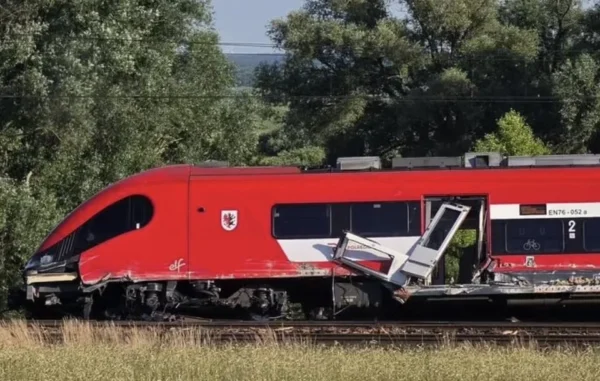
Poland’s domestic rail network faced significant disruption after two passenger trains collided in Białośliwie, Piła County, on the evening of June 25, 2026, affecting services on the Kołobrzeg–Warsaw and Piła–Bydgoszcz routes.
The side collision occurred after 18:00 on railway line 18 in Greater Poland Voivodeship. Around 200 passengers were travelling on the two trains. Eleven people received medical assistance at the scene, while three men were transported to hospitals in Piła and Chodzież.
Rail traffic on the Piła–Bydgoszcz section was suspended following the incident, creating immediate uncertainty for passengers travelling through north-western and north-central Poland. Emergency services also established a temporary passenger assistance point at the Volunteer Fire Brigade station in Białośliwie while onward transport was organised.
No final official cause had been confirmed in the initial emergency information, making it important for travellers and tourism businesses to avoid speculation while investigations continue.
Piła–Bydgoszcz Suspension Disrupts Regional Journeys
The most immediate travel consequence was the suspension of traffic on the Piła–Bydgoszcz corridor. The route supports regional mobility between important urban and commercial centres and is used by residents, business travellers, students and visitors exploring northern Poland.
Passengers booked on services through the affected area may face delays, altered departure times, replacement transport or rerouting. Travellers should check current operator information before leaving for the station because the operational position may change as recovery work progresses.
For tourists combining rail journeys with hotel reservations, guided tours or same-day connections, even a temporary closure can produce wider disruption. Missed transfers may affect arrival times in Bydgoszcz, Piła and other cities connected through the regional network.
Travel agencies and tour operators should review north-western Poland itineraries and allow additional time for journeys crossing the affected corridor.
Kołobrzeg–Warsaw Travellers Face Connection Risks
The involvement of a service operating between Kołobrzeg and Warsaw gives the incident wider tourism significance.
Kołobrzeg is one of Poland’s leading Baltic coastal destinations, attracting visitors for beaches, spa tourism and summer holidays. Warsaw, meanwhile, is the country’s principal rail, aviation, meetings and corporate gateway.
Travellers using the route to reach Warsaw Chopin Airport, hotels, conferences or onward international services may require revised schedules. Those returning from the Baltic coast should avoid relying on tight connections until operations are fully stabilised.
Business travellers and conference delegates may be particularly exposed because evening delays can affect hotel check-ins, scheduled meetings and next-day appointments.
Rising Rail Demand Increases Disruption Impact
The collision occurred during a period of strong growth in Polish rail travel.
Poland’s Office of Rail Transport recorded almost 110.2 million passenger journeys during the first quarter of 2026, an increase of 7.6 per cent compared with the same period in 2025. Public-service trains accounted for the overwhelming majority of journeys, confirming rail’s importance to domestic mobility and tourism.
More than 88 million first-quarter passengers used regional, local and urban services. This means disruption on a single corridor can affect a large number of connected journeys beyond the trains directly involved.
Rail travel has become increasingly central to Polish city breaks, coastal holidays, business trips and lower-carbon multi-destination tourism. As passenger volumes increase, operational interruptions can have greater consequences for hotels, attractions and tourism businesses depending on reliable visitor arrivals.
Passenger Rights Apply During Major Delays
Travellers experiencing long delays should retain tickets, booking confirmations, receipts and any written information provided by the railway operator.
For eligible long-distance journeys, delays of 60 to 119 minutes may qualify for compensation equal to 25 per cent of the ticket price. Delays of 120 minutes or more may qualify for compensation of 50 per cent, subject to the applicable ticket and service conditions.
When disruption is expected to delay arrival by at least 60 minutes, passengers may also be offered options including reimbursement, continuation of the journey or rerouting.
Depending on the circumstances and what is physically possible, assistance can include refreshments, accommodation when an overnight stay becomes necessary and transport from a blocked train to a station or alternative departure point.
International visitors unfamiliar with Poland’s claim procedures should document the complete journey and request confirmation of delays where available.
Tourism Businesses Should Strengthen Contingency Planning
Tour operators, destination management companies and corporate travel managers should review rail-based programmes involving Piła, Bydgoszcz, Kołobrzeg and Warsaw.
Flexible tickets, longer connection windows and alternative road transfers can reduce the impact on clients. Group organisers should also nominate one person to follow operator updates and coordinate any changes.
The incident does not indicate a nationwide shutdown of Poland’s rail system. However, it highlights how localised disruption can affect coastal tourism, regional travel and major city connections.
Poland remains an important European rail destination, supported by rising passenger demand and an extensive domestic network. The immediate priority is safe operational recovery, clear passenger communication and reliable alternative transport.
For travellers, the practical message is to confirm services before departure, preserve all travel documentation and allow additional time when journeys depend on the Piła–Bydgoszcz or Kołobrzeg–Warsaw corridors.
For more travel news like this, keep reading Global Travel Wire