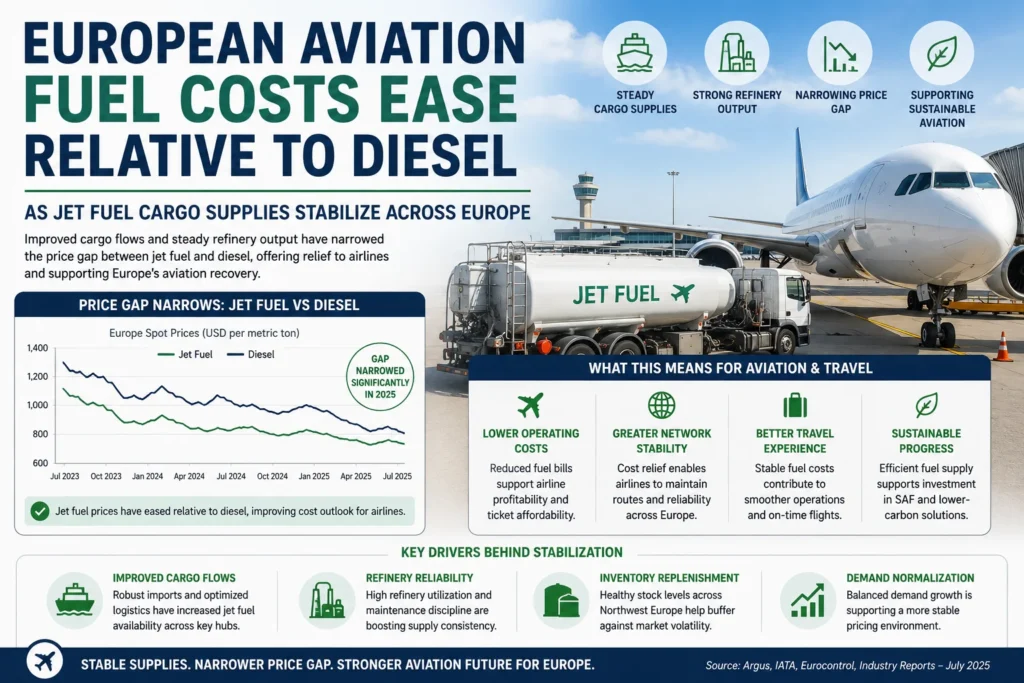
Refined energy markets across Europe are undergoing a notable structural shift as diesel prices have surpassed jet fuel for the first time in over a year. Strengthening aviation fuel imports alongside constrained road transport fuel supplies have altered the cost dynamics between commercial air travel and ground logistics. For the European tourism market and international transport operators, this rebalancing offers a period of relative cost stabilization for airline networks following months of volatile energy prices.
Official maritime trade tracking data and public energy sector statistics indicate that European aviation fuel imports rose steadily through the summer, reaching approximately 750,000 barrels per day. The increase in jet fuel arrivals, supported by shipments originating from the United States and West Africa, helped offset earlier disruptions across Middle Eastern trade corridors. Conversely, regional diesel inventories have tightened significantly, pushing road fuel costs higher even as peak summer air travel demand begins its standard seasonal transition.
Stabilization of Aviation Fuel Cargo Flows Supports Regional Connectivity
The normalization of aviation fuel supplies across major European transport hubs comes at a critical time for international travel connectivity. Earlier in the year, heightened geopolitical tensions and crude supply constraints drove aviation fuel spot prices to elevated levels. However, coordinated international trade adjustments have allowed European aviation authorities and airport fuel suppliers to secure steady cargo volumes.
By contrast, European diesel imports decreased to approximately 1.56 million barrels per day in recent weeks, down from nearly 2 million barrels per day recorded earlier in the year. Regional refinery maintenance schedules, export restrictions from key trading partners, and heightened demand from agricultural and industrial sectors have placed upward pressure on ground fuel benchmarks.
Public transport ministry monitoring reveals that as a result of these diverging supply chains, jet fuel has begun trading at a discount relative to gasoil futures—the primary benchmark used to price refined petroleum products in Europe. During mid-August, imported jet fuel cargoes were assessed at a discount of $24 per metric ton against gasoil futures, marking the widest price differential in over twelve months. This stands in stark contrast to earlier periods when aviation fuel commanded a premium of several hundred dollars per barrel over baseline refined products.
Implications for Airline Pricing and the European Tourism Market
The relative easing of European aviation fuel costs provides welcome operational headroom for commercial airlines, passenger charter services, and regional tourism boards. Jet fuel represents one of the largest variable expenses for commercial air carriers, often accounting for 25 to 30 percent of total operating costs.
When jet fuel prices spiked earlier in the year, air carriers faced mounting margin pressure, leading to adjustments in route capacity and fare structures across long-haul and short-haul networks. The recent stabilization of jet fuel prices allows airlines operating across European gateways to better manage fuel surcharges and maintain competitive ticket pricing during the upcoming autumn and winter travel seasons.
Furthermore, official tourist board releases highlight that consistent flight availability remains a key factor in attracting international visitors to Europe’s cultural centers, coastal resorts, and winter sports destinations. Stable aviation fuel costs enable carriers to preserve scheduled flights and protect global visitor volume, supporting local hospitality sectors, hotel occupancy rates, and urban retail ecosystems.
Shifting Costs Impact Ground Transportation and Tour Operators
While commercial aviation benefits from stabilized fuel import streams, the rise in diesel prices presents distinct operational considerations for ground tourism operators. In many European destinations, road transport forms the backbone of regional travel, encompassing coach tours, private transfer services, rental vehicles, and overland freight supporting hospitality supply chains.
Eurostat transport data confirms that road vehicles, including motor coaches and private automobiles, account for over 70 percent of all energy consumed within the European transport sector, with diesel powering a substantial majority of commercial fleets. As diesel cargo prices remain firm due to tight regional inventories, tour operators and coach companies are navigating elevated fuel overheads.
In response, regional transport authorities and tourism associations are encouraging fleet operators to accelerate the adoption of energy-efficient routing, alternative fuel technologies, and low-emission vehicles. Ground operators are also optimizing vehicle capacity and scheduling to mitigate the impact of higher diesel prices on passenger ticket costs and guided tour packages.
Long-Term Outlook for Sustainable Transport and Destination Resilience
The evolving pricing relationship between diesel and jet fuel underscores the broader necessity for energy diversification across the global travel industry. European energy guidelines and civil aviation strategies continue to emphasize the importance of building resilient energy supply chains while advancing long-term sustainability mandates.
Official statements from civil aviation organizations and European transport authorities reiterate the ongoing transition toward Sustainable Aviation Fuels (SAF) and low-carbon transport infrastructure. While conventional refined jet fuel continues to meet immediate operational requirements, public-private investments in synthetic fuels, bio-based aviation alternatives, and electrified ground transit are accelerating across the continent.
As Europe transitions out of the peak summer holiday season, public energy monitoring frameworks indicate that jet fuel supplies are expected to remain adequate to meet scheduled airline demand. By maintaining open import channels and diversifying fuel sourcing, the European tourism ecosystem is better equipped to absorb broader energy market fluctuations, ensuring long-term resilience for international travel and regional destination development.
For more travel news like this, keep reading Global Travel Wire